Written by Lidia Vijga
If you are bootstrapped, you do not need more articles for the sake of publishing. You need content that helps you survive and grow. And today that matters even more, because almost 90% of B2B companies are already using content marketing. The internet is full. Generic content will disappear into the noise.
So when you hire a writing service, do not ask who can write the cheapest blog post. Ask who can help you build revenue.
Start with ROI before you hire anyone

This is the first thing I would fix if I were in your shoes.
Before you hire a writer, decide what the content needs to do. If you skip this step, you will end up paying for words, traffic screenshots, and reports that feel busy but do nothing for the business.
I measure content with two buckets. I call them soft conversions or hard conversions.
- A soft conversion is when someone reads an article and gives you an email in exchange for something useful. That could be a gated guide, a PDF, an e-book, specialized calculator, or a simple tool.
- A hard conversion is when someone reads the article and books a call right away.
Most buyers are not ready to book a call the first time they find you. They are doing research. They are comparing you with competitors. They are trying to understand the problem.
That is why I care so much about the next step after the article. If they are not ready to buy, what can they do? Can they subscribe? Can they download something useful? Can they enter your newsletter so you can warm the relationship over time?
There is a reason I take this seriously. 57% of companies with blogs say they have acquired customers directly from blog-generated leads. Blog content absolutely can drive business. But it only works when the path is clear.
If a writing service cannot explain how your content moves a reader from article to lead to conversation, I would keep looking.
Writing skill alone is not enough

When I vet a service, I care less about the agency brand and more about the actual person doing the writing.
Ideally, the person writing your content would be the actual target audience you are trying to reach. If not, they should at least know that audience deeply. They should understand the industry vocabulary, the pressure, and the objections. They should know what matters to that buyer and what sounds fake right away.
This becomes critical in sensitive industries. If you are building in healthcare, fintech, cybersecurity, or any compliance-heavy space, you cannot produce high level fluff. You cannot hire a random junior writer and hope they figure it out. Your content writer must understand the industry and your target audience inside out.
So ask directly: Who will be assigned to write your content? What have they done in my industry? Have they written for my ICP before? Can they show me pieces written for this exact type of reader?
If the answer is vague, the content will probably be vague too.
Audit the content writing service the way your buyers will audit you

I always start with a simple check. Can I find the writing service easily?
Can I find them on Google? Can I find them through ChatGPT or other AI search tools? If yes, that tells me they probably know how to make content discoverable by Google and AI searches. If no, I get skeptical fast.
And this matters even more now because 94% of B2B buyers use AI tools in their buying process. If a service cannot make its own content visible there, why would I trust them to do it for me?
Once I find them, I read carefully.
I look for depth. I look for real examples. I look for content that sounds like it came from a person who actually did the work in the field. I do not want overly polished, repetitive writing that says all the right buzzwords and nothing useful.
One of the best ways to judge a service is to ask yourself one simple question while reading: does this sound like someone in the trenches, or does it sound like someone guessing from a distance?
Ask content partners how they extract insights

This is one of the most important questions you can ask, and founders skip it all the time.
How are you going to extract the insight?
Great content rarely starts with a blank page. It starts with raw material that is already inside your company. It starts with sales calls, product demos, closed-lost conversations, onboarding calls, support tickets, and the same pain points your team keeps hearing week after week.
If a service does not ask for those things, that is a red flag for me.
When I craft stories at BYVI, I do not use one standard template for every founder. I look at what they did before. I look at their background and I try to connect the dots. Then I build custom questions around that. Founders often hide the best insight in the part they are shy to say out loud.
They don’t know how much they know until you get it out of them.
That is exactly what a good content partner should do for you. They should have a process for turning those raw internal materials into something clear, helpful, and persuasive.
So ask them what they need from you. Ask what the workflow looks like. Ask how they will use transcripts. Ask how they turn a closed-lost call into a useful article. Ask how they decide which pain point becomes the topic.
If they cannot explain the system, there probably is no system.
The best content writing agencies know how to run collaborations

I say this a lot because I really believe it: content collaborations are the most underrated strategy in content marketing.
A strong writing service should know how to build relationships and help you enter ecosystems through content collaborations. This is one of the clearest signs that they understand ROI. Simply because collaboration helps you borrow trust and authority from an expert. It also makes the content deeper, more useful, and easier to distribute.
To expedite your go-to-market strategy, you will have to collaborate on content with industry experts to establish your presence in the market, become a part of the conversation, and get in front of your ideal buyers.
Content collaboration is also a powerful way to build relationships with potential prospects. I have seen this work repeatedly at DeckLinks, where our collaborators frequently became paying customers.
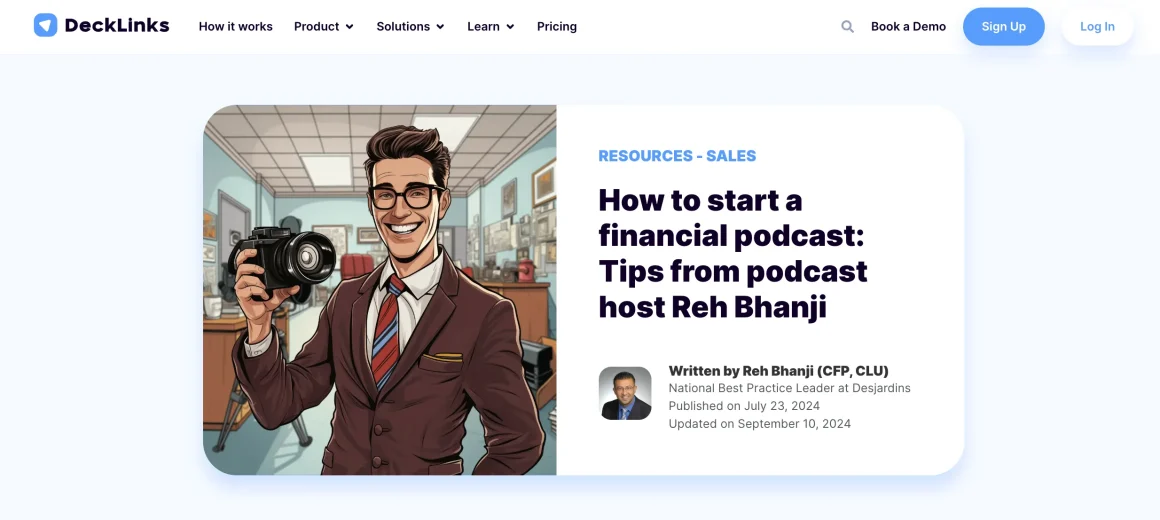
I collaborated with an expert on a financial podcast guide. That piece still ranks number one on Google, and it attracted clients. I also collaborated with an insurance company on a content piece around a shared pain point in their industry, which was trust. That company became a client.
None of those wins came from a hard sales pitch. The relationship never starts with a transaction. I lead with curiosity. I lead with give first. I make the contribution easy. Bullet points are fine. Voice memos are fine. I do the writing. I give the expert credit and backlinks. Then both sides distribute it.
That is the precise system I would look for in a content partner.
A generic agency will tell you how many posts they can ship each month. A serious one will tell you how they can bring in customers, partners, vendors, or subject matter experts and turn one article into a relationship asset.
Clarity tells you almost everything
By the time I get on a call with a content writing service agency, I already know what I want answered.
- I ask who is writing the content.
- I ask what experience that person has in my space.
- I ask what they need from me.
- I ask how they extract insight from calls and transcripts.
- I ask what soft CTA and hard CTA they want around each article.
- I ask how they will know if the leads are qualified.
- I ask where the content will live.
- I ask how they will distribute it after publishing.
- I ask how they make content discoverable by Google and AI searches.
Then I listen to how they answer.
If they stay at the level of word count, traffic, and vague SEO promises, I lose interest. If they cannot explain their workflow, I lose interest. If they hide the real writer behind an account manager, I lose interest. If they never mention newsletters, sales enablement, or collaboration, I start thinking they are selling production, not outcomes.
You need a partner who acts as a guide, not a seller. You need someone who is as invested in taking you to market as you are. Someone who knows that your content has a job to do.
Own your own content engine

I believe you should own your own content engine.
I know founders are busy. I know your brain is 100% on product, sales, hiring, support, and whatever else is breaking that week. I also know a lot of startups do not have the team structure to do content well in-house. So yes, many founders outsource.
Still, I think the core insight should stay with you.
Most writing services fall into two buckets. They are generalists who can write a clean SEO optimized article but do not really understand your market. Or they are true specialists in your field, and they are very expensive. For a bootstrapped founder, that’s a bad trade most of the time.
That’s why I recommend building an in-house content engine. You possess the raw truth inside your company. From customer calls and sales objections to product insights and closed-lost transcripts, your first-party data is your true edge. AI can’t replicate that, and your competitors don’t have it. This combination is what makes your content stand out, engaging for readers, and effective for both SEO and AI search.
Final thought
Bootstrapped founders do not need more fluff. We need traction.
Choose a content writing service the same way you would choose any serious growth partner. Look for audience fit. Look for a real extraction process. Look for distribution. Look for discoverability. Look for a clear path to soft conversions or hard conversions.
And if you cannot find that partner, bring the content writing in-house.
Own your own content engine. Build the audience around the problem you solve. And become the most helpful brand on the internet. That is where ROI starts.
FAQs
Is paying for a content writing service more cost-effective than outbound marketing?
Yes, it is significantly more cost-effective. With the right partner, inbound content yields a 62% lower cost per lead than traditional outbound. Paid ads quickly burn your limited runway. A solid writing service builds a compounding organic asset you own forever. For a bootstrapped founder, this efficiency is completely non-negotiable.
Can a content writing service completely replace our startup’s outbound sales?
Not immediately, but it transforms your pipeline. Content marketing delivers 3× more leads at a fraction of the cost of traditional outbound. Instead of cold pitching, your sales team gets to engage prospects who already trust your brand. You do not stop selling. You just stop pitching to strangers who do not care.
How do I vet a service’s ability to drive real startup traffic?
Check their organic footprint. A study shows 53% of all tracked web traffic comes from organic search. If an agency cannot rank their own domain on Google, they will not rank yours either. Do not accept traffic screenshots from paid ads. Demand proof of sustained, organic growth that actually converts into revenue.
Why do generic content marketing agencies fail B2B startups?
Because B2B buyers are too smart for fluff. Today, 94% of B2B buyers use AI tools during their purchasing process. If your agency writes generic, AI-generated overviews, buyers will instantly spot this. You must hire specialists who extract raw, unfiltered truth from your founders. Anything less disappears into the noise.