
Written by Lidia Vijga
A growth experimentation culture is leverage inside your company. It helps you find what actually moves the business, without betting quarters of runway on guesswork.
2026 reality: speed is cheap, learning is rare
In 2026, AI can ship “good-looking” work fast. Landing pages, ads, product copy, even strategy docs. A lot of it still sounds the same.
Your edge is learning. The teams that learn fastest make cleaner calls, waste less money, and stay calm under board pressure.
The 5 beliefs that create a real experimentation culture

Culture shows up when a test doesn’t lift and your team has to decide what it means.
1. Everything evolves
Channels saturate. Buyers change. Competitors copy. What worked last quarter can be dead next quarter.
Keep a learning loop running. If you’re comfortable with hustle, grind and endless pivots, you’re already built for this.
2. Learning beats winning
Most tests won’t “win,” even for world-class teams.
Microsoft shared that only about 33% of tested features improved the metric they targeted. Industry research also shows only 10 – 20% of A/B tests produce a statistically significant lift.
So reward learning. A test that teaches you nothing is the real waste.
3. Prioritization is part of the culture
VC money creates options, and options create noise.
I like scoring ideas by Reach, Impact, Cost, and Evidence. It forces focus fast. It also blocks “success theater,” where people test things because they look impressive.
4. Leverage is the point
Bing reported running over 200 concurrent A/B experiments on any given day. In their world, a 1% lift = ~$10M/year kind of insight matters.
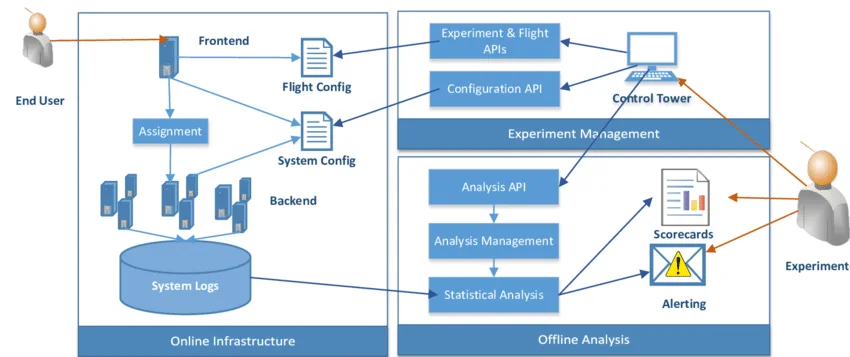
One ad headline experiment drove a 12% revenue increase. It was around $100 million per year.

Their scale is special. The habit is portable. Look for outsized levers.
5. A solid foundation that encourages curiosity
Reaching that level requires thorough testing systems, a culture of inquiry, and total company buy-in. Keep in mind that messy tracking turns experiments into debates. Unclear ownership turns learnings into lost Slack threads.
Get clean instrumentation and keep one shared library of all the findings and results.
The 6-step loop I use to make experimentation boring (in a good way)

Run this loop every week. That’s how experimentation becomes culture.
Step 1: Turn the north star into levers
Your north star is usually lagging: ARR, bookings, retention.
Break it into inputs you can test. In B2B, think reply rate, demo conversion, time-to-close, activation, and churn. Pick the lever with the biggest drop-off and write the problem in plain language.
Step 2: Build hypotheses from evidence
A hypothesis needs a “because.” It needs to be measurable.
Evidence comes from customers, your team, and the market. Talk to users. Sit in sales calls. Read support tickets. Listen for what they’re not saying.
Step 3: Choose the few bets worth a sprint
Now apply Reach, Impact, Cost, and Evidence. Keep it honest.
Some work doesn’t need testing. If it’s broken, fix it.
Step 4: Run minimum viable tests
Match the cost of the test to the risk of being wrong.
Sometimes your MVT is customer calls with a prototype. Sometimes it’s ads to a landing page. Sometimes it’s a full A/B test. The goal is fast, clean learning.
Step 5: Launch clean, then let it run
Double-check tracking on day one to catch bugs. After that, stop babysitting the dashboard.
Calm teams run better experiments.
Step 6: Learn, apply, and share
When the test ends, ask why it worked or didn’t. Segment results by the slices that matter to your business.
Then share the learning across the company. Experimentation dies in silos.
The human part: psychological safety is a growth lever

Most teams don’t struggle with ideas. They struggle with fear.
The dark side of entrepreneurship is real, and people default to black and white thinking. Your job is to normalize the grey. Talk about failures as positive learning moments. Always ask what you gained and how you will iterate.
You will see a massive improvement in your team’s energy when you frame every failed test as a win for the insights it provides.
A 30-day rollout you can actually execute
- In week 1, pick your north star and a few levers. Create one experiment template and one shared library.
- In week 2, run one product MVT and one go-to-market MVT. Pair it with a short customer research sprint so your next hypotheses have real evidence.
- In week 3, run a weekly review with one goal: learning. No spinning. Just clarity and next steps.
- In week 4, do an unfiltered retro. Improve tracking, ownership, and hypothesis quality. Then run the loop again.
Keep the loop. Keep your team.
Control the narrative beyond the funding headline. Build a company that learns in public and learns in private. That story attracts talent too.
Turn your work into play and keep your experimentation culture human enough that people stay brave and curious.
That’s how you grow fast without burning out your team.