Written by Lidia Vijga
I’m based in Toronto, but you can feel San Francisco from here. The mood spills into founder chats, hiring conversations, and every feed. Right now, the vibe feels hectic.
When OpenAI said it had closed a $122 billion round at an $852 billion post-money valuation, everyone noticed. When Anthropic’s $30 billion Series G put that company at a $380 billion valuation, the message got even louder. The upside in AI is massive. It is also packed into a very small circle.
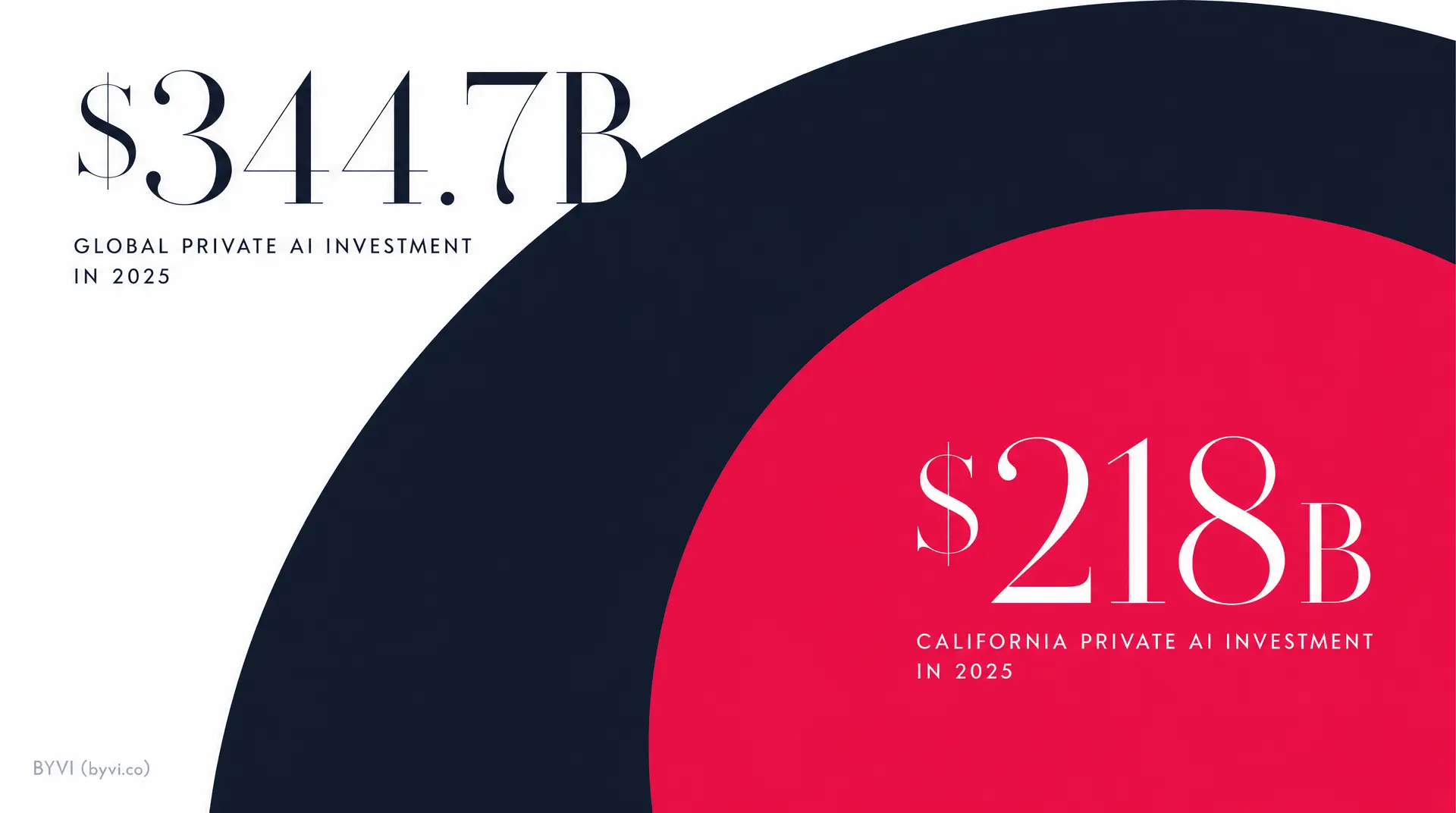
Stanford HAI reported that private AI investment reached $344.7 billion in 2025, up 127.5% year over year. The same report shows California alone pulled in $218 billion. That kind of money changes behavior fast.
People outside that circle start doing ugly math. They look at their salary. Their options. Their runway. Their age. Then they look at a small group of people who made retirement money in a few years. A lot of them start asking the same question: am I already too late?
I care about that question because of its impact. It breeds fear and envy, causing smart people to abandon real problem-solving to chase big-name startups. This is the dark side of the AI boom: the money is real, but so is the crushing pressure.
The Gold Rush Is Warping How People See Work
For a long time, the Bay sold a simple story. Work hard. Be sharp. Join the right company. Stay close to the future. Your outcome might not be perfectly fair, but it could still make sense.
A gold rush breaks that story.
Suddenly the corporate ladder looks like the wrong building to climb. People start asking if they should become founders. Or switch jobs again. Or learn AI overnight. Or somehow get into the tiny group with life-changing upside.
Even the baseline is warped. Census data shows San Francisco County has a median household income of $140,970, a median home value of $1.39 million, and median gross rent of $2,476. In that environment, a very good income can start feeling average. That messes with your head if you let it.
This is where comparison gets dangerous. You stop asking, “What problem am I good at solving?” You start asking, “Which path gets me rich fastest?” That shift looks small. But it changes everything.
A lot of people now feel they can do all the right things, work a well-paying job for years, and still never touch those outcomes. Layoffs make that feeling even sharper. So does watching AI change the day-to-day shape of work almost overnight.
The Fear Is Real
The fear around work is not made up. Gallup’s 2026 survey found that 50% of U.S. employees now use AI in their role at least a few times a year. The same survey found that 18% believe their job is very or somewhat likely to be eliminated within five years because of AI or automation.
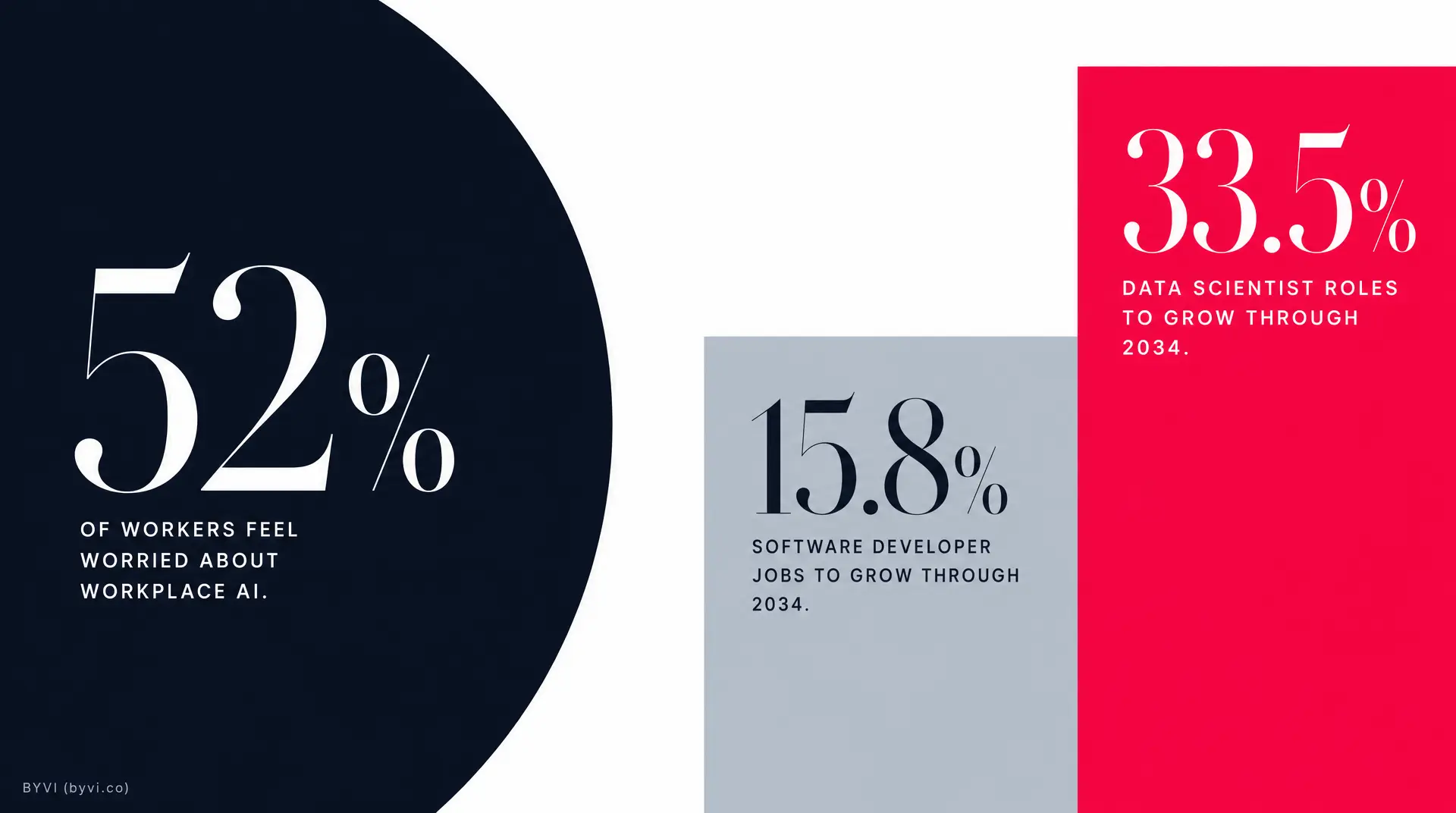
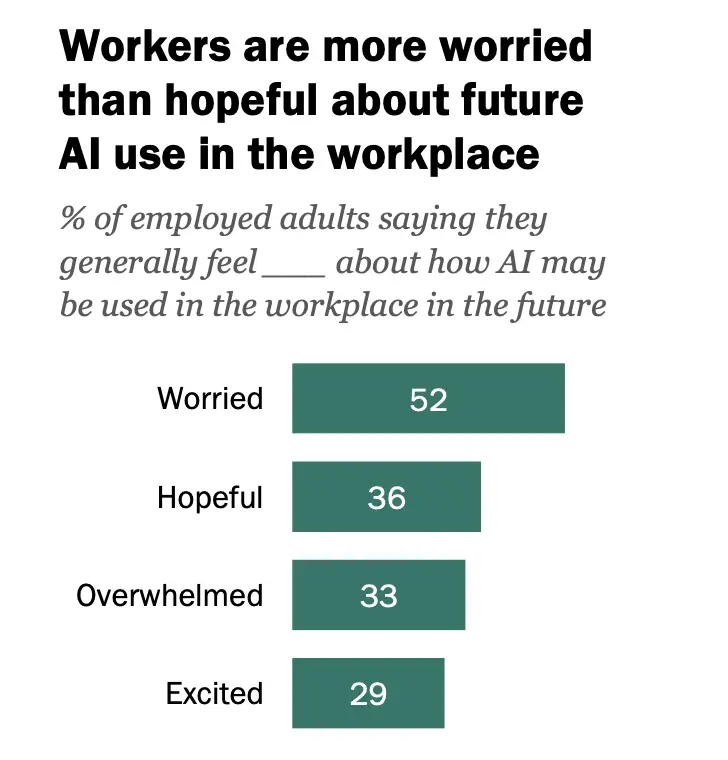
The emotional side looks rough too. Pew Research Center found that 52% of workers feel worried about workplace AI and 33% feel overwhelmed. Only 6% think it will create more job opportunities for them in the long run.
What does that do to a 24-year-old engineer? What does that do to a manager with kids? It makes work feel shaky at the exact moment people need stability.
A lot of engineers are wondering whether the skill they built their whole identity around still carries the same value. Younger workers feel this especially hard. A Stanford Digital Economy Lab paper found a 16% relative employment decline for workers ages 22 to 25 in the most AI-exposed occupations. You can see why so many younger people feel like the future moved without asking them.
Middle managers feel the pressure differently. Many have families. Many do not have deep AI skills. Many do not feel they can just wake up tomorrow and start a company. They can see the writing on the wall, but they do not see a clean path forward.
This is why I keep telling founders to stop thinking in black and white colors. The labor market is moving fast, but the answer is still messy. BLS projects software developer jobs to grow 15.8% through 2034, while data scientist roles grow 33.5% and computer programmer roles decline 6.0%.
Then look at how the tools behave. A Harvard Business School and BCG study found that GPT-4 users completed more tasks and finished faster when the task fit the model’s strength. The same study found accuracy dropped on a task outside that frontier.
AI helps. But AI also creates hidden challenges.
That grey area matters. If you panic, you either freeze or chase hype. Both are expensive.
Sudden Wealth Can Scramble Purpose Too
There is another side to this story that people do not talk about enough. Some people “made it” so fast that their old life plan stopped making sense.
I am not asking anyone to feel sorry for them. I am saying purpose gets weird when money arrives before meaning catches up. If work was your path to freedom and now you are already there at 30, what comes next? For some people, the answer becomes status, attention, or building another company just because they can.
You can feel that emptiness in the ecosystem too. Some companies are being built from obsession. Some are being built from envy. Some are being built for status points. The market eventually feels the difference.
I do not believe early-stage founders get a clean work-life balance. There is more like work-life blend. Your brain is 100% on. That only works when the problem matters to you so much that you turn your work into play. If the mission is fake, the grind gets very dark very fast.
The dark side of entrepreneurship has always been there. AI money just made it louder.
The Media Machine Is Feeding the Wrong Lesson
Traditional tech media keeps pushing the same signals to the top. Big rounds. Big valuations. Big names. That trains everyone to believe only the already visible companies matter.
I believe this is a major gap in the startup world.
The founders who need visibility most are usually the ones who get ignored. The bootstrapped founder who will never get a TechCrunch headline may be solving a sharper problem than the loudest company in the room. They may understand their customer better too.
That gap is exactly why I built BYVI. My team and I went through a period when getting traction and exposure felt really hard. Then a journalist came out of nowhere and wrote about us. That story changed our path. It led to partnerships and clients. I never forgot that feeling.
It made something very clear to me. PR matters most when you are early. Later, press can be a nice signal. Early on, it can change the company.
What Founders Should Do Now

Build from Proximity, Not Panic
If AI has you feeling late, slow down. Panic is expensive.
I gave this advice to a founder once, and I would give it again today. Build in the industry you already understand. A founder friend of mine wanted to jump into a space that had nothing to do with his background. He had 10 years of experience elsewhere. My advice was simple: stay close to what you know, solve a problem for people you understand, and use the expertise you already paid for with your life.
That advice matters even more in a hype cycle. Go by what’s already happening under the hood. What problem do you understand deeply? Which customer do you actually know? Where do you already have trust, context, and language?
When helping founders find their path, I always ask: who is the one person you want to help solve a constant, painful problem?
Across BriefBid, DeckLinks, and BYVI, I keep coming back to the same pattern. I saw a gap. Then I built something practical around it. I did not start with the trend. I focused on the problem and the people I cared about most.
If you are still employed, you do not need to blow up your whole life tomorrow. Learn while you are inside the system. Talk to buyers. Notice repeated pain. Sometimes the best startup idea is sitting inside the workflow that currently frustrates you.
Own Your Own Content Engine
The AI boom changed distribution too. Visibility now comes from many places at once. Google. AI search. Reddit. Reviews. Product docs. Niche blogs. Newsletters. Founder posts. Your brand story gets built across all of them.
AI search does not go by keywords the old way. Buyers now explain their whole situation, almost the same way they do on a sales call. Your content needs to answer that directly.
That is why I feel very strongly about this point: own your own content engine. The true authority cannot be outsourced. Bring the content writing in-house. Or at least keep the raw knowledge in-house and turn it into content with care.
Create helpful content and always provide a unique point of view. People can see through generic fluff. AI can too, in a different way. Surface-level content fails to signal authority, and your brand gets ignored.
Don’t forget that LLMs are pattern matching machines. They look for consistency. Depth. Proof. They crawl Reddit for community sentiment. They crawl reviews. They read case studies. They read documentation. If your website says one thing, your founder says another, and your customers say something else, the model gets confused. Then it forms the wrong narrative about you.
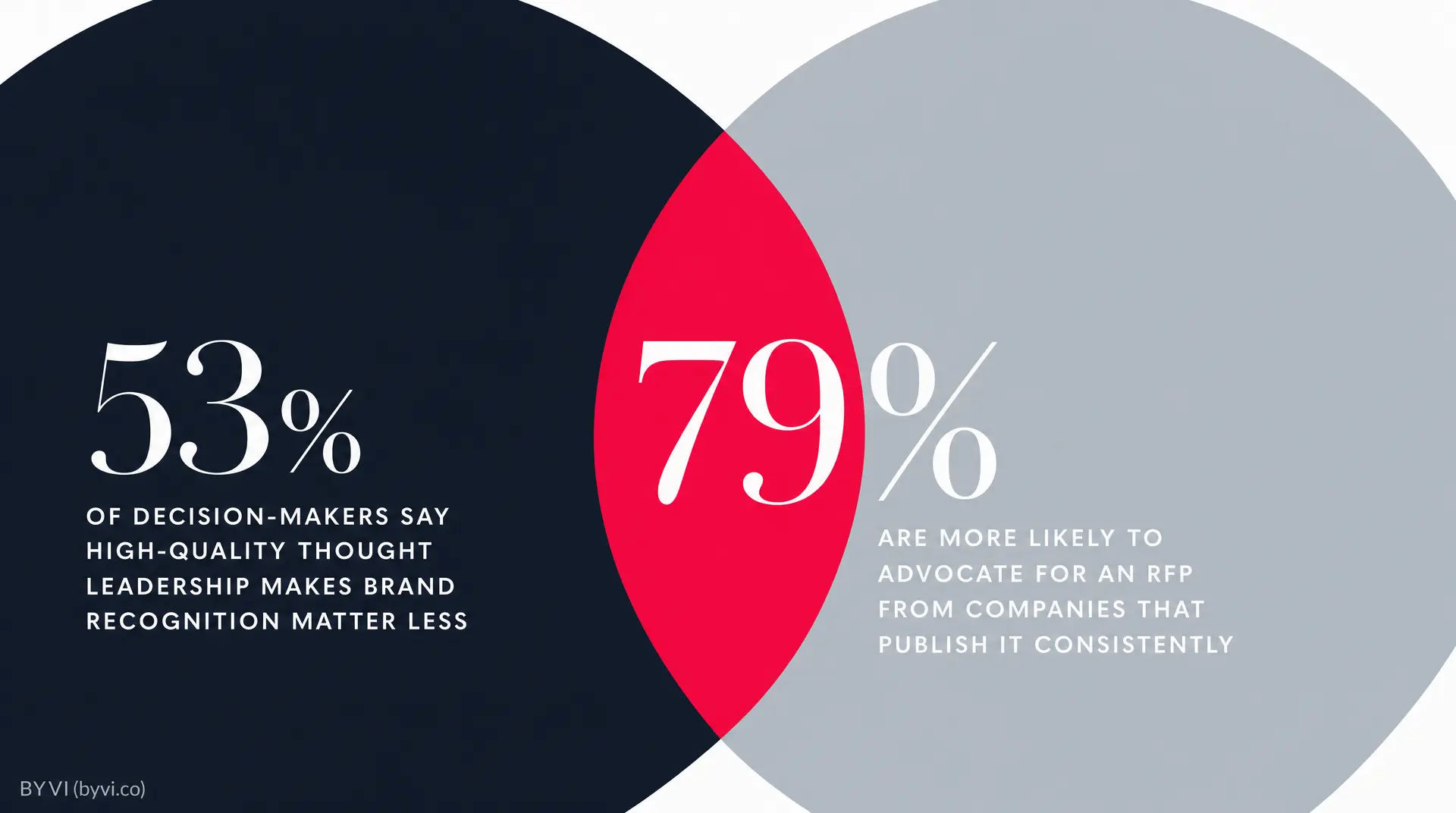
This is where founder-led content gets very powerful. Edelman and LinkedIn found that 53% of decision-makers say high-quality thought leadership makes brand recognition matter less, and 79% of hidden decision-makers are more likely to advocate for an RFP from companies that publish it consistently.
At DeckLinks, I have spent a lot of time thinking about how B2B content feels on the receiving end. Human-centered content still wins attention. In the AI era, it wins even more. Buyers want a human behind your brand.
What Investors, Advisors, and Ecosystem Builders Need to Change

This part is not only on founders. Investors, advisors, journalists, and community builders shape the mood too.
Stop rewarding headline theater. Look for the founders who are quietly solving boring, painful problems.
If you really want to support early-stage founders, do more than applaud them online. Buy from them when there is a fit. Pilot the product. Make the intro. Put them in the room with the right buyer.
Founder communities cannot live on encouragement alone. Founders need customers. Partners. Momentum. Otherwise the community just turns into a pointless social club.
I also think communities should be highly curated. Verticalize the events. Keep the room relevant. Founders open up more when they feel they are among peers who understand the same reality. That’s when the conversation gets honest. And that’s when people stop performing success.
The ecosystem learns faster when people close to the problem speak openly. Founder-to-founder stories do that better than polished PR ever will.
Final Thought

SF’s AI gold rush is changing wealth, work, identity, and ambition all at once. That is why it feels so intense. It reaches far beyond a tech trend. It is reshaping how people measure themselves.
I still think this is one of the best times to build something new. New technology creates new pain points, and pain points create companies. But you need the right reason to build.
Solve the problem you know. Stay close to your niche. Own your own content engine.
I hope founders do not give up, no matter how loud this market gets. Most founder stories are not straight lines. They are hustle, grind and endless pivots. Keep going anyway. Keep iterating. You are going to get somewhere.
And if you have influence in this ecosystem, use it to make visibility and opportunity accessible to the people who actually need it.
FAQs
How is the AI boom impacting junior engineering roles at early-stage startups?
It is actively shrinking entry-level opportunities. A Stanford study found early-career workers in highly AI-exposed roles faced a 16% relative employment decline. Startups are leaning on models to execute junior code, forcing new hires to demonstrate senior-level problem solving immediately to survive the current market.
Does the AI capital boom make building a startup outside Silicon Valley harder?
Capital is aggressively localized, but your customer base is not. In 2025, California absorbed $218 billion of US private AI investment. While funding is intensely concentrated, founders outside SF can leverage lower burn rates to build highly profitable, bootstrapped businesses without the extreme local psychological pressure.
Can generative AI genuinely bridge the resource gap for bootstrapped founders?
Absolutely, especially when scaling basic operations. Research indicates that generative AI assistants increased customer support productivity by 14% on average, heavily benefiting less-experienced workers. Bootstrapped founders can leverage this to build incredibly lean teams, accelerating execution without raising VC money just to cover overhead.
Should non-AI startups force generative AI features into their MVP to attract investors?
Absolutely not. Forcing AI into an MVP signals panic, and panic is expensive. While generative AI companies pulled in $170.9 billion in 2025, sophisticated ecosystem builders see right through thin wrappers. Solve your core customer’s actual pain point. Do not build for the hype cycle.