Written by Lidia Vijga
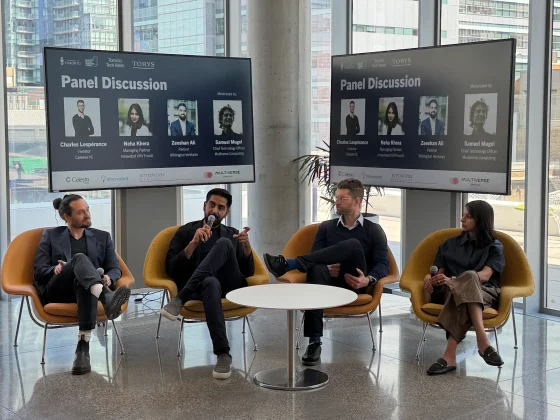
This article is based on the conversation at Toronto Tech Week, moderated by Amanda Lang. Reynold Xin is co-founder of Databricks, the San Francisco-based data and AI infrastructure company valued at over $130 billion. Mike Murchison is CEO of Ada, the agentic customer experience platform.
In 2009, a PhD student, Lester Mackey, entered a competition Netflix had created to find the best movie recommendation algorithm. The prize was a million dollars. The rules were simple: beat Netflix’s own algorithm by 10%. There was just one problem: the dataset was too large to fit on a laptop.
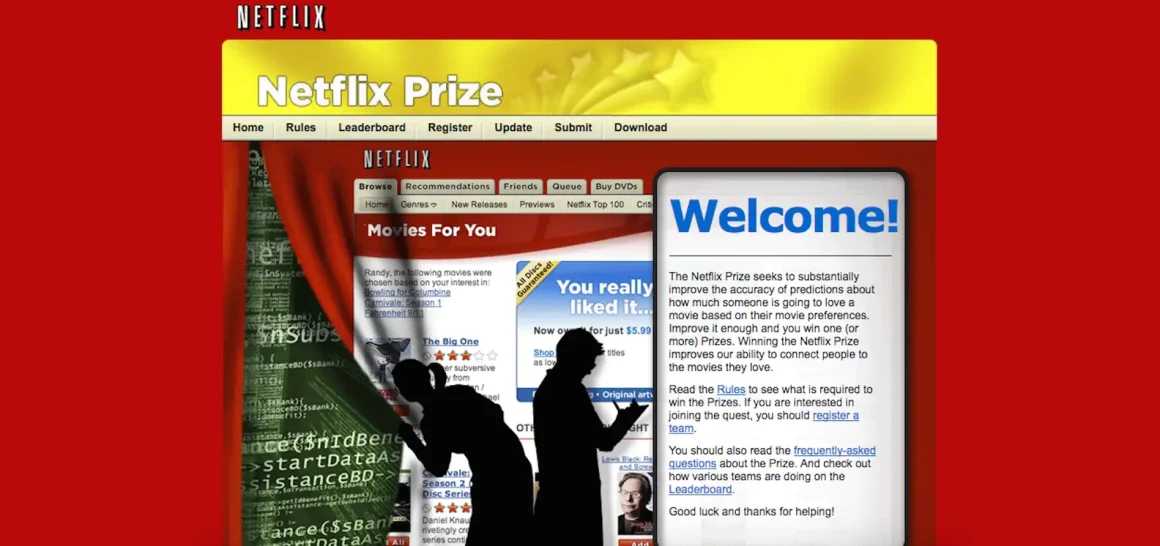
Mackey asked a labmate who would become his co-founder if they could build something to handle it. They wrote 600 lines of code over a weekend. Mackey competed. He tied for first place on the improvement score. He lost the million dollars because the other team submitted their entry 20 minutes earlier.
That 600-line weekend project became Apache Spark. The open source standard for data processing used by most of the world’s largest companies. The seed of Databricks, now valued at over $130 billion.
Reynold Xin, Databricks’ co-founder, tells this story without drama. That’s partly his style, but it’s also because he understands something most founders spend years resisting: the beginning of a great company almost never looks like one. It looks like a competition you lose. A product nobody will pay for. And 3 years of misery in the middle of what looks, from the outside, like a success.
When Traction Is a Lie
By 2013, Databricks was a real company with real momentum. Apache Spark had become the de facto standard for large-scale data processing. Thousands of engineers were showing up to conferences. There were selfies. There was what Reynold diplomatically calls “massive open source traction.”
There was also, by the end of 2015, roughly 1M dollars in annual revenue. 3 years in.
“We were a commercial failure for the first 3 years,” Reynold says.
“From the outside it was hard to understand because a lot of the metrics were vanity metrics about open source adoption. But when you looked at revenue…”
And this is a huge trap. Not failure — the appearance of success while the business itself doesn’t work. The metrics that feel good are not the metrics that matter. Thousands of downloads and a room full of raving fans is not a business.
The breakthrough, when it came, had two parts.
First: building actual go-to-market machinery. Databricks was a group of engineers and founders wandering around trying to sell a product. That’s fine as a learning experience — Reynold believes it — but it doesn’t scale. You need the infrastructure of a real business.
Second, and more fundamentally: creating proprietary IP. This is the part founders of open source projects resist most. But Reynold puts it like this:
“Just because we created a massively successful open source ecosystem doesn’t mean customers should pay us for what they’d have gotten for free. There needed to be some value that was justified.”
The vision didn’t change. The go-to-market and the proprietary layer had to be built around it. One without the other is either a movement or a charity.
What Mike Did That Almost Nobody Does
Before Ada, Mike Murchison was building a consumer app. It was growing. And then, the way scaling companies do, it started treating its own customers as a liability.
“Customer service got worse the bigger we got,” he says. “We went from knowing our users’ names, craving their feedback — to our customer service operations being focused entirely on reducing contact.”
He started cold-calling VPs of Customer Experience to understand why. He talked to twelve of them. All twelve said the same thing: we talk to our customers less as we grow. Customer service is a cost center. I am literally compensated on how much I can reduce contact this year.
“When I heard that maybe the twelfth time in a row,” Mike says, “I started to develop a thesis.”
His thesis: the future’s biggest winners would figure out how to talk to their customers more, not less. They would compete on the quality of experience they delivered. This was 2016. Large language models were years away. He had a conviction and no product.
Here is where Mike did something most founders don’t. He didn’t go build. He went back to those same twelve VPs and asked if he and his co-founder could join their teams — as customer service agents. Seven said yes. He spent a year in the weeds, working support queues, learning the operations from the inside, before he revealed what he was actually building.
“We learned very manually how to provide great service at scale,” he says. “That has informed our approach and continues to today.”
This is the thing that separates deep founders from competent ones. Mike didn’t just understand the problem intellectually. He lived it. He wasn’t studying the problem from the outside. He was the problem.
The Only Advice That Actually Matters
Reynold texted his co-founders before going on stage: What advice would you give?
Several responded. Then their CEO, Ali Ghodsi, replied: “I disagree with all of the above.” And offered a single sentence.
“Nothing can substitute for creating a product that is 10 times better than something else that exists.”
That’s it. Not 10 times better than the closest alternative at some features. 10 times better, full stop. Or going zero-to-one — solving something that was previously impossible. Do either of those things and you have a business. Do neither and no amount of execution, culture, or fundraising will save you.
“The 10x doesn’t mean exactly ten times,” Reynold clarifies. “It means it can’t be something fairly incremental if you actually want to build a very successful business.”
Mike adds the practical path:
“When you start a company, you’re so resource-constrained. You look at successful companies and think – they have resources, infrastructure, distribution that I don’t have. But there is one thing you can genuinely be the best in the world at: understanding your problem more deeply than anyone else.
That’s the edge. Not capital. Not talent. Not even technology. All of which you can eventually acquire. The edge is understanding. And it’s available to everyone who’s willing to actually do the work of getting it.
When Reynold talks about customer obsession, he’s not talking about a cultural value written on a wall. He means something specific. He was doing 10 customer meetings himself — not his sales team, not his product managers — over a two-week stretch that spanned an American holiday. He texts design partners on a first-name basis. He asks them not “what’s wrong with the product” but “what are your concerns” and “what else can we do for you.” The distinction matters. One question narrows, and the other opens.
Right now, those conversations are surfacing a single theme: AI token costs.
The world has swung from “use more, use more, use use use” to “I burned through my entire annual budget in the first quarter, now what?” Every company is having this conversation. That’s a product opportunity. You only find it if you’re in the room.
What the AI Era Actually Changes
Both founders are building AI companies and running their businesses on AI. Here is their take.
The cost of writing software is falling fast. A two-person team can do work that used to require a hundred people. The arbitrage opportunity for small companies right now is speed — moving while large incumbents are still figuring out their governance and approval processes.
Mike says:
“Showing up as a two-person team that can do the work of a hundred-person team really does make a difference, more so than it used to.”
Taste Is the New Moat
There’s a question that used to be fairly simple for founders: what makes us defensible? You’d answer it with technology, patents, network effects, switching costs. The standard toolkit.
Mike Murchison thinks the answer has changed:
“The most important thing right now is taste. It’s never been more important for you to say: this is what an amazing experience looks like, and to be able to paint it.”
He’s not talking about design sensibility. He’s talking about something harder: the ability to hold a precise, uncompromising vision of greatness at the exact moment when building has never been cheaper, faster, or more democratic.
At Ada, almost everyone in the company is now creating pull requests, contributing directly to the product, regardless of their background. Non-technical people shipping features. The cost of participation has collapsed.
Which means the old filters are gone. You can no longer hide behind process. “In the old world,” Mike says, “you could get away with asking ‘what do you need?’ and building something incremental. That worked. It doesn’t work anymore. The premium is entirely on judgment.”
That premium shows up in a specific way: the people who will win are the ones who can clearly say “this is not good enough”, before the market tells them. Not after the NPS score comes back. Not after a competitor ships. Before. The vision has to be internal and precise, not external and reactive.
Reynold agrees, and then adds a wrinkle that makes the argument more complicated.
“If you assume the cost of software continues going down,” he says, “one natural outcome is that it becomes easy to copy. You can reduce taste by poor judgment, yes. But you can also simply copy it.”
His point:
Taste is real and it matters, but it isn’t a durable moat by itself. What can’t be copied overnight is the oldest, most unsexy list in business — brand, distribution, trust.
“A red Ferrari is a red Ferrari,” Reynold says. “You can’t have a red Xiaomi and sell it for half a million dollars.”
For founders at the earliest stages, this sounds like bad news — you don’t have any of those things.
Read it differently and it’s actually clarifying. In the short run, taste and speed are your moats. Move fast, build something extraordinary, get close to your customers before larger players figure out their governance process. In the long run, you’re racing to convert that early advantage into brand, distribution, and trust before the window closes.
The companies that do both — start with taste, compound into moats — are the ones that become generational.
The question to ask yourself isn’t whether you have taste. It’s whether you can define, specifically, what “extraordinary” looks like in your market — and whether every decision you’re making right now moves toward it or away from it.
The Things Successful Founders Don’t Usually Say
Reynold says something at the end of this conversation that most successful founders won’t say. Asked whether founders should start companies, he doesn’t give the standard answer.
“If you’re a strong engineer who can find a well-paying job,” he says carefully, “the expected value of working might actually be higher. The risk of failure is pretty high.”
He says it not to discourage anyone, but because he’s being honest in a room full of people who are about to make a consequential decision. He follows it with:
“That said, fail once, fail three times, keep going. There’s nothing wrong with it. The rate of learning is the highest with entrepreneurship. You will develop a skill set that your peers who went to big companies simply won’t have.”
Mike extends it: “The downside is so much more minimal than you think. And there’s so much more upside in starting something than most people realize.”
Both of them, in different ways, are pointing at the same thing. The failure people fear is rarely as catastrophic as it feels in advance. The learning is irreplaceable. And the environment you choose — the five people you spend most of your time with, the peer group that shapes what you think is ambitious and what isn’t — turns out to be one of the most important decisions you make.
“You can be the best in the world at understanding your problem,” Mike says. “You get to choose who influences you to be more ambitious. Those are both in your control.”
That’s the brick. The rest is building.