Written by Lidia Vijga
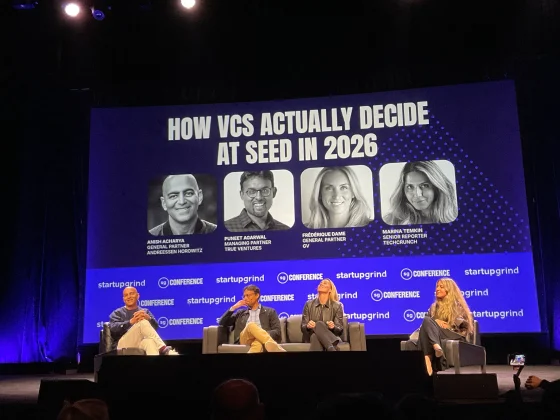
Notes from a Startup Grind panel on what brand actually means when your product can be cloned in a sprint — and what marketing leaders should be defending instead.
Every CMO I know has the same private suspicion right now: the things that used to be hard are getting cheap, the things that used to differentiate are getting commoditized, and the only thing that still feels defensible is the way customers feel about you. A recent Startup Grind panel — featuring marketing leaders from Figma, Vanta, Brex and beyond — landed on the same conclusion from five different angles.
The headline insight, compressed into one line, is this: in the AI era, brand is the moat. Everything else is a fast-following race to the bottom.
Brand is what people feel you stand for — not what you ship
The most quoted line of the night may also be the simplest: “At the end of the day, your users, your community and the people who love your product want to know what you stand for.”
Copy can be copied. Features will be replicated by a model in 3 weeks. The emotional and values-based residue your company leaves behind — what one panelist called the “beyond product functionality” layer — is the only asset that doesn’t get cloned.
For marketing leaders, the implication is uncomfortable: a lot of what counts as “marketing output” right now contributes nothing to that residue. It generates impressions and timeline real estate while leaving the underlying brand exactly where it was.
The launch treadmill is a vanity metric
The panel was especially blunt about shipping cadence. “It’s a trap to fall into the launch treadmill because it makes you feel very active if you’re producing all these artifacts,” said one speaker. “People like your posts on LinkedIn and Twitter. But the reality is it’s really meaningfully shifting whether customers are adopting, using, engaging deeply with your product.”
Frequent launches feel like progress because they look like progress. Internally, they fill review meetings; externally, they get reposts. But the metric that matters — does this change how deeply customers use the thing — is rarely the metric being optimized. Worse, teams slip into “a binary, we launched it, we’re done kind of mentality and then onto the next,” which severs the marketing function from the actual adoption curve.
The fix is counterintuitive in an industry built on momentum: launch less, bundle more, and let the timing serve the story. “What you do could mean pushing back a launch, collapsing launches together so you have a bigger moment, telling the more thematic bundle.” A thematic moment that lands is worth 10 “launches” that scroll past.
A caveat about pace: don’t read OpenAI’s cadence as a benchmark. As one panelist explained, “the big labs, you’re building from model capabilities forward” — they ship because their job is to educate the world about what models can now do. Product companies “shift from customer needs backwards,” which is a fundamentally different game. Importing the frontier-lab tempo into a vertical SaaS company is cargo-cult marketing.
Pick your enemy, not your competitor
Brand is sharpened by what it’s against. But the panel was careful to distinguish picking an enemy from picking a fight.
For early-stage companies, the most productive enemy is usually the status quo itself. “For us, our first enemy was a taxi, not Lyft,” said the Uber alum on the panel. That framing did something a competitor jab could not: it told users what kind of world the company believed in. Taxis weren’t another app; they were a daily indignity. Naming the indignity gave Uber a meaning beyond the product.
For more established companies, going after a much larger incumbent remains the safest, highest-leverage play. Scott from Brex described the famous Concur campaign: “We turned their name into a curse word, Concur…rrrgh!. And when you have a competitor that’s significantly larger, it’s a very safe bet and a great way to get more mind share if you go with them.”
Anthropic’s Super Bowl spot aimed at OpenAI was, in his read, the same playbook scaled up — “incredibly unexpected and because of that was one of the most bold things I’ve seen.”
The harder question is what to do with rising peers. The traditional answer is to ignore them and refuse to lend them legitimacy. That instinct is being rewritten. “The prevailing wisdom is to do nothing there and not recognize them,” Scott said, “and my prediction is you’re going to see more of [direct rivalry] because markets are getting some more competitive.” Harvey vs. Legora is the current poster child: “The fight becomes the story and it elevates both of the projects.”
A warning, though: this only works from a position of clarity. “You have to come at it from a position of confidence and clarity about your why and what you stand for,” said Figma’s speaker, who pointed to the company’s own decade-long stance — advocacy for design as a discipline — as the anchor that lets sharper messaging work. Without that anchor, “done wrong, it can have really negative repercussions on your brand.”
The takeaway for CMOs: write down your enemy, but also write down why you’re against them. If the second sentence doesn’t trace back to your mission, don’t pick the fight.
Build the marketing team your funnel actually needs
The most useful operational thread of the night was on hiring. The panel pushed back on the default reflex of “we need a head of marketing” with a more diagnostic frame: hire to the bottleneck.
“Go with a diagnosis of what your funnel really needs,” one speaker said. If demand is strong but conversion is leaking late, product marketing is the spike. If demos close but pipeline is thin, “you probably want growth marketing and demand gen as the spike of your marketing leader.” If you’re building a category, the spike is brand and narrative.
In this era, the most contested hire is product marketing.
“Product marketing is probably one of the most sought-after hires right now,” and for good reason: the central job is to “figure out your why — what makes you different, what makes you differentiated in the market. That, I think, is the north star of this current time and era.”
When every competitor can ship the same feature in a quarter, the team that can articulate why their version matters wins.
Two practical updates to the old org chart are worth flagging.
First, the disciplines are blending. “With the aid of AI, it’s much easier to flex into demand generation or into brand storytelling,” and a strong product marketer can now read a demand-gen dashboard without a translator. The cycle from idea to execution has collapsed — “you can go from idea to execution in a much shorter cycle time than before” — because the ad ops, design, and analytics layers that used to require entire teams can now be carried by one operator. Expect more from each hire, but expect to need fewer of them.
Second, the founder is part of the marketing team whether they like it or not. The panel was unanimous that the best founders “intuitively care about brand and communications and how you tell a story.” When that’s true, the first hire can be a growth marketer rather than a narrative one — the founder is already carrying the narrative. When it’s not, product marketing has to come first, because nothing the rest of the team builds will compound without a sharp answer to “what are we, and what are we against.”
The pricing pendulum hasn’t landed yet
A short detour on pricing, because every CMO is being asked about it. The fashionable claim that “per-seat is over” is, in the panel’s read, overblown. Consumption pricing is real and rising, but it carries its own friction: high cognitive load for users trying to value individual tasks, and runaway-spend anxiety from buyers who answer to a CFO. The pendulum will swing back. The likely steady state is a hybrid — consumption bucketed into predictable tiers, with thresholds that trigger upgrades rather than running counters that trigger panic.
The marketing implication is to know your buyer. Developers will tolerate metered pricing; back-office buyers will not. Package accordingly, and lead with the buyer’s mental model, not the engineering team’s.
A test you can run yourself
The most operational takeaway from the panel was also the most testable. Quiz every person in your company on two questions:
- Who are we building for
- How are we different
If everyone answers the same way, you’ve won 75% of the battle.
Most companies won’t pass. The fix is not a brand refresh. It’s writing down — in the founder’s voice, not the agency’s — a half-page of prose that backs up the positioning, and then making sure the website headline reflects it without jargon.
“Memorialize your vision beyond your head,” the panel said, because if it only lives in the founder’s head, the company has no brand asset at all.
Today, that half-page may be the most valuable thing the marketing team owns. Product gets copied. Pricing gets matched. But the story — the one your team tells with conviction, in your founder’s own voice — is yours alone. And that’s the moat.