Written by Lidia Vijga
At Stripe Press, Klarna and Stripe took the stage to make a case that might surprise most e-commerce teams: the biggest threat to your sales in an AI-driven world isn’t a bad checkout experience – it’s never being found in the first place.
The talk, centered on agentic commerce, offered a ground-level look at an infrastructure shift that’s already in motion. AI traffic to e-commerce sites is up 393% year-on-year according to Adobe’s Q1 2026 report. But the opportunity that number represents is being quietly squandered, because the product catalogs agents are being sent to read were never built for machines.
The Invisible Catalog Problem
This was the statistic that opened the discussion:
According to Klarna, 66% of product pages can’t be fully read by AI agents.
That’s not a rounding error. It means the majority of product pages that an AI shopping agent visits today are returning incomplete data. And incomplete data means the agent can’t confidently recommend the product. From the agent’s perspective, those items might as well not exist.
To make the point concrete, the speakers walked through a case study of a major activewear brand. The brand had 160,000 products in its catalog. Of those, only 10,000 (just 6%) were actually discoverable by AI agents.
The cause wasn’t a technical outage or a broken feed. It was a single missing attribute: GTIN (Global Trade Item Number) coverage across their feeds sat at 0%.
“For that reason, the AI agents are not able to confidently compare, rank and recommend this product.”
Without GTINs, agents couldn’t build complete product cards. Without product cards, they couldn’t make recommendations. The brand’s catalog was effectively invisible at the most important new layer of commerce.
The framing was direct and simple: “If you can’t be found in this layer, your product doesn’t ever have a chance of being purchased at all.”
3 Attributes That Unlock AI Discoverability
The talk distilled the discoverability problem down to 3 catalog attributes that every merchant needs to get right.
1. GTIN (Global Trade Item Number)
GTINs are the connective tissue of agentic commerce. They’re the identifier that lets an AI agent match your product listing against the same item sold by other retailers – enabling comparison, ranking, and confident recommendation.
Without a GTIN, an agent querying a product graph simply can’t build the complete picture it needs. The activewear brand case study (mentioned earlier) illustrated this failure mode at scale.
2. Shipping Cost
Agents don’t rank on product price alone. They rank on total price. If your shipping cost isn’t part of your feed, the agent is presenting an incomplete picture to the consumer, and your product will lose out to one where the full economics are visible.
“If you’re not giving a full picture to the agent and the consumer, your product won’t be picked.”
3. Delivery Time
When a consumer tells an agent “I need these running shoes by Friday,” the agent filters its results to products where delivery by that date is confirmed. It doesn’t guess or check elsewhere. If your delivery window isn’t explicitly stated in your product feed, your item is excluded from that search entirely — no matter how good the price or how relevant the product.
All 3 attributes are prerequisites, not nice-to-haves. The agents doing the searching require structured, machine-readable data to do their job – and merchants who haven’t built for that are already falling behind.
Klarna’s Discovery Layer
Behind the scenes, Klarna has built the infrastructure designed to power agentic product discovery at scale: 100 million unique products, 400 million merchant offers, 4,300 subcategories, and one million merchant partners — all surfaced through a single API that’s normalized across merchants, LLM-optimized, and protocol-agnostic.
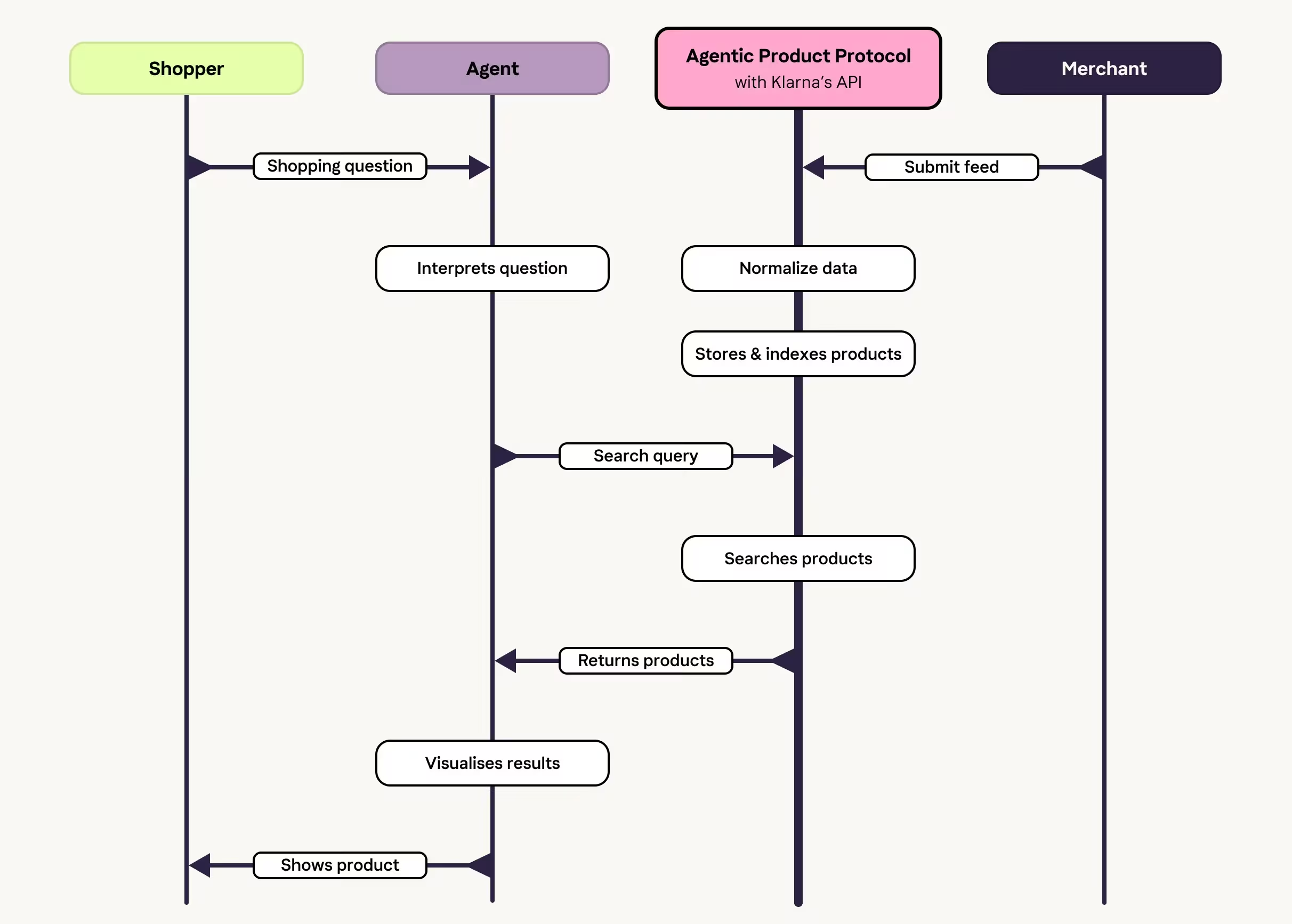
The pitch is straightforward: agents query the graph, get structured product data in real time, and can reliably compare and rank items across different sellers. As the speaker described it: “This graph really is what allows your products to be found.”
Rethinking How Payments Work in Agentic Flows
If the first half of the talk was about discovery, the second was about what happens after an agent finds the right product, and why the payment handoff is more complicated than it looks.
In traditional e-commerce, the buyer and the payment processor are in the same session. In agentic commerce, they’re not. The agent acts on behalf of the buyer, but the merchant still needs to process the charge. Alison from Stripe framed this as a fundamental separation:
“Payment intent is being separated from payment processing.”
To solve this, Stripe created Shared Payment Tokens (SPTs). The concept works like a sealed package: the agent creates a token scoped to a specific seller, for a specific timeframe, containing the buyer’s payment credentials. That package is handed to the merchant, who opens it, reviews it, and decides whether to process it or decline.
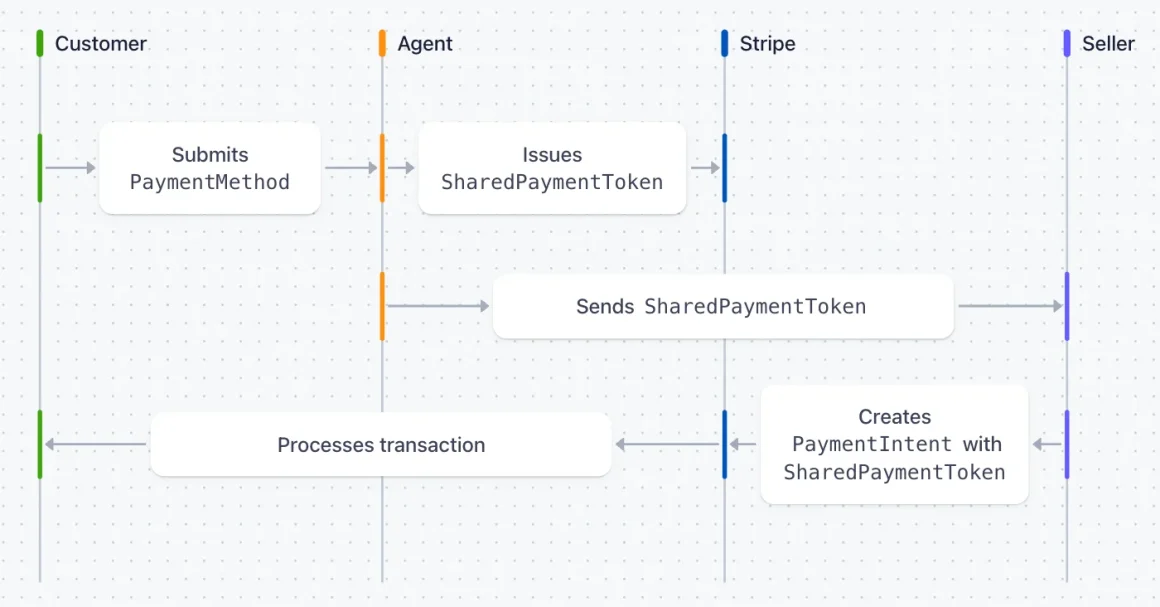
“You’re able to scope it to a specific seller, a specific time, and then you issue that to the seller and the seller at that time when they receive it, can open it up and they can say, I like what I see, I’m going to process as payment.”
Crucially, SPTs work with existing infrastructure — existing network tokens, device tokens, Klarna tokens. When Stripe launched SPTs, they supported cards only; Klarna support has since been added, with expansion to 100+ payment methods underway through Stripe’s growing ecosystem.
What This Means for Merchants Already on Stripe
For merchants already using Stripe and Klarna, the practical lift is close to zero. Agentic flows reuse existing Stripe components. Existing fraud configurations, Radar risk signals, and payment method settings carry over automatically. As Alison put it: “If you have enabled Klarna, it is already enabled in your agentic flows.”
Product catalogs can be fed into the discovery layer via CSV upload or import APIs, with the option to plug in existing commerce stack integrations rather than rebuilding from scratch.
In Agentic Commerce, a Failed Transaction Has No Recovery Play
One of the more striking moments in the talk was the discussion of what happens when an agentic transaction fails, and why it’s categorically different from a regular abandoned cart.
In standard e-commerce, a failed checkout is painful but recoverable. You can retarget, send a follow-up email, offer a discount. The consumer is still reachable. In an agentic flow, that path largely disappears. As the speaker explained:
“That’s very different when there’s a failed experience in an agentic flow, because that’s something that a consumer might not recover from, at least not quickly.”
Worse, a failed transaction doesn’t just cost the merchant a sale, it damages the consumer’s trust in the agent itself. “They might not trust that agent very quickly again.” This changes what agents optimize for. Rather than pure conversion, they weight for reliability in roughly this order: consumer trust, payment flexibility, post-purchase liability, and then approval certainty.
The implication for merchants: the bar for agentic transactions is higher than for web transactions, because the failure modes are harder to recover from.
Account Linking Challenge in Agentic Commerce
The talk closed on one of the more existential concerns merchants raised: how do you maintain a direct relationship with your customer when an agent is in the middle?
Personalization, loyalty programs, purchase history, recommendations — all of it depends on knowing who the customer is. When an agent intermediates the transaction, that connection can break. As Alison noted:
“That’s probably one of the number one pieces of pushback we hear from merchants when we’re talking about agentic commerce – how do I maintain that relationship with my customer?”
Account linking is the proposed answer, connecting the consumer’s identity across agentic flows so merchants can preserve personalization and relationship data. “Solving the account linking challenge is what will allow them to really bring that rich experience and the personalization into agentic flows.”
The Takeaway
Agentic commerce isn’t on the horizon, it’s already scaling. The 393% growth in AI traffic is being driven by agents that are actively shopping, comparing, and recommending right now. The merchants who will win in this environment are the ones who’ve done the foundational work: clean GTINs, complete shipping data, accurate delivery windows, and product feeds built for machines to read.
The checkout experience still matters. But by the time a consumer reaches it, the hardest work is already done — or it isn’t. In agentic commerce, the sale is won or lost in the catalog, long before anyone clicks buy.