Written by Lidia Vijga
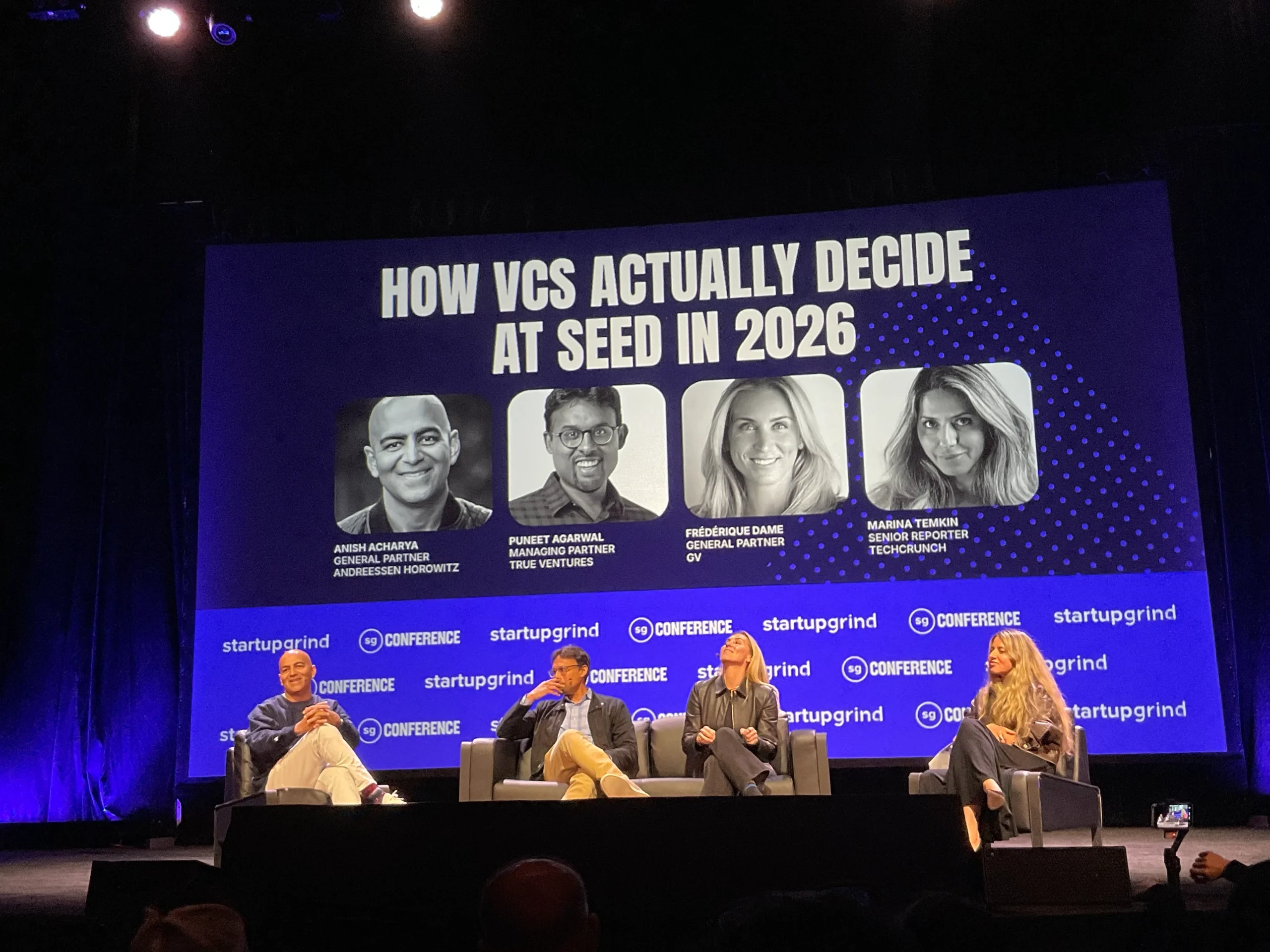
If you’re gearing up to raise a seed round in 2026, the playbook has changed. At a recent Startup Grind panel, a group of seed investors spelled out exactly what they’re looking for — and what’s getting founders passed over. Here’s what you need to know.
The bar has moved: come with traction, not just an idea
The cost to build has collapsed. AI tools mean a motivated founder can ship a working product in weeks, not months. Investors know this, and they’ve adjusted their expectations accordingly.
“The cost to build is almost zero these days”
That means showing up to a seed meeting with nothing but a deck and a vision is increasingly not enough. Investors now expect a working prototype at minimum — and if you have early customers, even better.
One investor pointed to a portfolio company called Nectar Social, an AI platform for community management, as an example of the new standard: they raised their seed round with a working product and actual paying customers already on board.
What to do: Ship before you raise. Even a rough MVP with a handful of real users is worth more than a polished pitch. If you’ve been waiting to fundraise until things feel “ready,” that instinct is now correct — investors are watching for it.
The market is both flush with cash and brutally concentrated
There’s a strange tension in seed markets right now. Capital is abundant — “tons of money in the system,” as one investor put it — but it’s flowing to a smaller and smaller number of companies. A handful of AI startups are vacuuming up enormous rounds, while the rest of the market fights for scraps.
One investor described this openly: “It’s a hard environment to be in where this much money is being concentrated in so few companies.” They also noted that early venture — the art of backing founders before outcomes are obvious — is getting squeezed out as the market turns more transactional.
The best investors still want to fund before things are known. That window exists. But it’s just narrowing.
What to do: Don’t assume that a hot AI market means easy fundraising. Target investors who are genuinely early-stage focused. The transactional end of the market will make you jump through hoops for worse terms. Find the partners who still want to bet on people.
What investors are actually looking for in founders
Credentials, pedigree, and even age matter far less than people assume. What investors are actually reading for is a specific set of signals.
A life mission, not just a startup idea
The bar isn’t “I have a good idea.” It’s “I am the person who was always going to build this.” Investors are betting on a 10–12 year relationship, and they need to believe the founder will survive the emotional ride that entails.
“If you have a vision and you feel so clear in your heart, in your gut that this is what is your life mission,” one investor said, “and you can articulate it and actually find the investor that sees it with you and can be your partner on this journey — I think it’s fascinating.” What they’re looking for is a missionary, not a mercenary.
Is there a real “why” behind what you’re building? That’s the question they’re asking themselves as you pitch.
Boldness and a contrarian point of view
Safe ideas don’t produce outlier returns, and investors know it. They’re drawn to founders who hold views that feel a little uncomfortable — people willing to bet on a future most haven’t seen yet. Being bold doesn’t mean being reckless; it means being willing to articulate a conviction clearly even when the room isn’t sure yet.
The ability to build and sell
One investor put it plainly: “The first thing I look for is: can you build and can you sell?” These are often treated as separate skill sets that get split across a founding team, but at the earliest stage, investors want to see that the lead founder can do both — or at least credibly lead both.
The selling piece matters especially for storytelling. “That narrative is so critical,” one panelist said, “because it defines how you’re going to hire people you shouldn’t have any business hiring, how you’re going to get funding you shouldn’t have any business getting, and how you win your first customers.” A founder who can build but can’t tell the story is leaving enormous leverage on the table.
Hands-on involvement in the product
The panel was clear: investors want founders who do the work, not just manage the people who do. They’re watching for the founder who is in the product details day in and day out, setting the standard by example rather than delegating from a distance.
One investor described an Uber leader as the model: deeply embedded in product decisions, going to Singapore to interview an intern to understand local market needs firsthand, still working alongside the team at midnight. That kind of operational presence signals both genuine commitment and the self-awareness to know where value actually gets created.
Relentlessness and speed, at any age
“That relentlessness, that speed” — one panelist repeated this phrase as if it’s the filter everything else runs through. The good news: this is a mindset trait, not a demographic one.
The panel was explicit that great founders come from all age groups. Younger founders tend to be more technical and carry fewer preconceived notions — which is part of why the panel sees a “renaissance of weird products” as building gets easier. But older founders are also coming off the sidelines in this moment, and investors welcome that. What they’re evaluating is drive and mental agility.
Consistent follow-through over time
A great first pitch is table stakes. What actually builds investor conviction is a pattern of doing what you said you’d do.
One investor described being a fan of founder updates for exactly this reason: “Meeting the same person multiple times and saying ‘I’m going to do a thing,’ and then you show up the next time and you did that thing — plus more.” If you’re building investor relationships before your raise, treat every interaction as a chance to demonstrate follow-through. It compounds.
A culture of relentlessness built around the mission
Finally, investors are looking at the team you’re assembling, not just you. Are the people around you bought into the mission? Do they want to win, or are they just taking a paycheck?
“You need to build a culture of relentlessness around hiring the right people that are really bought into the mission and really want to win,” one investor said. This ties directly to how you lead — whether intensity in your company comes from inspiration or from pressure. Investors can usually tell the difference.
What to do: When you pitch, don’t just explain what you’re building — explain why you specifically are the person to build it. What do you see that others don’t? What have you already done that proves you can execute? Then keep the relationship alive after the meeting: send updates, show follow-through, and let investors watch the pattern develop over time.
Narrative is a competitive weapon
In a crowded market, your story is your differentiation. One investor described seeing five companies pitching in the same space, and then a sixth walked in with a completely different quality of insight: “They told the story in such an authentic way that they have an insight of what’s coming in the short term and what they see in the long term.”
That’s what you’re competing for. Not a better feature list — a better view of the future.
Investors want to fund the company that will be big in three to five years, not the best version of what exists today. “We’re not looking for the incremental sixth player, even if the market’s very big,” one investor said. They’re looking for founders with a genuine, forward-looking viewpoint — not just pattern-matching on what’s already working.
What to do: Build a narrative that explains where your market is going, not just what your product does today. What insight do you have about where things are headed that most people haven’t figured out yet? That’s the pitch.
On valuations: don’t optimize for the highest number
Seed valuations in AI are at all-time highs right now. The panel was clear: that’s a trap.
“You cannot optimize for the biggest valuation,” one investor said. The logic is simple — whatever you raise at, you have to grow into. Take an inflated seed valuation, and you’ve set a high bar for your Series A at a time when “if there is a correction, it can be very brutal.”
More importantly: the right investor is worth far more than a few extra million on the cap sheet. Choose partners who will actually help you, who believe in what you’re building, and who will be useful in hard moments.
What to do: Be thoughtful about your valuation, not just hungry. When choosing between term sheets, optimize for who is sitting across the table from you, not just what’s on the page.
On hustle culture: intensity from mission, not mandate
The panel pushed back firmly on the idea that founders need to work themselves into the ground. “996 is the output of culture, not the input point,” one investor said.
The key distinction: intensity that comes from believing in the mission is valuable and sustainable. Intensity that comes from mandated hours is neither. As one investor put it, “If AI is supposed to make you so much more productive, you don’t necessarily need to work like you’re burning out.”
Build a team that genuinely wants to win — not one that’s grinding out of fear. That’s the culture investors want to see.
The bottom line
The 2026 seed market rewards founders who show up with evidence: a product that works, a life mission, a narrative about the future that’s original, and a track record of doing what they said they would. The money is there. The bar is just higher, and the competition for the best investors is fierce.
The investors on this panel were clear: they’re still excited to back people before outcomes are certain. But they need to see enough signal to believe you’re the one.