based on insights from Archana Somasegar, founder At MineMe
A VP of Customer Success at a Series C SaaS company spent months building what she was proud of: a proper CS machine. Health scores tied to product usage. Automated alerts at 90, 60, and 30 days before renewal. A QBR cadence. A team of CSMs who knew their books of business cold.
Then one of her best accounts churned. She found out why a year later: the customer had quietly shifted strategy 9 months earlier, following a new CFO hire. There was no signal in the data. No flag in the CRM. No alert. Just a renewal conversation that started three weeks before expiration, and a customer who had already made up their mind.
This is the central contradiction of proactive customer success: most of it isn’t proactive at all.
The CS Mantra That Became a Myth
“Proactive customer success” has become the operating philosophy for virtually every CS org at growth-stage companies. Conference tracks are dedicated to it. Job descriptions demand it. Entire platforms have been built around it.
And yet churn keeps happening. Net Revenue Retention keeps disappointing. And CS leaders at Series C companies (companies that have already figured out product-market fit, that have mature CS organizations, that are spending real money on tooling) are the ones who feel this most acutely.
These teams aren’t failing for lack of effort. The tools they’re running on were designed around a narrower model of what knowing your customer actually means.
What Actually Breaks at Series C
At Series A and B, customer success is still a relationship business. You have a manageable number of accounts, relatively similar customers, and enough CSM bandwidth to maintain deep context on each one. You can look across 3 to 5 systems to understand an account and you can get away with outreach that treats your base as a single segment. It works because the math still works.
Series C breaks this entirely.
“Headcount cannot solve the issue,” says Archana Somasegar, founder of MineMe, a customer intelligence platform.
“As your customer base diversifies, you need to bring data into one place to raise real opportunities and separate signal from noise.”

Archana Somasegar, founder of MineMe
The portfolio grows. Customer profiles diverge. The CSM-to-account ratio stretches. And the “proactive” motions that worked at smaller scale (the health score dashboards, the renewal-triggered workflows, the QBR cadences) start to collapse. Not because the tools are bad, but because they were designed for a world that no longer exists.
The strategic imperative also shifts. At Series A/B, the name of the game is new logo acquisition. By Series C, the growth model has to run on retention and expansion: maximizing revenue from an existing, diversifying customer base. That requires a completely different CS playbook, and most organizations are still running the old one.
The Blind Spot in Every CRM
Here is the architectural problem: your CRM was built to track what is happening in your world. Product usage. Support tickets. NPS responses. Login frequency. Health scores. It is, in every meaningful sense, a record of your customer’s relationship with your product.
What it doesn’t track is what’s happening in their world.
A new CFO who comes in with a mandate to cut SaaS spend. A layoff that eliminates the internal champion who drove your product’s adoption. An earnings call where the CEO announces a strategic pivot away from the use case your product serves. A competitor product launch that reshapes their roadmap.
These are the signals that actually predict churn, and almost no CS platform ingests them natively.
“We are often so obsessed with what’s happening to our customer in our world that we don’t think about what’s happening in their world. While it sits outside our ecosystem, it certainly affects a customer’s usage. Did they just release an earnings report? Did they just have a RIF? Did they hire someone new or announce a new strategic imperative? All these things can really impact how your product can deliver value, and if you’re not constantly aware of that and adjusting your value narrative appropriately, then churn will happen.”
– Archana Somasegar
This is the proactive customer success trap: teams invest in faster, more sophisticated reaction (better health scores, more granular triggers, more automated playbooks) and call it proactivity. But reacting quickly to signals your own system generates is still, structurally, reactive. You’re just shortening the lag.
The Real Difference Between Reactive and Proactive Customer Success
The distinction is more consequential than most CS leaders acknowledge.
Reactive CS, even when fast, operates inside a closed loop: something changes in your data, a workflow fires, a CSM acts. The ceiling on this approach is determined by the quality of data you already hold, and that data is almost entirely backward-looking.
Truly proactive CS operates in open context: the customer’s business environment is continuously modeled, signals from outside the product are weighted alongside signals from within it, and outreach is triggered by what’s happening in the customer’s world, not just in yours.
This requires a different kind of tooling and a different organizational mindset. Most CS platforms, even sophisticated ones, haven’t been built this way. Their underlying data models are still centered on the vendor relationship, with AI layered on top to summarize or generate templates.
“If AI is just bolted on, the underlying segmentation and logic is still static. You’re just using AI to summarize and create templates, rather than using it deeply in model reasoning. With AI-native, the thresholds and the customer’s segmentation are all dynamic and analyzed in real time, so your models evolve with your customer, rather than requiring an admin to overhaul all your logic flows every time something changes.”
– Archana Somasegar
The difference matters at scale. Static models become stale. Customers change faster than CS teams can update their playbooks. And by the time the lag shows up in your health score, you are already in a reactive posture. You just don’t know it yet.
3 Questions Every Series C Customer Success Leader Should Ask
The path forward doesn’t start with buying new tooling. It starts with an honest audit of what your current motion is actually optimized for.
1 . Does your CS data model include anything that happens outside your product?
Not just what the customer does in your platform, but what’s happening in their business. Hiring signals. Earnings reports. Executive changes. Product launches. If the answer is no, your “proactive” motion is operating on a fraction of the relevant data.
2. Do your CSMs have any systematic way to know when a customer’s business context has shifted, before the customer tells them?
The best CS teams at Series C aren’t waiting for customers to surface problems. They’re surfacing context the customer didn’t know they needed to share.
3. Are your “proactive” outreach triggers based on what just happened, or on a model of where the customer is heading?
There’s a meaningful difference between a health score that reflects last quarter’s usage and a model that predicts next quarter’s risk. Most organizations are running the former and calling it the latter.
The Customer Success Practices That Look Proactive But Aren’t
The habits that need to change aren’t only about tooling. They show up in daily practice: QBRs built around metrics that matter to you rather than to your customer, outreach cadences that only accelerate when a renewal is 30 days out, CS teams positioned primarily as a buffer between customers and support queues. These aren’t fringe behaviors. They’re industry defaults, and they share the same underlying logic: the system is oriented around what’s easy to track inside your own ecosystem, not what actually predicts whether a customer renews.
That’s not a criticism of the teams running these motion. It’s the natural output of a category built around vendor workflows rather than customer realities. The tooling caught up to the relationship layer of CS years ago.
The intelligence layer (the part that models what’s happening in a customer’s world, not just in your product) is exactly what MineMe was built to solve.
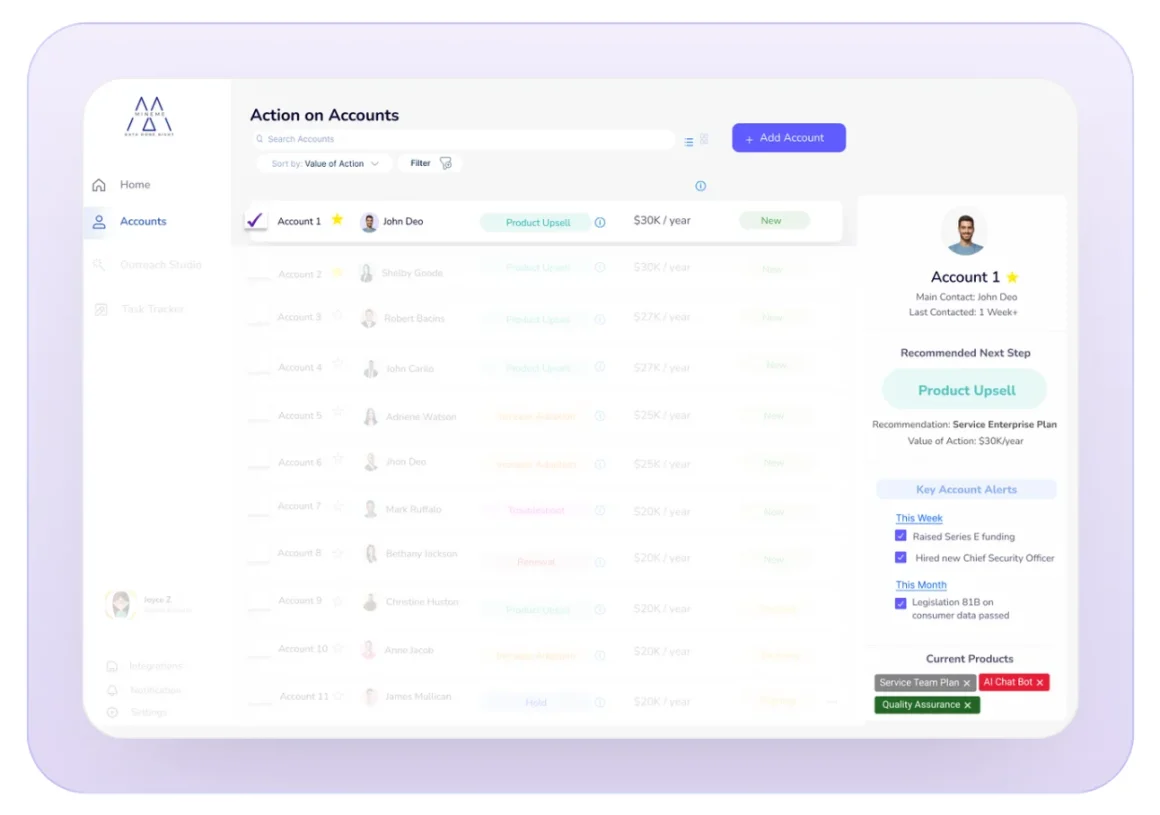
The CS leaders who close that gap first won’t just see lower churn. They’ll find themselves having fundamentally different conversations: not “here’s how you’ve been using the product this quarter,” but “here’s what we noticed in your business, and here’s how we can help.” That shift changes the entire nature of the relationship.
A team that monitors your product usage is a vendor. A team that watches your world is something much closer to a strategic partner.
And for Archana Somasegar, the real goal was never purely defensive to begin with. “NRR is an exceptional metric,” she says. “You want to reach your churn goals, but importantly, growth opportunity is critical.” A CS org built to earn that growth isn’t built on better dashboards. It’s built on paying attention to the right world.
Insights by Archana Somasegar
Archana Somasegar is the founder of MineMe, an AI-native customer intelligence platform that combines real-time external signals (funding rounds, executive hires, product launches) with CRM data to predict next-best actions and surface expansion and retention opportunities for customer-facing teams.