Written by Lidia Vijga
Deep tech companies face a unique paradox: the harder the science, the longer the runway required before anyone can tell if it will work. The investors willing to fund that uncertainty are few, the milestones are non-obvious, and the playbooks from software startups rarely transfer.
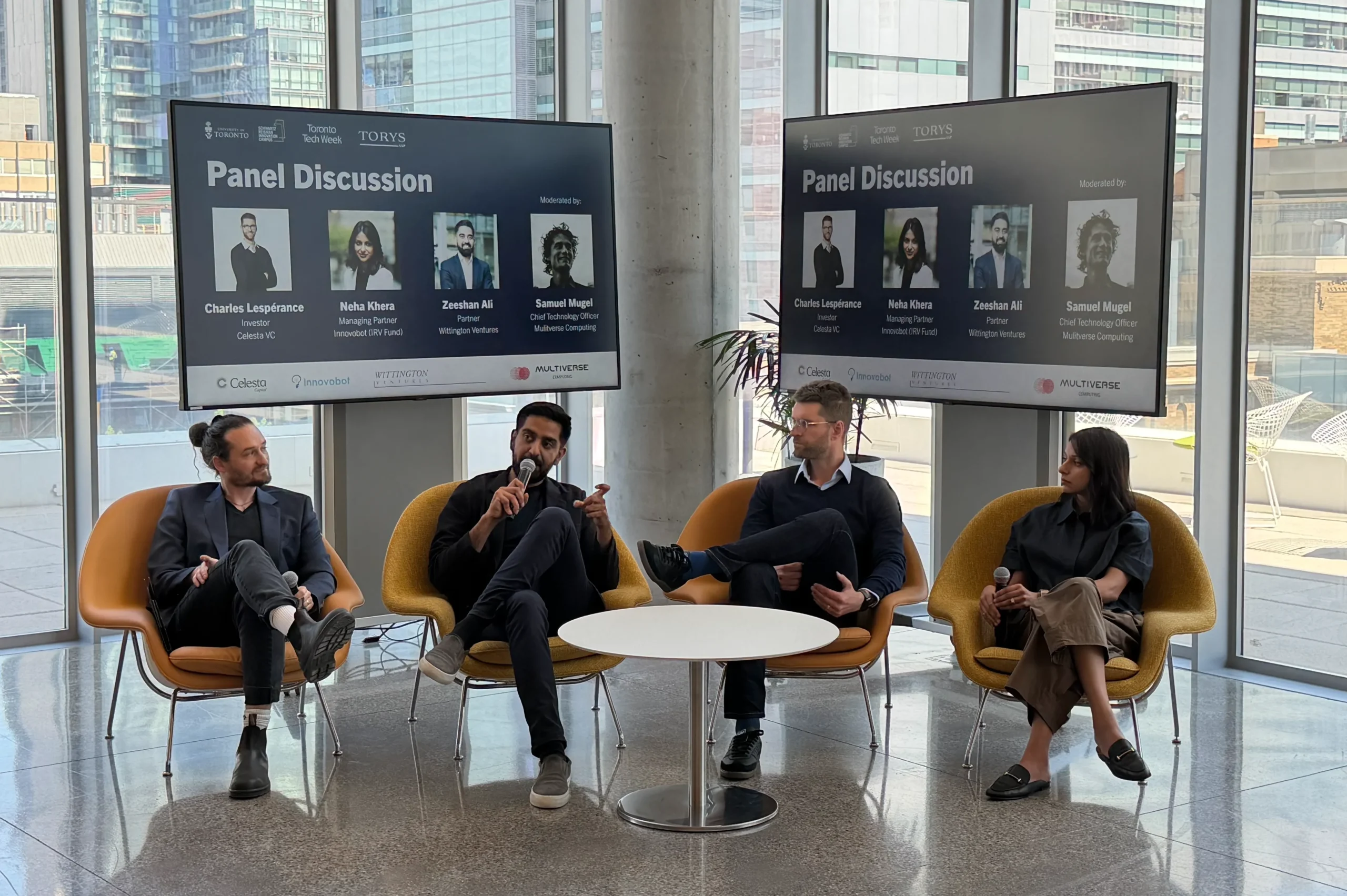
At a panel hosted at the Schwartz Reisman Innovation Campus, 3 of Canada’s most active deep tech investors shared what they actually look for, from first-check pre-seed bets through Series A.
About the Panelists


Charles Lespérance is a Partner at Celesta VC. He co-founded BDC’s $200 million Deep Tech Venture Fund, backing early-stage companies in quantum computing, AI, semiconductors, and robotics. He holds an MBA from Harvard and a mechanical engineering degree from McGill

Zeeshan Ali is a Partner at Wittington Ventures, leading the firm’s early-stage Innovation Fund focused on climate and healthcare deep tech. He was previously Managing Director of the MaRS Investment Accelerator Fund, one of Canada’s most active seed-stage funds.

Samuel Mugel is Co-Founder and CTO of Multiverse Computing, a quantum computing company. He holds a PhD jointly awarded by ICFO (Spain) and the University of Southampton (UK) and serves on the McKinsey Tech Council and Forbes Tech Council.
Where Capital Is Flowing Right Now
The framing that dominated the panel’s opening was a historical analogy: AI today resembles electricity in the early industrial era. The first wave of benefit was marginal, a 10% efficiency gain here, a lower defect rate there. The real transformation came when factories and processes were redesigned from the ground up with electricity built in. We are entering that second phase.
“Where we are right now with AI is sort of at that point — and so the broad category, what we can call ‘physical AI,’ is thinking: now that we know AI exists, how can we rebuild industries? How can we rebuild companies and processes from the ground up, acknowledging AI is just the way this thing can work.”
Charles Lespérance, Celesta VC
Capital is flowing into 3 overlapping areas:
- Physical AI and robotics — smart factories, autonomous systems, and hardware products that embed AI into real-world processes rather than sitting on top of them.
- Semiconductor and compute infrastructure — the architecture and memory innovations needed to handle increasing AI workloads.
- Defense and sovereign technology — geopolitics is creating a new class of first-buyer: nation-states with higher willingness to pay, longer adoption timelines, and a strategic imperative to fund hardware applications that would previously have taken too long to become venture-compatible.
The Wrapper Test: Separating Real Companies from Quick Builds
With so much excitement around AI applications, founders often ask whether what they’re building is a durable business or a thin layer sitting on top of someone else’s model. The panel offered a clean heuristic:
The Wrapper Test
If you need unlimited money to compete, you’re going head-to-head with OpenAI or Anthropic. If you can build it very cheaply, it’s probably a wrapper. The sweet spot is narrow: applications with concentrated or proprietary datasets, computer vision use cases where large language models lack an inherent advantage, and niche problems where the platform players won’t bother to compete.
Localization is one emerging thesis.
Neha Khera from IRV described a contrarian bet: while most investors are doubling down on data center growth, the cost of token inference is becoming prohibitive enough that distributed, on-device or regional AI becomes the more interesting build.
“Our thesis is actually swinging the other way. We think localization is going to start to boom. We think this whole concept of token maxing is going to become too cost prohibitive.”
Neha Khera, IRV / Innovobot
When Does a Project Become a Company?
For researchers and scientists considering commercialization, this is the first real decision point. The panel was clear that great science and a viable company are not the same thing, and investors see the full spectrum.
Zeeshan Ali from Wittington Ventures described 3 signals that separate a project from a company in formation:
- Founder conviction on a specific application — not just “this science is interesting” but “this is the exact problem I am building to solve.”
- Market signals in the ecosystem — a potential customer, a partner expressing intent, a regulatory opening, or some external proof that the application has pull beyond the lab.
- A founder psychology shift — the willingness to optimize for company building rather than the next publication. Speed, go-to-market, and team formation must displace the academic reward cycle.
Samuel Mugel, moderator and CTO of Multiverse Computing, offered a founder’s perspective: Multiverse operated as a non-profit association from 2017 to 2019, publishing research and conducting business development, before formally incorporating. By the time they raised capital, they had customers, a reputation, and a story that investors could validate — an unusually strong position for a company at that stage.
“By the time we decided to incorporate in 2019 we felt we had enough notoriety, we had the reputation and we had our first customers. So in 2018 we went through Creative Destruction Lab as one of the only startups there that had actual customers.”
Samuel Mugel, Multiverse Computing
Pre-Seed: What Gets Funded and at What Terms
Pre-seed in deep tech typically corresponds to TRL (Technology Readiness Level) 4 or 5 — meaning commercial trials have not yet begun, and the technology is still being validated in a controlled or simulated environment. Investors at this stage cannot de-risk the technology. What they are underwriting is the team and the application.
Typical Pre-Seed Parameters
- Raise amount: $1–$3M is the typical range for a Canadian deep tech pre-seed.
- Valuation: a $5M post-money valuation is a common reference point, though it can rise to $10M depending on team pedigree, market dynamics, and the defensibility of the IP.
- Founding Team: First-time founders skew toward the lower end. Repeat founders with track records can command a premium.
The Milestone Sizing Trap
One of the most practical warnings from the panel: do not raise an amount that is insufficient to hit a meaningful de-risking milestone.
“Don’t raise the money if you don’t think it’s enough to get to a substantial de-risking milestone — because you’re only going to get one shot at that. Some ideas just need $10–20M even to be spun out. Don’t raise $2M because you think that’s what you can raise if you know you need $20M.” — Charles Lespérance, Celesta VC
If your technology requires running a full mask set at TSMC on a two-nanometer process node, you cannot prove anything meaningful on $1.5M. Investors will not be able to evaluate you, and a failed pre-seed round is much harder to recover from than an adequately sized one.
What the Founding Team Must Show
The panel converged on complementary skills as the most important predictor at the pre-seed stage, but diverged on what that looks like exactly:
- IRV / Neha Khera: requires a strong commercial co-founder alongside the technical founder. Technical excellence is common; commercial vision and sales capability are the limiting factor.
- Celesta / Charles Lespérance: comfortable backing technical-only teams, provided the founders are willing and able to talk to customers. The iteration speed between engineering and sales is faster when the person who built the product is making the sale.
- Wittington / Zeeshan Ali: deep subject matter expertise from strong academic institutions is the baseline, with a preference for multiple founders over solo founders given the intensity of company building.
The common thread: the founding team must be able to raise capital, articulate a vision, set strategy, and engage customers. Whether that requires one person who can do all of it or two complementary people is fund-dependent — so founder-investor fit matters as much as team composition.
The Cap Table: Clean vs. Messy

A clean cap table at the pre-seed stage is a prerequisite for raising future rounds. The panel described what “clean” looks like, and catalogued the most common failure modes.
The Ideal Cap Table Structure
- Full-time founders hold the majority of equity, split in proportion to their actual time commitment.
- Academic founders who are retaining their professorships should receive smaller equity stakes that reflect their part-time involvement.
- University or institution ownership, if the IP is being spun out, should sit at 2–5% maximum.
- One legal entity containing everything — no consulting company, no IP holdco, no opco with a topco stacked on top.
- Standard legal documents: CBCA forms in Canada, or Y Combinator SAFE templates.
Red Flags That Kill Rounds
- Academic advisors owning majority of the shares while working part-time.
- Draconian IP agreements with royalty clauses that make the company’s economics unworkable.
- Venture studios taking 40–50% of equity in exchange for incubation support.
- Complex holding structures built without experienced startup counsel.
The Series A: The Hardest Round
Every panelist agreed: the Series A is the hardest raise, not because of market conditions, but because the bar shifts fundamentally. Pre-seed is a bet on people and potential. Series A demands that the gap between technology and product has been substantially closed — and that you can demonstrate it.
The Core Principle: One Risk at a Time
Celesta’s framework was explicit: at Series A, they are willing to take either technology risk or market risk, but not both simultaneously.
“By the time you come to us to raise a Series A, you need to have a really good sense for: once you’re done building your thing and you have production samples, who’s going to buy it, how much are they going to pay for it, what design slot is it going into, what are your margin details.” — Charles Lespérance, Celesta VC
Revenue is not required. But customer discovery is. There is a critical difference. You do not need to have made sales — but you must have done enough customer work that you know exactly what specifications you are building to, which customers will buy at what price, and what your supply chain will require. Discovering your customer’s actual requirements after you have already committed to a foundry or a material process can cost 24–36 months and be unrecoverable.
Why Deep Tech Series A Investors Are Hard to Find
The number of Series A investors globally who have deep tech — specifically hardware — as a core thesis is far smaller than the number of software Series A investors. The problem is that many software-oriented funds are beginning to expand into deep tech without changing how they underwrite companies. They still expect SaaS-style revenue metrics and ARR growth. Founders can waste significant time in these conversations.
- Know your investor’s actual thesis before a first meeting.
- If a fund evaluates your hardware company the way they evaluate a SaaS business, move on.
- Deep tech Series A investors will review patents, evaluate IP defensibility, and build views on technology timelines, not just revenue trajectories.
Canada vs. the US: The Incorporation Question
The question of where to incorporate — and when to flip to a US entity — came up repeatedly. The panel’s consensus was clear: stay Canadian early, and defer the US move unless there is a specific commercial reason to do it now.
Why Canada First

- Non-dilutive capital abundance. IRAP (Industrial Research Assistance Program) and SR&ED (Scientific Research and Experimental Development) tax credits provide one-to-one matching on private capital in many cases. Non-dilutive financing is the cheapest form of capital after revenue.
- CCPC status. Canadian Controlled Private Corporation status unlocks refundable tax credits, meaning the government writes you a check even if you have no taxable income. It also determines the tax treatment of employee stock options — a meaningful consideration for retaining early talent.
- Talent quality. Multiple panelists mentioned that Canadian technical talent in areas like AI, quantum, and semiconductors is genuinely competitive with top US markets.
“Non-dilutive capital is the cheapest form of financing. That and revenue. Leverage it. It is your friend. Don’t be so swayed by this US pull so early in your journey.”— Neha Khera, IRV / Innovobot
When to Access US Markets

The Series A or B stage is the natural inflection point. At that scale, money crosses borders effectively, the transaction friction is low relative to the capital involved. Accessing global investors at Series A or B sends a signal that you are not a regional champion but a global one.
The exceptions are commercial necessity — for example, US defense contracts that require an American entity with appropriate IP firewalls. In those cases, the move can happen earlier. But absent a specific commercial reason, the panel’s advice was to defer.
What’s Structurally Missing in Canada
The panel was candid about the ecosystem’s gaps:
- Dilutive capital is sparse.
There are approximately 9 dedicated deep tech investors nationally, a thin market for the volume of deep science being produced at Canadian universities. - No retail investor culture in startups.
Canada has world-class pension funds, but that capital is concentrated and conservative. Individual and retail investors are largely absent from the startup asset class. - Translational infrastructure.
The ability to move from proof of concept to pilot to adoption — particularly in regulated sectors like healthcare and climate — requires operator density, procurement pathways, and commercialization expertise that is more concentrated in Boston and San Francisco than in Canadian cities. - Foreign investment attraction.
The incentive infrastructure for attracting global capital to Canadian companies requires more deliberate effort.
7. Exit Pathways: What Actually Works in Canada

The honest answer from the panel: M&A exits within Canada are difficult, and will remain so for the foreseeable future. The industrial fabric of the country — heavily weighted toward resource extraction, financial services, and retail — does not produce a natural acquirer base for deep tech companies. The few Canadian corporations that could theoretically buy a deep tech company typically carry high debt loads and weak balance sheets.
The IPO path is more viable, as Shopify and Xanadu have demonstrated. Christian Weedbrook of Xanadu publicly described keeping his company incorporated in Canada through his entire fundraising journey — a choice that extended his timeline by at least two years, but preserved CCPC status and other structural advantages.
“Right now it looks like a really dire situation — can Canada actually build tech companies that are going to succeed? And then you zoom back a little bit and realize: at one point, Nortel was the seventh most valuable company in the world. There is no inherent reason we couldn’t do it again.” – Charles Lespérance, Celesta VC
The longer-term ambition, articulated by Charles Lespérance, is to build Canadian companies large enough that they become acquirers themselves — recreating the M&A ecosystem that existed around Nortel rather than perpetually exiting to US strategics.
8. The Investor’s Role Beyond Capital
At the pre-seed and seed stage in deep tech, the gap between what investors bring and what founders need is about more than money. The panel emphasized ecosystem value: introductions to customers, help with early hiring, and access to commercialization pathways that technical founders may not know how to navigate alone.
Wittington Ventures, through its connection to the Weston family foundation, can help portfolio companies access non-dilutive funding streams they would not otherwise find. Celesta’s semiconductor expertise means founders get supply chain advice that generalist investors cannot offer.
The practical implication for founders: when evaluating an investor, ask specifically what they have done for their last 3 portfolio companies at your stage — not what they claim to offer.
“Truly understanding what your investors’ ecosystem value is can really help founders think through their business as they’re scaling up at an early stage.”
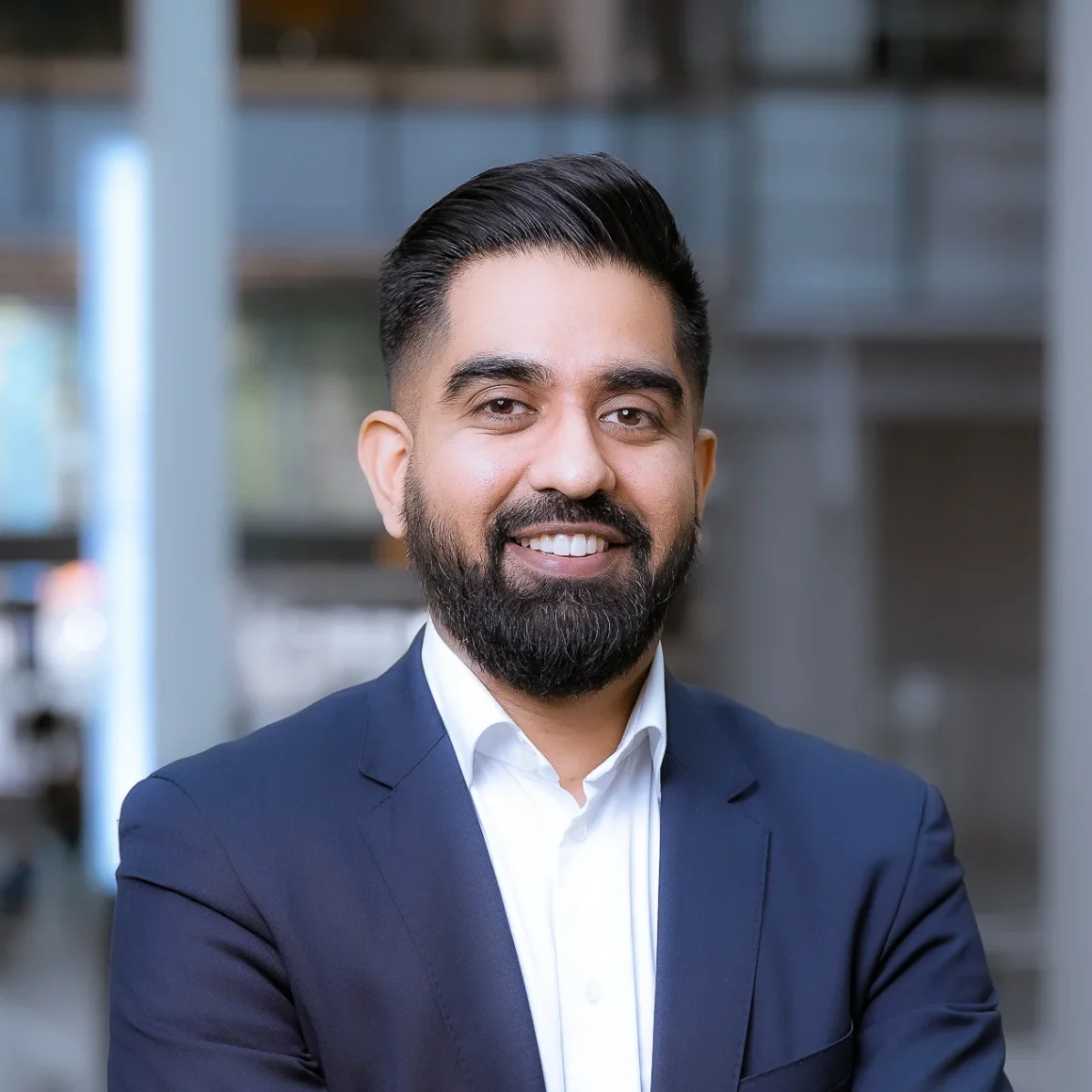
Zeeshan Ali, Wittington Ventures
One founder insight from the panel: a small, specialized fund that joined at the pre-seed stage — deploying a modest amount of capital — remained worth fighting to keep on the cap table through Series C because the board alignment was exceptional. Cheap capital from an aligned investor often beats expensive capital from a prestige name with misaligned incentives.
Key Takeaways by Audience
For Founders Building Deep Tech Companies
- Size your pre-seed to hit a real de-risking milestone, not just to survive the next six months.
- Clean your cap table before you raise — complex structures are nearly impossible to unwind after capital is in.
- Do customer discovery before Series A even if you are pre-revenue. Know exactly who will buy, at what spec, and at what price.
- Leverage Canadian non-dilutive capital (IRAP, SR&ED) aggressively. It is the cheapest financing available after revenue.
- Incorporate in Canada and defer a US flip until Series A or B, unless there is a specific commercial reason to move earlier.
- Match your investor to your company type. A fund that underwrites hardware like SaaS will waste your time.
For Researchers and Scientists Considering Commercialization
- Identify the specific application before incorporating. Investors are funding a problem to be solved, not interesting science.
- Part-time involvement is possible, but your equity stake should reflect your actual time commitment.
- Founder psychology matters as much as technical expertise. Optimizing for the next paper and optimizing for company building are incompatible at the same time.
- Consider using a non-profit or research entity structure for the first 1–2 years to build reputation and early customer relationships before formal incorporation.
For Operators in Technical or R&D-Driven Companies
- Deep tech companies are not software businesses with longer timelines — the KPIs, milestones, and investor expectations are fundamentally different.
- The gap between POC and adoption in regulated sectors (healthcare, climate) is one of the largest structural barriers in Canada. Operators who can bridge this gap are in short supply and high demand.
- If your company is approaching a US expansion decision, assess CCPC implications for your employees’ stock options before making the move.
For Investors Evaluating Early-Stage Deep Tech
- Pre-seed in deep tech means TRL 4–5: you are underwriting team and application thesis, not technology performance.
- Series A requires the de-risking of either tech risk or market risk — not both. Be explicit about which one you are taking.
- University spin-out IP structures vary enormously. Read the licensing agreements before term-sheeting.
- Canada has ~9 dedicated deep tech investors. The gap between supply and demand in dilutive capital is real and represents an opportunity for new entrants.