Written by Lidia Vijga
A record 63% of new startups are now solo, and everyone’s celebrating. The same report shows the median one earning less than a year ago. When anyone can build the same product in a weekend, shipping stops being the win. It goes to whoever takes the market first and keeps it.
Maor Shlomo built Base44 by himself, went from $0 to $1 million ARR in 3 weeks, grew it past 400,000 users, and sold it to Wix for $80 million about 6 months in, without raising a dollar. No co-founder, fewer than 10 people, sole shareholder. That’s the screenshot every founder saved this year, and the proof text for a genuinely huge shift: solo founders now make up 63% of the C corps formed through Stripe Atlas in Q2 2026, an all-time high.
That same Stripe post carries a second, quieter number. The typical solo founder, the one right in the middle, made 23% less in their first 6 months than the typical founder a year earlier.
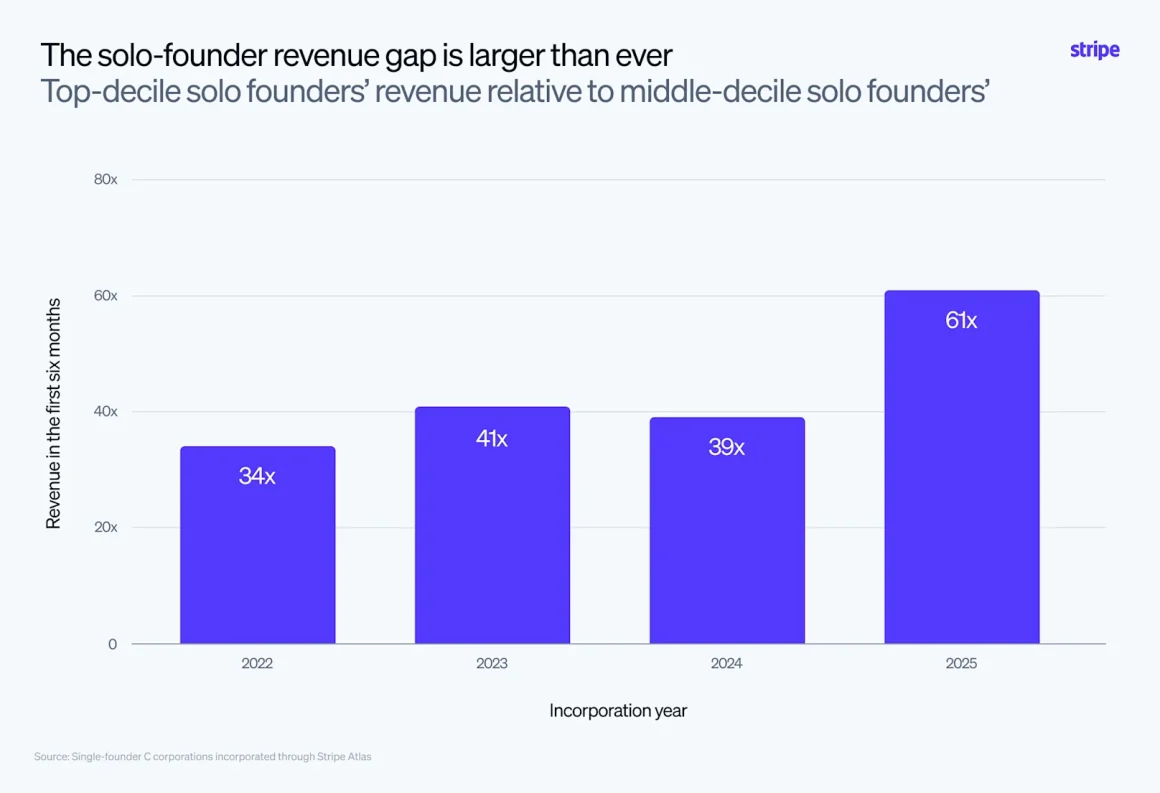
The top 10% made 19% more. So the money is splitting: the average founder is sliding while the best pull away, and the gap between them is the widest it’s ever been.
In 2022, the top solo founders made 34 times as much as the typical one in their first 6 months. By 2025 they made 61 times as much. The boom is real. So is the fact that most of the people inside it are earning less than solo founders did a year ago.
The number everyone screenshotted hides a second number
Most people share the 63% as a win for solo founders. Flip it around and it reads as a warning. If solo founders are 63% of new companies and the typical one is earning less, that’s not more opportunity to go around. It’s more founders fighting over the same customers: more people building, the same number of buyers, smaller slices for everyone.
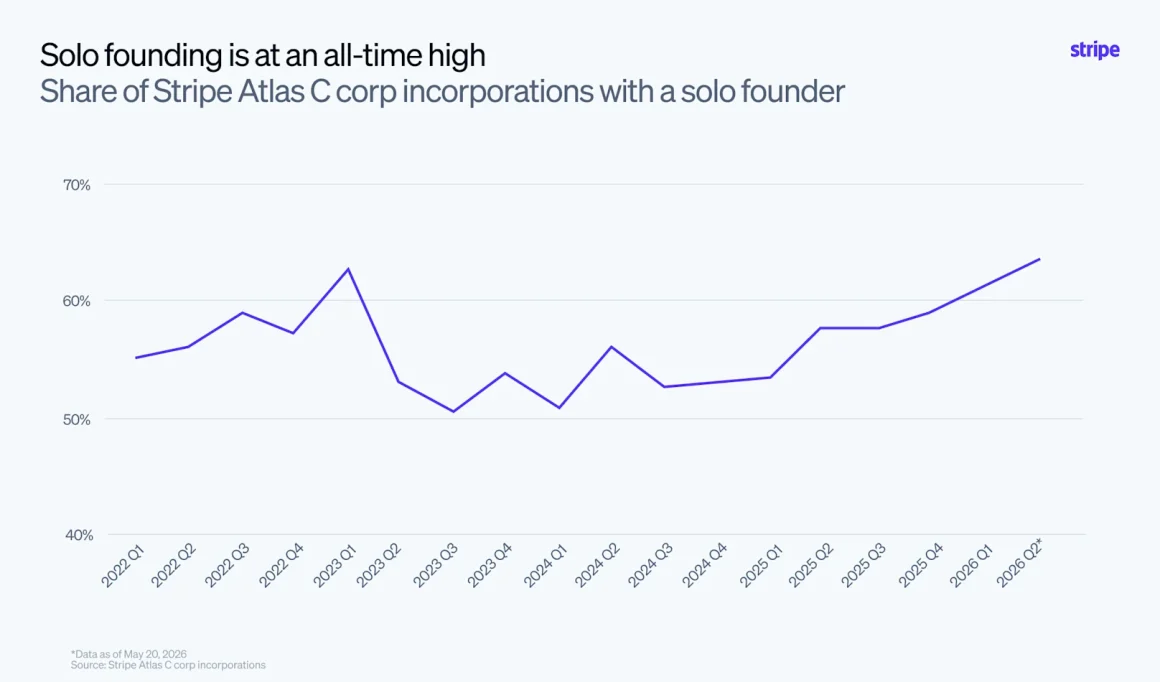
The good news and the warning are the same fact seen from two sides. When anyone can ship software in a weekend, “I built a product on my own” stops being impressive the moment 100,000 other people did it this quarter too. Building used to be rare enough to set you apart. Now it doesn’t.
When everyone is AI-native, AI-native stops being an edge
Stripe found top-decile solo founders were about twice as likely as median founders to build AI-native products, and the obvious takeaway is “go build AI-native.” Except the same analysis notes the AI-native advantage doesn’t come from a few breakout apps at the very top. It shows up across the whole distribution, from roughly the 50th to the 95th percentile. AI-native is table stakes now, not an edge.
Think about what that means for the weekend build. The tool that let you ship a working product in 2 days is the same tool a hundred thousand other founders used the same weekend.
The build was never going to be the moat. Marc Lou, who’s launched 35 startups solo, says: the next generation “will be no-code people focused on solving a problem, shipping crazy fast with AI, and cracking distribution on social media.” The moat moved. It sits in two places now, and the best founders grab both.
Speed wins the market
Base44 is a speed story before it’s anything else. Shlomo didn’t out-engineer the field. He got a rough product in front of people, found what worked, and captured a category in weeks: $0 to $1 million ARR in 3 weeks, 140,000 users in 7. By the time competitors had a serious answer, he’d sold the lead to Wix for $80 million.
When building is free, the first founder to reach real customers at scale gets a head start everyone else has to spend money to erase.
That head start is worth more in 2026 than it’s ever been, because it’s more perishable than ever. The clone that used to take a competitor 6 months now takes a weekend, so the window where being first actually means something is short.
You either use that window to grab share, sign customers, and become the default answer, or you lose it fine-tuning a product nobody’s tried yet
Shlomo used that head start to grab the market, then took the exit before the moat question even came due. Speed didn’t just win him the market. It won him the option to leave on top.
Brand keeps it
Speed opens the lead. It doesn’t hold it, and most founders aren’t exiting in 6 months. Something has to make customers stay when a cheaper copy shows up next Tuesday, and the most reliable something is a brand a competitor can’t fork.
Pieter Levels is that lesson stretched over a decade. He runs a portfolio that publicly reports around $3 million a year with zero employees, on a famously boring stack of PHP, jQuery, and SQLite.

What isn’t boring is the audience of roughly 600,000 he built over 10 years of shipping in public. When he launched Photo AI, it did a few thousand dollars in week one and grew to six figures in monthly revenue inside 18 months. The code was ordinary. The people who already trusted him were the whole engine, and they’re the reason a hundred identical AI photo apps never took his lunch.
Speed and brand aren’t rival strategies. They’re two halves of the same job. Speed wins you the market before the crowd arrives. Brand keeps you there once it does. Base44 leaned on speed and sold fast. Pieter Levels leaned on brand and keeps growing year after year. Most founders who want to still be here in 3 years will need both.
The playbook I’d run right now
The good news buried in Stripe’s data is that the winners aren’t winning on pure luck. They share habits you can copy today, and none of them require a bigger team.
- Ship before you’re ready. Base44’s first version was rough, and it still beat every polished product that shipped a month later. Getting real customers today buys you a lead that a better-looking launch next quarter can’t.
- Grab the biggest market you can, fast. Top-decile solo founders sold into an average of 10 countries in their first month, against 3 for the median, and international made up 51% of their revenue versus 2%. One person with a laptop has no reason to cap the market at their own zip code while a competitor takes the rest of the world.
- Pick a niche too small to attract 500 copies. Stripe found solo B2B founders earned more than 4 times the median revenue of solo B2C founders, and top solo founders were nearly 30% more likely to build for businesses.
- Build the audience so the lead sticks. Start posting your work, your numbers, and your reasoning now, even with nothing to launch. And yes, that means building an audience on X or making reels on Instagram if that’s where your customers are.
- Track retention above everything else. Nearly 30% of first-month customers came back the next month at top-decile solo startups, compared with 8% in the middle. Repeat customers are the cheapest growth you’ll ever get, and they’re the clearest sign you’ve built a lead a clone can’t casually take.
Win it fast, then make it stick
The boom didn’t do the hard part for you, and that’s the assumption founders keep tripping over. When building gets cheap, your edge has to come from what’s still hard: getting there first, grabbing the market, and earning the trust that keeps it.
And that’s the good news. Effort still wins, and the founders willing to put it in have a bigger edge than ever.