Written by Lidia Vijga
For most women building companies, the way fundraising actually works is rarely said out loud, something I came to understand while building and raising money for my own startup DeckLinks. It asks for a lot before you’ve raised a dollar. You need a warm introduction you probably don’t have. You’re also expected to fit a pattern (Stanford or MIT, ex-Google or ex-Meta, the second-time founder who already had one exit). And if money does come, it often costs you a board seat, a real chunk of your equity, and a timeline set by people who have never built anything themselves.
Plenty of good companies never get past that, not because the idea was weak, but because the door was narrow. AeQuitas Invest is worth paying attention to because it starts from the opposite premise, that almost none of that has to be the price of admission.
The Current State of Funding for Women
Women start nearly half of all businesses in the United States, yet startups led by women receive less than 2% of U.S. venture capital, according to PitchBook’s dashboard data.
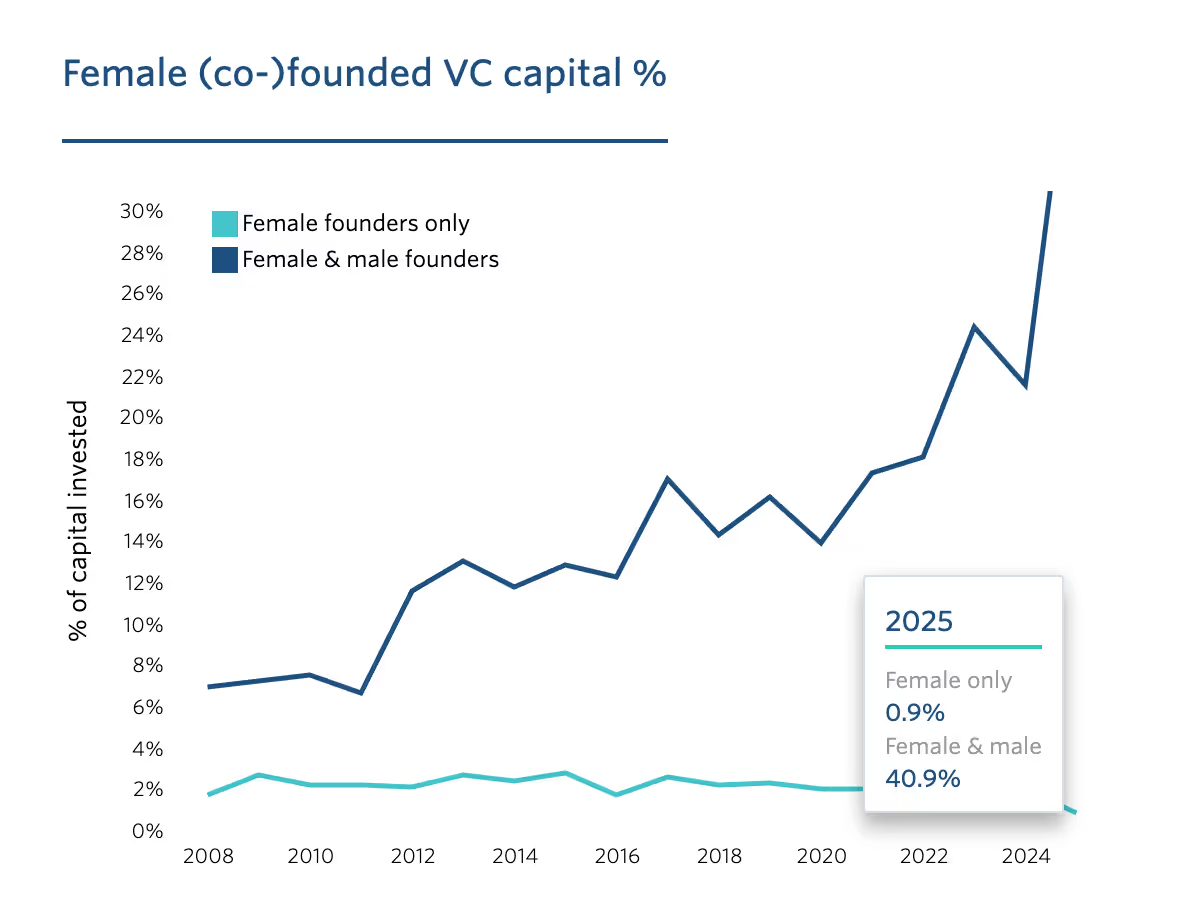
That is not a performance problem. Women-founded companies have been shown to deliver roughly 2.5 times better returns than male-founded ones, and women entrepreneurs earn 78 cents for every dollar invested, compared with 31 cents for men. The capital is simply not following the results.
“I built AeQuitas Invest because I believe the answer isn’t to fix venture capital from within. It’s to build infrastructure alongside it — infrastructure that expands who gets to invest, who gets to raise, and how capital actually flows.”

Molly Huyck, CO-Founder at AeQuitas Invest
A Crowdfunding Platform Built by Women, for Women

Launched in 2024 by former PayPal executive Molly Huyck and U.S. Navy veteran and marketing executive Amie Konwinski, AeQuitas Invest (known as AQi) is an SEC-registered, FINRA-member funding portal that lets women-led businesses raise capital directly from everyday investors through Regulation Crowdfunding.
It is, by the founders’ account, the only U.S. portal founded by women, owned by women, and exclusively serving women-owned companies.
The 5 myths that keep women from raising
In a recent conversation with Crunchbase News, co-founders Molly Huyck and Amie Konwinski laid out the case for the platform. For a founder weighing whether to even start, the most useful way to understand AQi is through the 5 myths they take apart.

Myth 1: “Raising from the crowd is just asking for charity.”
It isn’t, and the distinction matters. “Kickstarter and GoFundMe are for charitable gifting,” Konwinski said. “We are not asking for charity; we are facilitating investments.” On AQi, the people who back you become investors who receive equity, not donors collecting a tote bag. The platform sits in the same regulated category as StartEngine and Wefunder — but with economics tilted toward the founder. “On platforms like Kickstarter, you might only keep about 60% of the funds raised,” Konwinski noted. “Our success fee is only 6.5%.” For a founder, that gap is the difference between a campaign that funds the business and one that funds the platform.
Myth 2: “The $5 million cap means it’s not real money.”
Regulation Crowdfunding limits a raise to $5 million in any 12-month period, and founders often dismiss it as small. The founders push back hard. “I would challenge the notion that $5 million isn’t enough,” Konwinski said. “For many of the companies we work with, that is a strong runway for 18 to 24 months.” And because Reg CF allows rolling raises, the ceiling resets: a company can raise up to $5 million every 12 months, hit a real milestone, and then pursue a Series A from a position of strength. “We are here for those who get ‘ghosted’ by VCs,” Konwinski said, “or don’t want to leverage their homes to secure an SBA loan.”
Myth 3: “To raise, you have to give away control.”
This is the belief that costs founders the most, and it is where AQi’s model diverges most sharply from venture capital. “VCs often demand board seats, veto rights and up to 20% equity,” Konwinski said. “With us, founders usually give up only 5% to 10% equity, allowing them to maintain control of the company they built from the ground up.”
Myth 4: “A crowd of small investors will wreck your cap table.”
The fear that hundreds of small investors will clutter a cap table and frighten off future backers is handled structurally. “We utilize special-purpose vehicles,” Huyck said. “This consolidates all Reg CF investors into a single line item on the company’s cap table, often with a lead investor managing voting rights. This keeps the cap table clean.” In other words, you can open your raise to the public and still walk into a Series A conversation with a tidy structure and your authority intact.
Myth 5: “Without a VC breathing down your neck, you’ll lose discipline.”
The founders see it the other way around. “Women entrepreneurs are natural ‘hustlers’ who are inherently self-motivated,” Konwinski said, pointing to a base of Gen X founders balancing companies with families who have “developed an incredible ability to multitask and execute.” Discipline doesn’t require a director with veto power; it requires good counsel. “We encourage founders to bring on advisers rather than giving up board seats too early,” Huyck said. The same goes for the exit. Many women founders are mission-driven and have never been forced to think about one. “We provide the guidance to help them think through those horizons,” Huyck said, “so they can make informed decisions rather than being forced into a timeline by traditional VC pressure.”
Why women can’t wait for VC to change

Huyck doesn’t expect the venture world to fix itself. “I don’t see the VC space changing soon because it is heavily reliant on ‘pattern matching,’ where investors look for people and paths that resemble previous successes,” she said. “Until that breaks, women founders face significant barriers. Crowdfunding is a vital, viable alternative.” Her conviction is personal: two decades at PayPal, mentoring women through the Cherie Blair Foundation, where she learned of the $5 trillion gap in global GDP tied to women entrepreneurs’ lack of access to capital.
What AQi adds on top of the regulated mechanics is a hand to hold. The founders describe themselves as a “quarterback,” connecting entrepreneurs to accountants, lawyers and marketing firms, whether they are just starting or ready for a “glow-up.” “On many larger platforms, you are processed through an AI-driven, automated checklist,” Konwinski said. “We are building relationships, talking to our founders, and acting as their partner throughout the process.”
Where the AeQuitas Invest platform is now
The platform spent its first year building technology and six more months clearing SEC and FINRA registration — friction the founders wear as a badge, because it is what lets investors trust the marketplace. It now has a pipeline of 20 businesses, closed its first campaign in May 2026, and has more launching in the weeks ahead. For a founder who has been told to wait for a warm intro that never comes, the message underneath all 5 myths is the same: the door you were told to knock on isn’t the only door. This one was built for you, and it’s already open.