Written by Lidia Vijga
Joe Hu came to Canada barely able to trust his own spoken English. He did not wait until he felt ready. In 80 days, with no coding background, he built the AI examiner he needed. It is now used by thousands of learners, and it helped him finally pass the English test he had struggled with for years. Proof that you can build your own way forward.
I met Joe (Beiqiao) Hu at Toronto Tech Week. When I asked him what had brought him there, I braced for the usual founder answer, some polished version of “I built an app that.” Instead he said:
“I believe in serendipity.”
It stopped me. Not only the thought, but the word. Serendipity is a word I picked up only after 10 years of living and studying in Canada.
Joe Hu, Beiqiao Hu, still remembers the trick he used in primary school. When the English teacher asked the class to read vocabulary aloud, he did not know how. So he asked the classmate next to him to write the Chinese pronunciation under each English word, and he read the Chinese instead. He calls what he had back then “deaf and mute” English: he could squint at a word on a page, but he could not hear it and he could not say it.
That kid grew up to score 106 out of 150 on China’s national college entrance English exam, 469 on CET-4, and 426 on CET-6, and then quietly decided he was simply not a language person. When he thought about studying abroad as an undergraduate, the moment he pictured his English level, he gave up on the idea. He tried to improve after graduation. He says he failed every single time.
Today he lives in Ottawa, has spoken at more than 20 events around Canada, runs a company called Just Joe Technologies, and ships an AI product that tens of thousands of people use to practice speaking English.


Moving to an English-speaking country did not do that for him, and he is blunt about it. Living abroad, on its own, changed nothing. What changed things was building the tool he wished existed, then aiming it squarely at himself, every day. Serendipity, maybe. But the kind you have to build with your own hands.
Starting over, one word at a time
The restart came in 2020, at home during COVID. Joe went back to the foundations, vocabulary one word at a time, which felt faintly ridiculous for a grown man who read English on Twitter every morning and assumed he was basically fine. Then he sat a reading mock in May 2021 and scored 5.5. It took him 3 hours. Reading and listening came back with effort. Speaking and writing were a different category of difficulty. He had a full-time job, so he hired one-on-one tutors and bought himself some technique. In March 2022 he scored a 6.5 on IELTS, the number he had set as a private border: clear it or stay home. He still calls it one of the best days of his life.
Speaking would not let go of him, though. He got a school offer in 2023 and spent a good while quietly unconvinced he belonged. What finally loosened that doubt was not an exam. It was a trip to New Zealand, where eleven native speakers, one after another, told him his English was good. One American teacher said it was better than that of most Chinese speakers she had met. Something settled in him: his English was already enough for a real conversation. He filed his study permit.
“Living abroad didn’t magically improve my English. Dedicated practice did.”

The idea that arrived in the shower
Joe was already the type who builds his way out of a problem. He had wired up custom GPTs to grade his own IELTS reading and writing. Speaking, the part he actually needed, had nothing good behind it. Then in November 2023 OpenAI gave ChatGPT a voice, and Joe had the idea in the shower that would eat the next two years of his life: simulate the entire speaking exam, examiner and all.
He built the IELTS Speaking Simulator GPT that December and open-sourced it. His read on why it worked is sharper than it first sounds. A speaking exam ships with a rubric, which means the AI’s output has something concrete to be measured against, which makes the whole task an unusually clean fit for the technology.
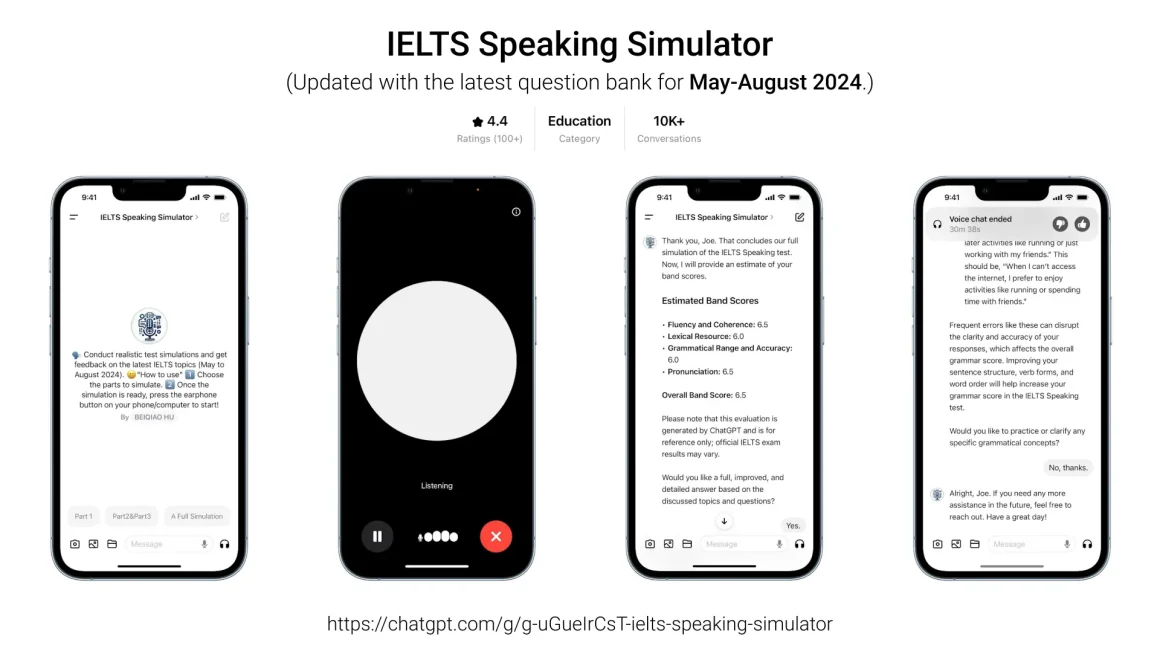
“Even hallucination is a feature, not a bug,” he says, and in this one corner of the world he is correct: an examiner that improvises fresh questions is simply doing its job. He used it daily, shipped a V3, posted it to RedNote, and watched it go viral. Over time roughly 50,000 learners ran on it.
He also caught the flaw that would quietly become his company’s entire thesis. After each session he copied the feedback into Notion, then never opened it again. Same topics, same mistakes, on a loop.
The problem, he worked out later, was never how much he practiced. It was how well.
Knowing when to quit, and when to wait
In August 2024 Joe landed in Canada for a master’s, and got a small pleasant surprise at the door: a classmate already knew his simulator GPT. Joe wanted to turn it into a real product and did not believe he had it in him, so he set himself a low bar, refresh the question bank each season and call that maintenance.
Then the model moved. OpenAI shipped a real-time voice API late in 2024, and Joe built a demo at an AGI Venture Canada hackathon.
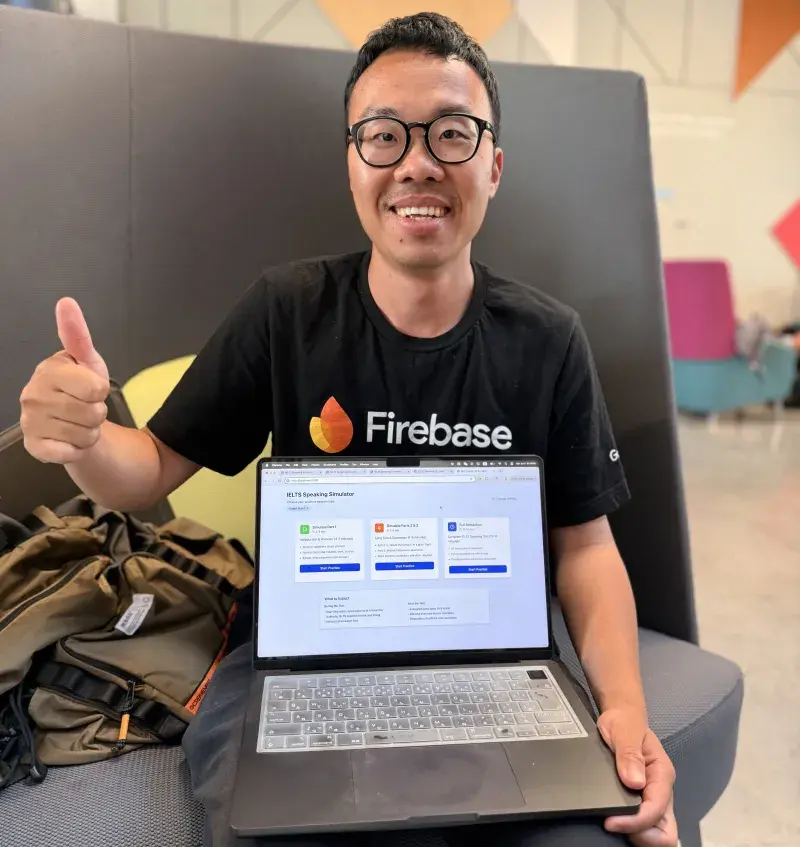
It worked, and it was expensive: a two-minute conversation cost more than $2. Worse, every time he fixed one bug, three new ones appeared, which is the specific suffering of building software while leaning on AI to write the parts you do not fully understand. So he stopped. On purpose. He decided to wait for better models rather than ship something he was afraid to touch.
Most founders would file that under failure. Joe filed it under timing, and timing turned out to be the skill that separated this attempt from the last one.
A trip to the Bay Area in mid-2025 handed him the line he kept repeating to himself: build something that belongs to yourself.


By then he had spent the year crossing from non-technical to genuinely shipping front-end work, first with Cursor, then with Claude Code. He flew home to Ottawa with a plan and a stack of free AI credits.
“The most important lesson: build something that belongs to yourself.”
Mark, and the two-minute report that became a company
The center of this story is not a model release. It is a man named Mark. Non-native English speaker who sounds native, former army officer, economist by trade, onetime United Nations employee, and, in his own words, a full-time grandpa and part-time citizen in action. They met before a networking event in Joe’s first month in Canada. When Mark heard that Joe wanted to get better at English, he started sending him voice messages and handed him a deceptively small assignment: report your day, out loud, in no more than two minutes.
Joe did it inconsistently at first. Last summer he committed, sending Mark a report every day and getting feedback every day in return. Mark even gave the habit a name to make it stick: Reporter Joe Speaking.
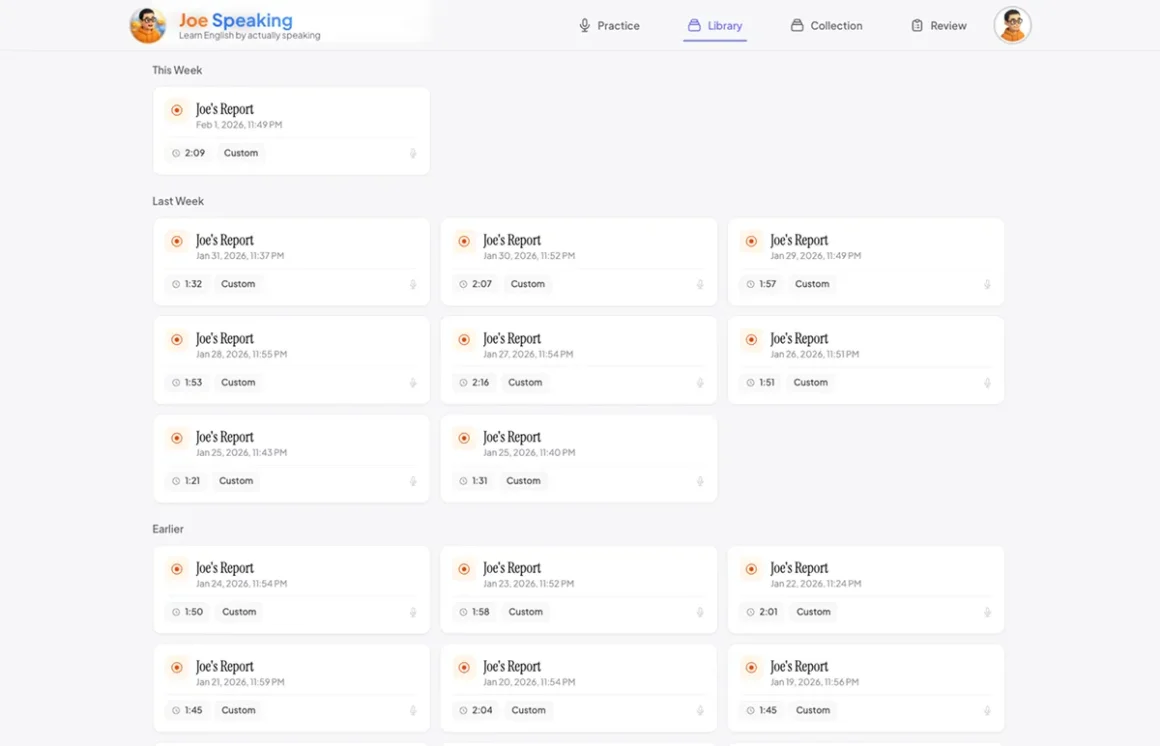
Joe often could not feel his own progress, but Mark and a mentor could see it, and more than any band score, he noticed he could now describe his own life without flinching. This, far more than the exam, is why the product exists. He wanted somewhere to keep his daily reports and get them graded. “If I hadn’t met Mark, I might not have built this,” he says. “Thank you, Mark.”
The pressure that turned a habit into a company was bureaucratic. Joe needed a CLB 9 to chase permanent residency after graduation, so he went back to practicing, even treating networking events mainly as speaking reps rather than for the networking. His score would not move off roughly 6.5. He got critical of the AI, went back and read the feedback properly, and conceded it was right.
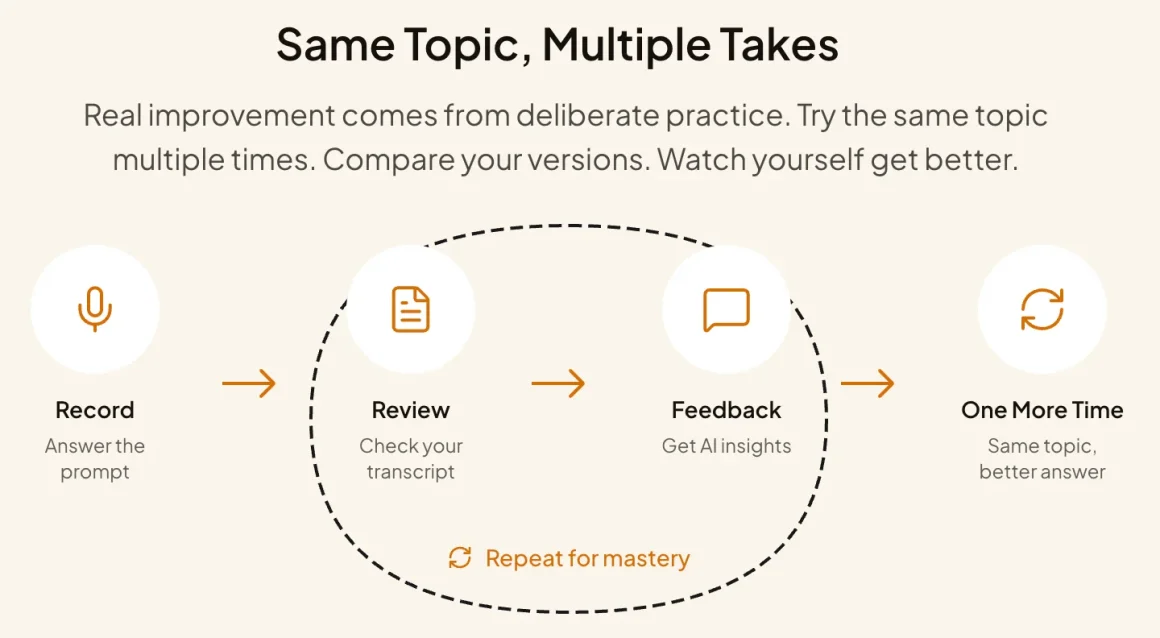
The weak link was him. He did not have the patience to run the same topic twice, or the stomach to listen back to his own voice. That admission became the product’s spine: feedback and repetition over an endless feed of fresh questions.
80 days to a working product
He folded the whole thing into his master’s research under professor Tony Bailetti at Carleton, and paired it with a scoping review of the actual learning science, mechanisms with names like interleaved practice and elicited feedback.

One project, several problems solved at once. He also made a clear-eyed case for why he was the right person to build it: an AI tinkerer who owned the exact pain and understood it from the inside.
He started building in mid-November 2025 on free Claude Code credits. When Opus 4.5 launched, it moved what he believed was possible, and he could suddenly see the thing shipping. When the free credits ran out he paid for a $200 subscription and has zero regret about it: without it, he says flatly, the product would not exist. The voice integration nearly broke him. He budgeted one week to wire up Gemini and spent five. His first 3 paying customers hit a brutal first impression, the connection dropping after ten minutes, and he made stability the only thing that mattered until it held.
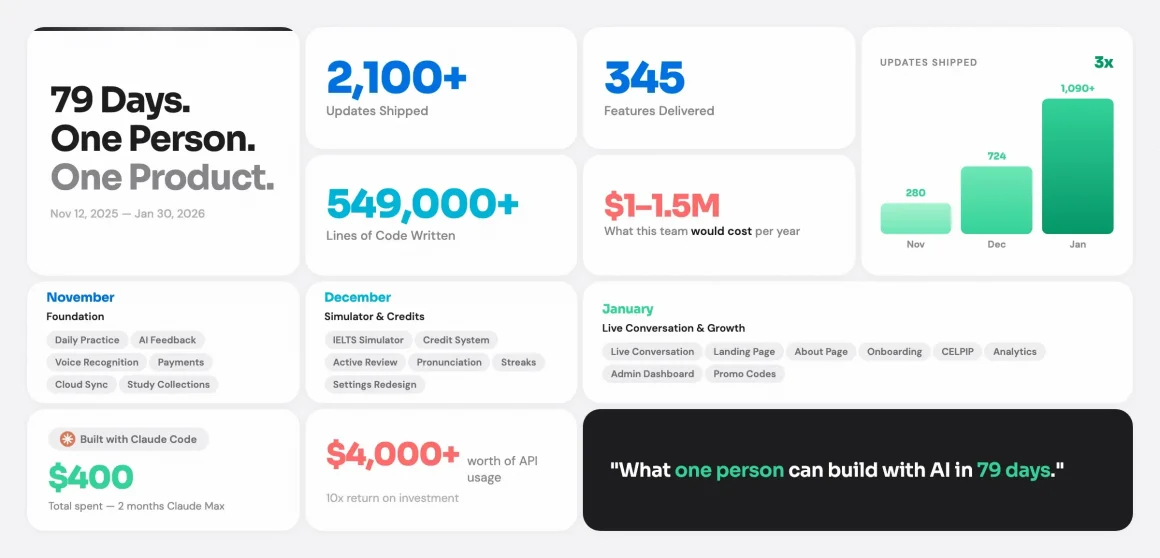
“I built this whole product in less than 80 days, by myself. It has bugs. But it’s something I couldn’t have imagined a year ago.”
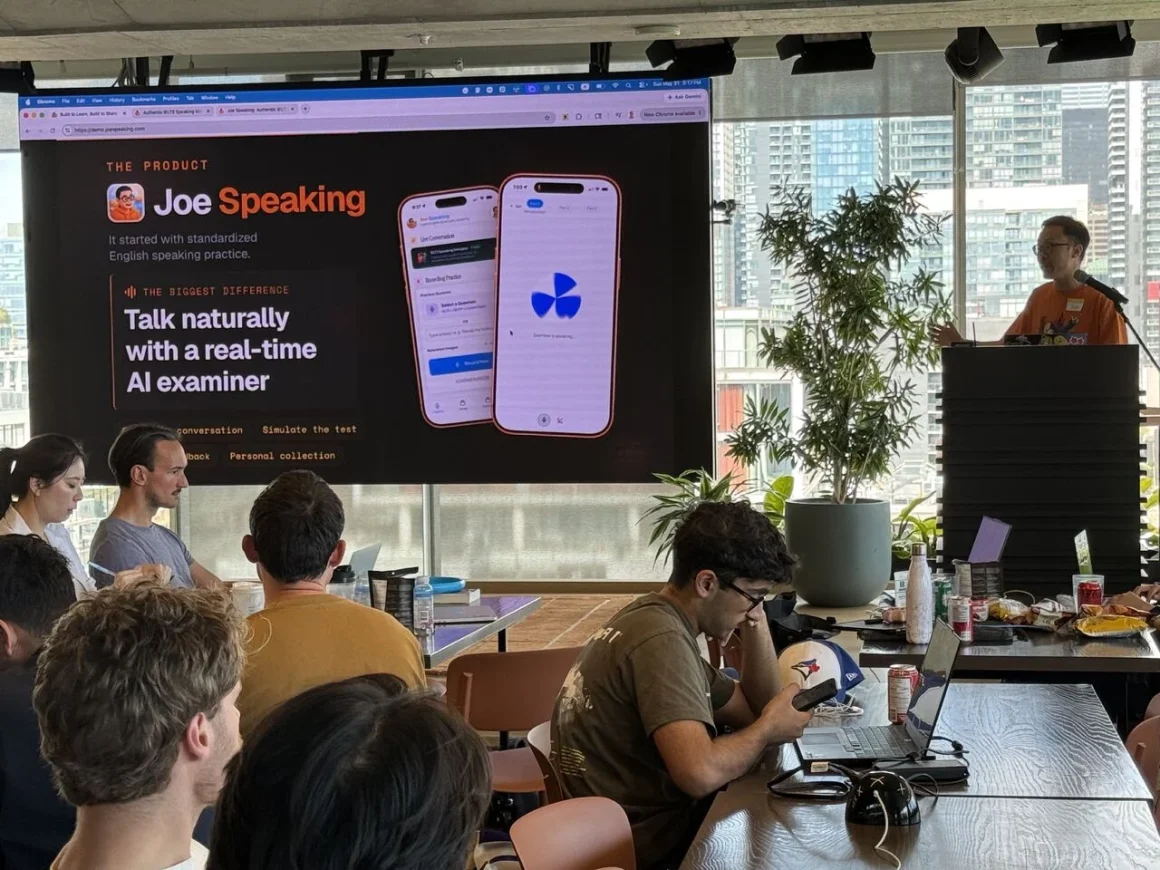
What came out the other side is Joe Speaking: a real-time AI examiner for IELTS and CELPIP that hands you a band estimate, a transcript, a replay, and section-by-section feedback for about a dollar a session, against the $25 to $60 an hour a human tutor charges.
Underneath the exam mode sits the habit Mark taught him, recording your day, reviewing it, running the same topic again, comparing the takes. It was enough of a business to put his name on real paperwork. He registered Just Joe Technologies, tagline included: Building What Was Impossible Yesterday.
The number he had chased for years
In May, after months of rehearsing on software he had written himself, Joe sat the test and scored CLB 9 on his first attempt, the number he had carried around for years. He refuses to treat it as a finish line. The real target, he will tell you, lives outside any rubric: saying what he means, clearly and without fear, so people understand both his point and who he is.
That is the part worth sitting with. He still says his English is far from great and his app is firmly in alpha. He is not selling a tidy before-and-after. He is selling a method, and he happens to be its first and most honest test case.
What builders can learn from Joe
Be the market, not its observer
Joe never surveyed learners. He was the learner, which is exactly why he could feel it when the product was lying to him. That kind of judgment cannot be outsourced; it comes from needing the thing yourself.
Run on your own software
He practiced on Joe Speaking daily and earned his score with it. Using your product as its harshest user surfaces the truth faster than any round of customer interviews.
Ship the rough version in public
The open-sourced GPT was raw, and it still built him an audience of tens of thousands who were already waiting when the real app arrived. Those RedNote likes were also the fuel that kept him going on the hard nights.
Treat quitting as a tool
He walked away from the 2024 build on purpose, because the models were not ready, then moved the moment they were. Knowing when to wait is not the opposite of ambition.
Aim past the score
The line he borrowed from Mark runs under everything: it is not your band score that matters, it is how clearly you can say what you think and how confident you are while you say it.
“Language is for communication, not perfection. It goes beyond the test.”
Sell the loop, not the feature
His own bad habit, practicing without ever reviewing, told him where the value was hiding. He bet the company on repetition and feedback rather than on streaks and badges.