Written by Lidia Vijga
DayOne, a maternal-health team out of Montréal, can fit its entire pitch in one hand: a $5 kit that screens a pregnancy with no lab, no power, and no signal. But the kit isn’t the business. The real company is the infrastructure behind it, and spotting that gap between the object and the operations is the smartest move an early founder can replicate.
A midwife unzips a canvas bag on a dirt road, 2 hours from the nearest clinic. Inside is everything she needs to catch a pregnancy that’s about to turn dangerous: a blood pressure cuff, a urine dipstick, a glucose reader, a hemoglobin card, a thermometer. No lab. No power outlet. No signal. The whole thing costs $5.
That kit is DayOne, a maternal-health startup that came out of Montréal’s Coopérathon. Except the kit isn’t really the company. It’s the part you can see. The company is the part you can’t. What DayOne is really building is the system that carries that kit down every road a hospital never reached.

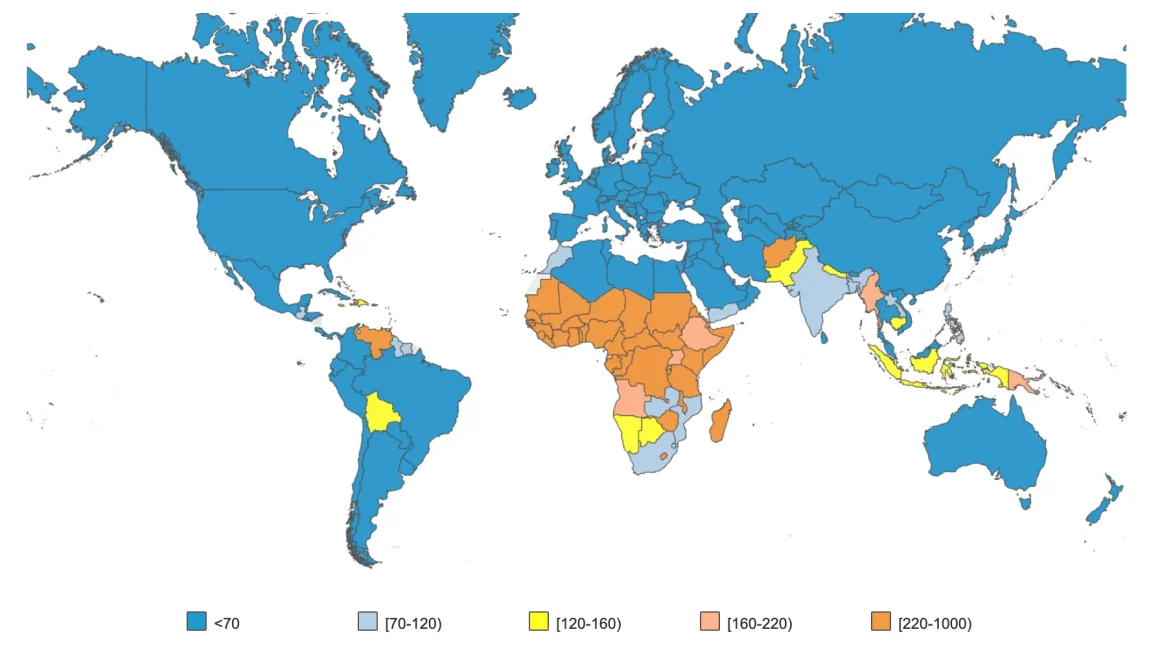
The scale of the problem DayOne is aiming at is staggering. In 2023, an estimated 260,000 women died from pregnancy or childbirth, one every 2 minutes, and nearly 70% of those deaths were in sub-Saharan Africa. It’s not only a Global South story either: more than 1 in 3 U.S. counties is now a maternity care desert. Most of these deaths are preventable with screening that already exists.
As DayOne’s own executive summary puts it:
“Innovation is not invention. It is the integration of what is already proven.”
The tools work. Getting them to the women who need them is the hard part.
So DayOne built a kit. And then it did something most first-time founders forget to do: it figured out that the kit was bait, and the business was everything the kit couldn’t show.


Entry point, product, network effect
Once the anchor lands, the real question is what you’re actually building underneath it. DayOne answers this in one line in its executive summary, and it’s the most quietly sophisticated sentence in the whole document:
“The kit is the entry point. The implementation system is the product. The data infrastructure is the long-term network effect.”
1. The entry point is the thing people can hold.
This could be the kit, the dongle or a free tool. Its only job is to make an abstract promise concrete and get you through the door. It doesn’t have to be where the money is, and it usually isn’t.
When Jack Dorsey and Jim McKelvey started Square, the wedge was a little white card reader he gave away so anyone could take a credit card on a phone. The dongle was the entry point.
Nobody built a $100 billion company selling dongles.

2. The product is the infrastructure that does the real work.
For DayOne, the kit is the hook, but the product is the implementation system: the training, the standardized workflows, the referral logic, the interoperability that makes a Ministry of Health actually able to run the thing at scale.
Look at Toast. It got into restaurants on hardware, the tablets and terminals you see on the counter. But in the third quarter of 2024, hardware was just $49 million of its $1.3 billion in revenue. Financial technology, mostly payments, was $1.07 billion, about 82%. The terminal got Toast onto the counter. The software and payments underneath are the company.
3. The network effect is the part that compounds.
This is the layer nobody can copy once you have it, and the one you have to design from the start even though it pays off last.
DayOne calls it the data infrastructure: every screening generates clinical data in places that never had any, and that anonymized, aggregated dataset gets more valuable with every kit deployed.
When the technology is ready but the system isn’t

In most hard markets, the technology was never the bottleneck. DayOne says this in its executive summary. Countless maternal-health pilots never scale, the team writes, because “implementation, not technology, remains the limiting factor.” The tools already work. Getting them to function inside a real health system is the part nobody designs for.
One Laptop Per Child is the cautionary version. The project shipped millions of rugged $100 laptops to schools across the developing world, a genuine hardware breakthrough.
Then a large evaluation of the program in Peru found no measurable gain in math or language test scores, because the laptops barely changed how teachers taught. The device worked. The implementation around it never existed, so the impact didn’t either.
The lesson did get learned. When Uruguay put the same XO laptops into the hands of every child in its public schools, it treated the rollout as an implementation problem first.
🚀 Así comenzamos la implementación de la mano de @fztorg, quienes no solo han capacitado a los docentes, sino que ahora inician la etapa de acompañamiento para asegurar el mejor aprovechamiento de la tecnología.
— OLPC (@OLPC) March 14, 2025
💻 ¿Quieres conocer más sobre las computadoras y sus… pic.twitter.com/qvytGgenig
Plan Ceibal, launched in 2007, wrapped the devices in dedicated support teachers, free internet in every school, and a digital library of curriculum, and it reached every primary student in the country. Same laptop, and this time a program that stuck, because someone finally built the system around it.
Don’t fall in love with the wedge
The failure mode is falling in love with your own entry point. It’s the most lovable layer, it’s tangible, it demos beautifully, it’s the thing people compliment. And it’s usually a commodity. Anyone can source a blood pressure cuff and a glucose reader. If DayOne were only a kit company, it would be in a price war within 18 months, competing on the cost of components it doesn’t manufacture.
The kit’s value isn’t the hardware. It’s that the kit is the only part of an implementation system you can point to.
Toast could have stayed a hardware vendor and been crushed by cheaper tablets. Square could have stayed a dongle maker and been copied by every payments processor with a plastic-molding budget. Both survived because they treated the tangible thing as a doorway they walked through, on the way to something bigger.
For founders, the discipline is to keep asking which layer a given decision serves. Are you improving the entry point because it moves the business, or because it’s the fun part to polish?
DayOne’s founders clearly know the answer. Their own words demote the kit to “entry point” while calling the invisible system “the product.” That’s an unusually clear-headed and self-aware thing for an early team to write down, and it’s the tell that they understand what they’re actually building.
Figuring out the layers this early is ordinary, essential founder work, and most teams do it a year too late.
The Takeaway: Find your $5 kit
If you’re building something abstract, and most interesting companies are, you have two jobs that feel like opposites. Make it tangible enough for a stranger to hold in their head, then remember the tangible thing is only the doorway. The house is everything behind it.
Find your $5 kit: the one concrete object, screen, or 7 lines of code that makes your invisible promise real. Lead with it everywhere. Then build the product behind it that people actually pay for, and design the data or network layer that compounds while you sleep.
DayOne turned a maternal-health infrastructure company into something you can carry in a backpack. Whatever you’re building, there’s a version of that kit waiting to be found, and finding it is the difference between a company people understand and one they merely nod along to.