Written by Lidia Vijga
Tom Pischel didn’t move to a big city to chase his startup. He stayed in Erin, Ontario, and built for the people already on his street. The town is the strategy, and it’s a moat most founders overlook while chasing bigger markets.
One rural says it all: “Road grooming ran past our driveway and nobody told us when. We found out when we heard the plow.” That line sits on the LocalXP homepage, and if you’ve ever lived somewhere small you already know how this feels. The closure, the detour, the farmers market that moved: the information existed, it just lived somewhere in a Facebook group, in a thread you weren’t in.
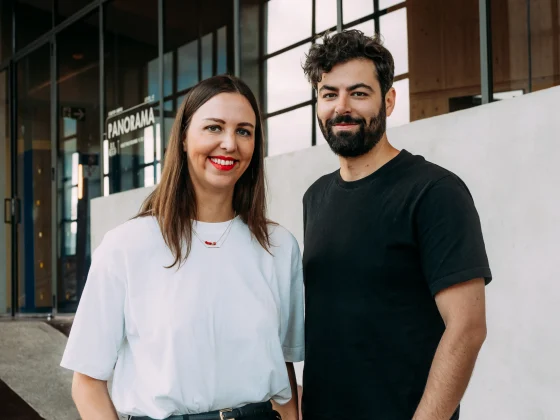
Tom Pischel lives in that reality. Erin is a town of 11,981 people in Wellington County, rural, about 80 kilometres northwest of Toronto and close enough to the Kitchener-Waterloo tech corridor to feel the pull of it.

When a December storm hit, Pischel watched his neighbours coordinate across scattered posts and group chats, and he decided the scatter itself was the problem. As he told the Wellington Advertiser in January 2026, important local information “is often scattered and difficult to follow in real time.”
Most founders would file that under “annoying” and move on. Pischel filed it under “build.”
The web designer who kept building for his neighbours
Watch this founder for the lesson in his track record: LocalXP is his third swing at this problem, and each one got sharper.
Tom Pischel is a front-end designer with about 6 years of product experience. His first project, Dwellcome was an app that helped newcomers to Canada find community resources like halal butchers and daycares.
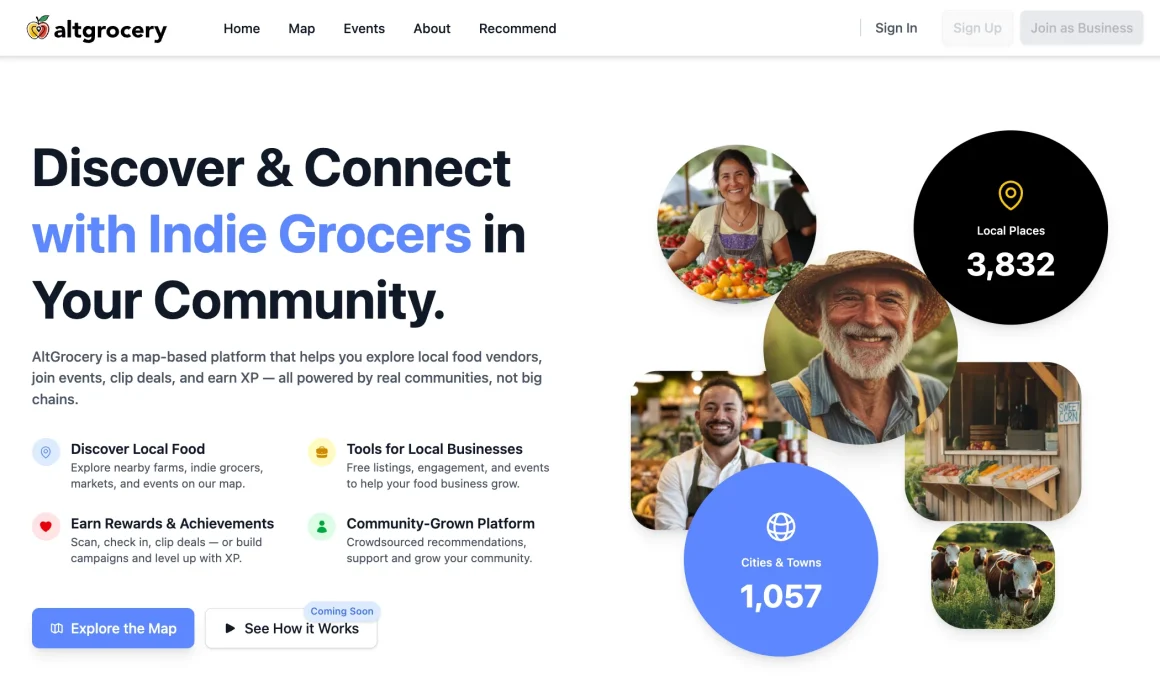
Then in May 2024 he launched AltGrocery, a free map of thousands of independent food businesses across Canada: farmers markets, local grocers, distilleries. He built it in two weeks after watching the “Loblaws Is Out Of Control” boycott flood Reddit and noticing there were, in his words, “no directories for those looking for alternatives to well-known grocery chains.” He kept it completely free, both for the businesses listed and the people using it.

Notice the through-line:
- Newcomers who can’t find local services.
- Shoppers who can’t find local food.
- Residents who can’t find local notice.
Same founder, same instinct, 3 angles on one problem: community information is real, valuable, and badly organized.
AltGrocery even lives on inside LocalXP now, as one of the example map layers in the product. Tom absorbed the earlier work rather than abandoning it.
And that is the true signature of a founder who keeps returning to the same problem because he can’t ignore it.
The pivot from points to notice
The most instructive part of the LocalXP story is what changed between that January write-up and the product today.

The early version leaned hard into gamification. You’d earn points for visiting a business, attending an event, or helping a neighbour, redeemable for rewards like a free coffee.
Fun, sticky, and the kind of thing a designer loves to build.
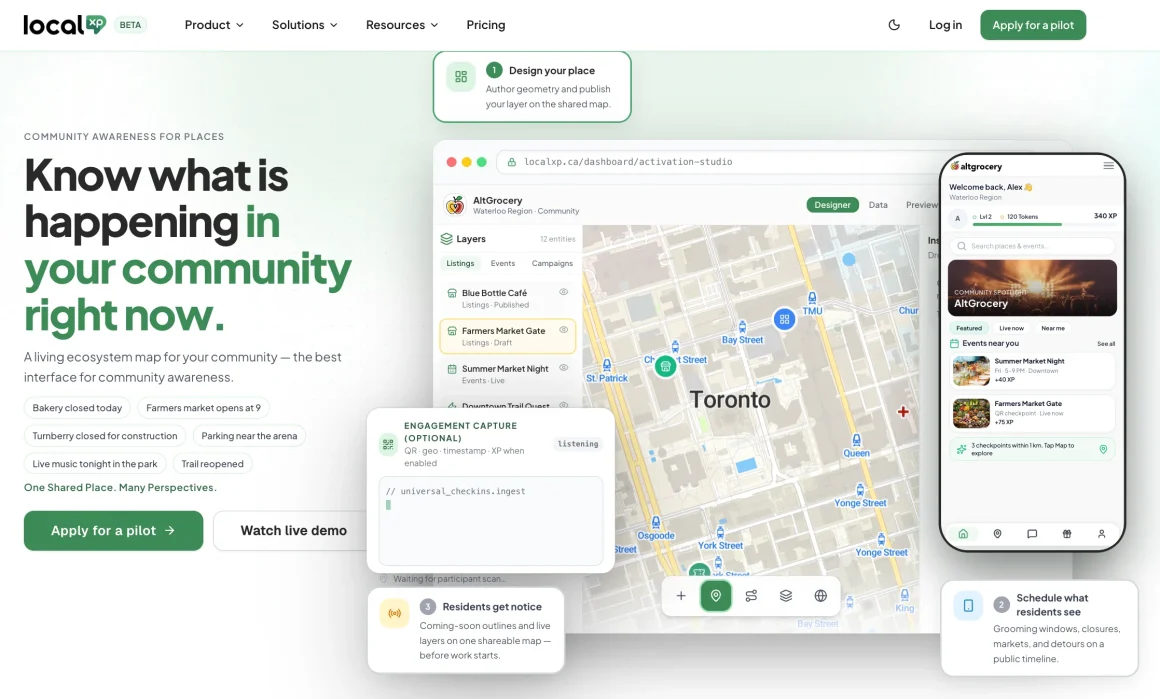
But somewhere between the storm and the current site, Pischel demoted it. The homepage now says: “XP is a single feature, not the platform,” and verified check-ins are “not the default experience.”
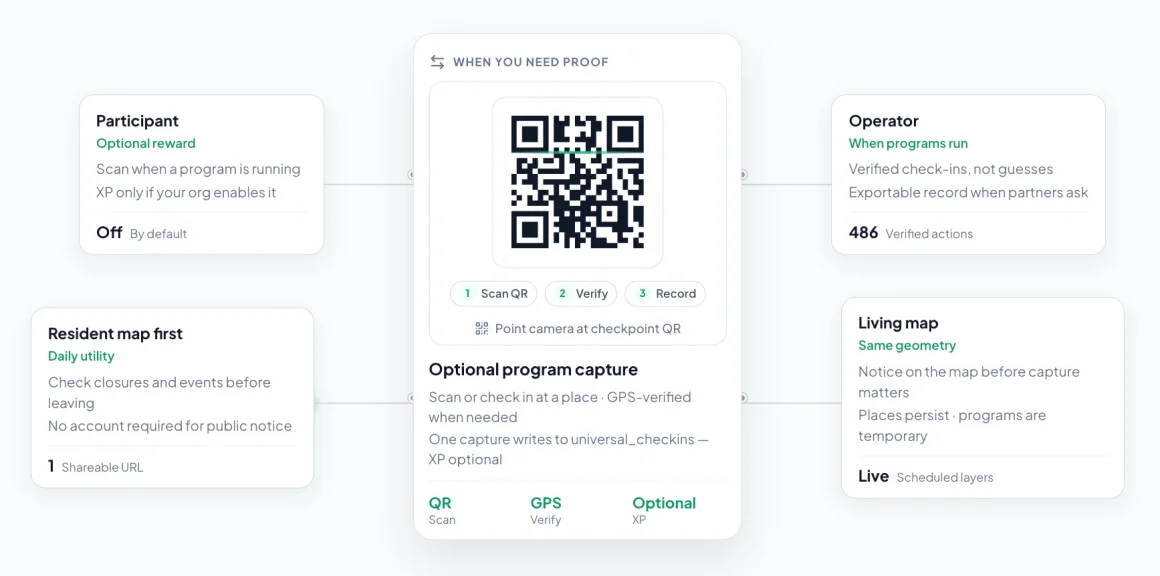
What moved to the center instead? Notice. Scheduled closures, grooming windows, market days, trail status, detours. The stuff residents need before they leave the house, rather than the stuff that makes an app feel like a game.
LocalXP now describes itself as “living community state: what is happening in your town right now,” and draws a sharp line against the incumbents: “Google owns navigation. Facebook owns conversation. GIS owns analysis,” and LocalXP wants the lane none of them defend.
That kind of restraint is rare, and it’s worth crediting. Pischel had a feature he clearly loved, the points and the rewards, and the maturity to set it aside the moment his community showed him what they really needed.
He shipped, he listened, and he let real use rewrite his plan. What the town wanted was simpler than a game: to be told what’s happening on its own streets.
Pischel had the clarity to hear that over his own clever idea, and the confidence to rebuild around it. Choosing the quieter, harder job over the fun one is the instinct that separates founders who serve a community from founders who just launch at it.
Why the small town is the moat

The instinct in startup land is to build for the biggest market you can describe on a slide. Pischel did the opposite, and it works in his favour.
Living in Erin means his feedback loop is literally at his front door. The municipal clerk who says “we post closures on Facebook, half the town never sees them” could be someone down the road from him. He can watch a program run, see what confuses people, and fix it by the weekend.
It also gives him a wedge the giants ignore. A town of 12,000 is too small for enterprise GIS pricing and too real to be served by a generic Facebook group. LocalXP is explicitly built to be “affordable for small communities and BIAs, not enterprise GIS pricing,” and it’s designed so a municipality, a utility, a business district, and a tourism group can each run their own layer on one shared map.
The design carries the same local logic. On LocalXP, one business keeps a single profile that can surface on the downtown map, the weekend market, a festival overlay, and a trail program at once, instead of rebuilding four separate listings. A bakery updates its hours once and stays current everywhere.

For a small main-street shop with no marketing budget, that’s the difference between showing up and staying invisible, and it’s the kind of unglamorous work you only think to build when the shop owners are people you actually know.
Bootstrapping this company also keeps him honest. Pischel funds LocalXP with rental income and paused his paid design work to build it, so there’s no investor clock pushing him to overstate the market or rush a launch. He can afford to get it right for one community before offering it to a hundred, and that patience is its own advantage.
The gap Tom is building into
The market case here rests on a documented collapse. Between 2008 and October 2025, 603 local news outlets closed across 388 communities in Canada, and only 264 new ones launched and survived. The local newspaper that used to run the closures, the market times, and the road work is, in hundreds of towns, simply gone.
Something has to hold that civic information, and right now the answer is “a dozen Facebook groups and a PDF.” That’s the vacuum LocalXP is walking into.
Rural towns like Erin sit right in the blast radius of that decline. When the shared source of “what’s happening here” disappears, the town doesn’t stop needing one. It just makes do with worse until someone builds a better one. Pischel is betting the better one is a map the community can trust and, crucially, own.
What this means for your startup
You don’t need a rural town or a mapping product to use what Pischel is doing. The moves are portable.
- Build for a problem you live inside. Pischel didn’t reach LocalXP through a survey. He found out the way his neighbours did, when the notice never came. Proximity to the pain is a research budget you can’t buy. If you’re solving a problem you only understand secondhand, get closer before you get bigger.
- Let users demote your favourite feature. Points were the fun part. Notice was the needed part. When real usage tells you the thing you love is the sideshow, move it to the side. The pivot from XP to notice cost Tom his cleverest idea and bought him a real one.
- Pick the market too small for the giants. A town of 12,000 is beneath enterprise pricing and beyond a Facebook group’s reach. That gap is a moat. Win the market the incumbents won’t bother to defend, then expand along the edges where you already fit.
- Bootstrap your way to conviction. Rental income isn’t glamorous, but it let Tom change his plan whenever he needed to, without investors pushing him to move faster than the work allowed. Money buys speed. Getting the first community right takes patience.
Start closer than you think
Tom’s whole approach fits in one sentence: live where the problem lives, ship to your neighbours, and let their real needs shape what you build. LocalXP is still early, with guided pilots running now and subscriptions opening soon, and whatever comes next, the way he got here is a playbook any founder can run. He turned a place most founders would drive right past into the one advantage nobody can take from him.
The best market research is a life lived close to the problem. You can’t outspend that, and you don’t have to. You just have to start where you already are.