
Written by Assel Beglinova
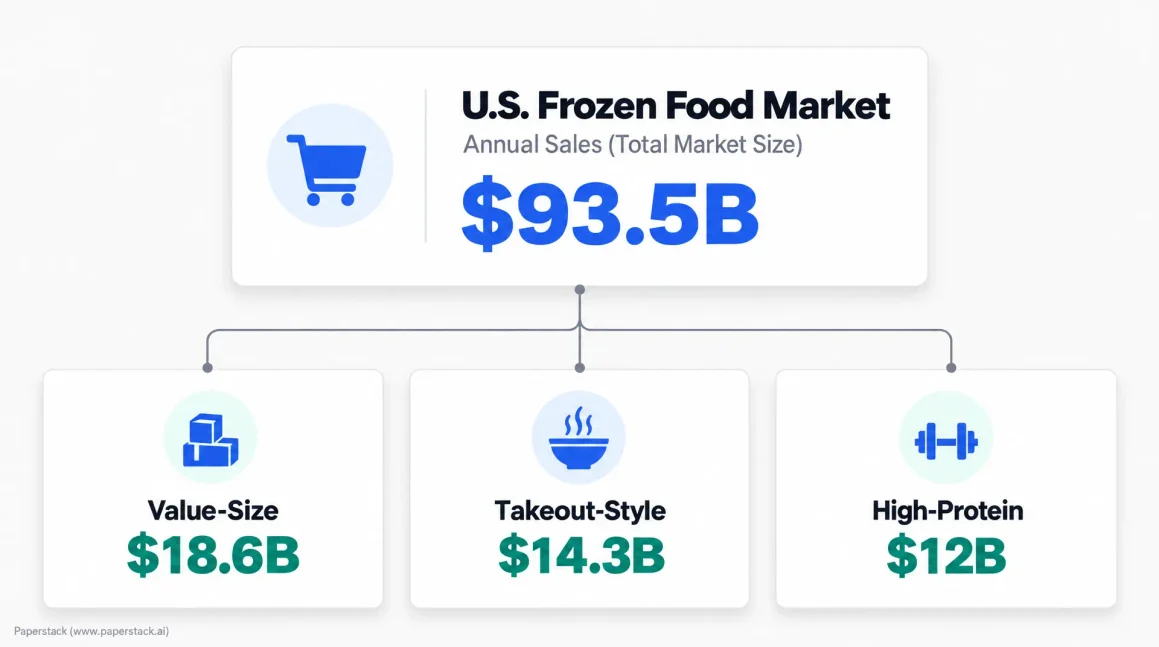
Conagra Brands’ third Future of Frozen Food report sizes the U.S. frozen food market at $93.5 billion in annual sales. It names four forces behind that growth: protein, restaurant-style food at home, family-style meals and breakfast at any hour. The report skips consumer surveys. It builds on Circana sales and consumption data, then adds on-pack claims, social trends and search. Observed sales are the kind of evidence I want brands judged on when they ask for capital.
Conagra posted nearly $12 billion in net sales in fiscal 2025, so it can absorb a slow launch or a stockout. A bootstrapped brand reads the same report from a very different cash position.
I finance consumer brands, so I read each trend as a cash flow cycle first and a product opportunity second. Each one changes when you pay your co-packer, how long product sits in a freezer, when your ads run and which channels your revenue comes from. If the capital behind a trend doesn’t match that timing, you pay for it in lost customers or lost ownership.
Key Takeaways
- Conagra Brands sizes the U.S. frozen food market at $93.5 billion in annual sales, driven by consumer demand for high-protein options, restaurant-style meals, family-sized portions, and anytime breakfast.
- Traditional commercial banks frequently decline loans for e-commerce brands generating $5 million to $7 million in revenue because reliance on third-party logistics creates an asset-light profile lacking physical collateral.
- Unexpected inventory stockouts reduce overall e-commerce profit margins by 20% to 30% due to the compounded costs of expensive air freight restocks and increased customer acquisition costs.
- Seasonal demand creates highly specific sales spikes, with Conagra data showing frozen game-day favorites selling 14% above weekly averages during the football postseason and potato skins rising 42% in February.
- Shopify’s standard U.S. revenue-based loans lack a remittance cap, meaning fast-growing e-commerce brands must remit double the daily cash when sales double, severely draining working capital during expansion.
- Value-size frozen products generate $18.6 billion annually and represent over 41% of frozen-aisle sales, requiring direct-to-consumer brands to expand into wholesale retail channels to capture family-meal demand.
- Asset-based lending typically advances up to 80% against eligible e-commerce inventory, but strictly limits borrowing capacity during peak seasonal sales when depleted stock shrinks the borrowing base.
Why Do Traditional Banks Decline Commercial Loans for DTC Frozen Food Brands?
When I worked in banking, I kept seeing strong consumer brands get declined. One was a DTC beverage brand doing over $3 million a year, with customers who loved it, healthy margins and steady cash flow. The bank saw no hard assets, because manufacturing was outsourced. It saw seasonal swings from summer demand. It also read marketing spend as an expense instead of a growth investment.
To a risk model built for factories and equipment, the brand looked unstable. Through a commerce lens, it had consistent sell-through, strong contribution margins and healthy cash flow timing. The bank’s model couldn’t see what I call cash flow quality, which is how predictable, well-timed and sustainable the money moving through a business is.
That systemic lending gap catches frozen brands too. E-commerce brands at $5 million to $7 million in revenue are often called too asset-light for a commercial loan. They rely on 3PLs and overseas manufacturing instead of owning collateral. A frozen brand running on a co-packer and a cold-storage 3PL owns just as little. When a bank does lend to a CPG brand, expect a personal guarantee, in-person appointments and months of waiting.
Covenants that require inventory on hand don’t fit either. The bank wants product sitting in the warehouse as collateral, while every week a pallet sits in your freezer costs you money.
The offers that show up after a bank says no can look cheap until you add up the total cost of capital. That means origination, underwriting and admin fees, wire transfer fees, and even fees for changing your bank account. Check the permitted use as well, because some providers only let you spend the money on marketing, or only on inventory.
What Are the Financial Costs of Inventory Stockouts for High-Protein Frozen Food Brands?

Conagra’s data puts high-protein frozen products at $12 billion a year, with volume up 11% in the 52 weeks ending October 19, 2025. Growth like that can outrun a production plan, and I consider selling out a financial failure. It’s like driving a customer all the way to your store, only for them to find out they can’t buy your product. From the outside it might look like a celebration, but inside it puts massive operational pressure on the team.
One wellness brand doing around $10 million had a marketing agency so efficient that inventory sold faster than anticipated. It had to order restocks urgently. It also paused every expansion into new channels, just to keep enough product for its core DTC customers.
When a brand sells out unexpectedly, it has to rush the restock through expensive air shipping and spend extra to win back disappointed customers. Together, that can take another 20 to 30% off overall margins. CAC climbs, often because community members feel left out when their friends got the product and they didn’t. You end up working twice as hard to get back where you were. Meanwhile, fixed costs like warehouse rent keep piling up with no revenue to cover them.
If ads are outperforming and draining inventory faster than planned, I’d slow down some promotions on purpose. You preserve the stock you have and make each sale more profitable, which helps cover the cost of expediting the restock. In the meantime, keep the community engaged and warm for the next batch to arrive. I advised an apparel brand to cut its promotional discounts during a supply chain delay. The higher margins let it afford to air-freight replacement inventory from a different manufacturer.
How Should DTC E-Commerce Brands Align Working Capital with Seasonal Frozen Food Demand?
Takeout-style frozen food is a $14.3 billion category, with families and younger shoppers driving its growth. A lot of that demand lands on specific dates. Conagra found frozen game-day favorites selling about 14% above their weekly average during the football postseason. Potato skins ran 42% above average in February 2025.
Dates like those raise the stakes on one of the most common cash flow problems I see in e-commerce and CPG. Revenue, marketing and inventory fall out of sync, even while sales look healthy. I’ve seen brands invest heavily in inventory ahead of demand and overlook the marketing. The product then moves slower than expected, and they end up running deep discounts just to free up cash.
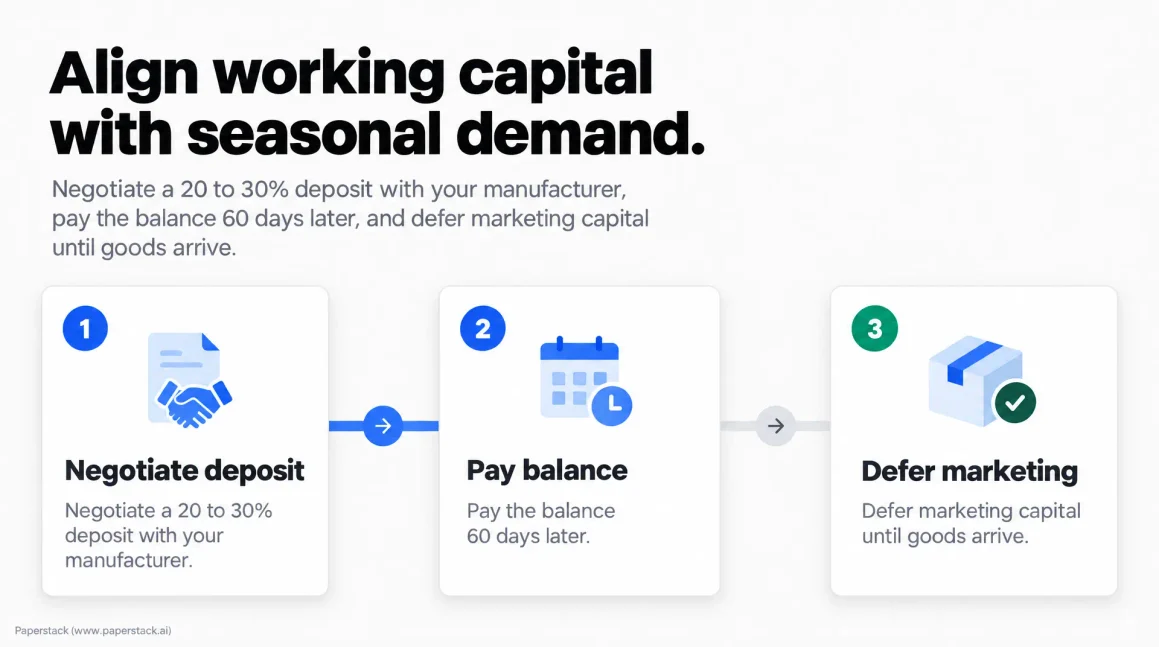
Your capital should run on the same calendar. Negotiate a 20 to 30% deposit with your manufacturer, with the balance due 60 days later or on shipment. Draw one tranche for the deposit and a second for the final payment. Hold back the marketing capital until the goods arrive. A corporate card with a 30- to 60-day float can carry the launch ads until the new stock is selling. If you won’t use capital in the next 30 to 45 days, don’t take it up front, because you start paying for it the moment you take it.
Just because your business qualifies for a million dollars doesn’t mean you have to take it all. One fast-growing brand took a $1 million loan when it needed $300,000, because it was approved and assumed growth would cover it. Its 25 to 27% daily sales remittance quickly doubled from $250,000 to $500,000, and it paid heavily for capital it wasn’t using. Compare that with a $10 million apparel brand where I structured a facility of slightly over $1 million. Only $300,000 went out immediately, and the rest was deferred for 60 to 90 days. That saved the business from carrying unnecessary capital costs.
Before you push ad spend into the postseason, do the math I’d want before Black Friday. Work out the minimum ROAS that still gives you a profitable sale, and check whether the spike in CAC leaves room for net profit.
How Does Revenue-Based Financing Impact E-Commerce Cash Flow During Seasonal Revenue Spikes?
When demand comes in waves, I prefer repayment tied to a percentage of actual sales. If sales go up, you remit more, and if they go down, you aren’t stuck stressing over a fixed payment. One $10 million snack brand faced a summer cash crunch. For brands whose DTC sales lean on Q4, revenue-based financing or a B2B channel can offset that kind of seasonality. Business clients often agree to upfront payment terms and larger orders.
Percentage-based repayment has a weak spot on the way up. Shopify’s standard U.S. loans are repaid as a percentage of daily sales. I see their lack of a remittance cap as a major limitation for fast-growing brands. At 17%, the dollars you send back double when your sales double. That faster repayment drains cash right when growth needs it, so you get penalized for your own growth. Shopify’s early-access Capital account lets eligible users adjust their rate within set thresholds, so read the exact agreement you’re offered.
Ask any provider how the maximum remittance is calculated, and whether the minimum is sustainable in a slow month. You don’t want to pay a full month’s worth of remittance in the first week because the structure was too aggressive. When you negotiate a cap, your own historical data is your strongest evidence.
How Can DTC Frozen Food Brands Finance Multichannel Expansion Into Grocery and Wholesale Retail?
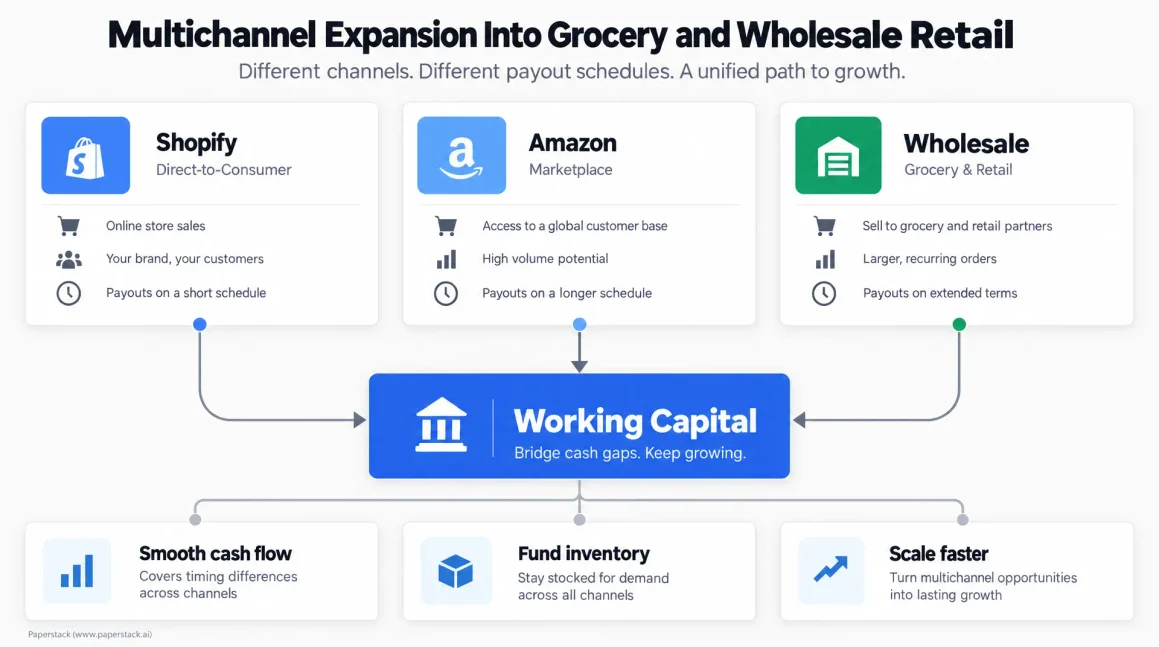
Family-style eating shows up in pack size. In Conagra’s numbers, value-size frozen products bring in $18.6 billion, over 41% of frozen-aisle sales, and grew 9% in three years. To win family dinners at that scale, a DTC brand will probably need grocery or wholesale, where cash arrives on a very different schedule than Shopify payouts.
One CPG brand I worked with had strong repeat customers, great margins and steady month-over-month growth, and it sold out every launch. It still kept hitting cash gaps. It paid suppliers 60 days before receiving inventory, then waited weeks for platforms like Amazon to release payouts. Its revenue was spread across Amazon, Shopify and wholesale. The other capital providers it tried would only underwrite one channel or offer factoring on wholesale orders. That left it juggling three or four lenders, each with its own repayment schedule.
Once its capital was based on the total performance of the business, it consolidated into one source and could focus on growth instead of juggling repayments. Around the same time, it faced a choice. It could say yes to a few strategic retail partnerships, or it could save inventory for DTC and cut marketing to conserve cash. With capital that saw the whole business, it could do both.
For a retail push, ask whether a provider counts all your channels. If Shopify is 30% of your business, a provider that only looks at Shopify misses 70% of your performance. A lender that only sees one channel can also panic when that channel slows, even while a retail launch is lifting the business overall. Also ask whether wholesale revenue counts when a draft order is created in Shopify, or only when payment lands in your bank account.
If retail becomes a big share of revenue, asset-based lending starts to fit. It typically advances up to 80% against eligible inventory and receivables. For a seasonal brand, the weak spot is the borrowing base, meaning the amount those assets let you draw. It shrinks as you sell through inventory in peak season, right when you need working capital most. One founder had a multi-million dollar limit and still couldn’t use it to rebuild stock after a busy season. Availability was tied to a percentage of their depleted inventory and receivables.
Should E-Commerce Brands Use Equity or Debt to Finance Experimental Frozen Food SKUs?
Conagra’s occasion data has frozen breakfast up 5% over five years, against 3% for frozen food overall. High-protein handhelds, bowls and breakfast sausage are gaining momentum, especially among Gen Z and Millennials who want convenience and flexibility at any hour. For a brand that already makes frozen food, a breakfast SKU is a natural extension. Until it has sell-through data, though, it’s an experiment, and experiments call for different money than reorders.
Non-dilutive funding works best for repeatable activities where you know exactly what things cost. That covers the inventory orders e-commerce brands typically place two to three times a year, and ad spend with a predictable ROAS. Equity was created for experiments like new products, new channels, specific hires and international expansion. It’s also the most expensive capital you can put into inventory.
One founder used venture capital for early inventory and owned less than 20% of the company while it was still doing a few million dollars in revenue. That left too little equity to raise the larger round needed to scale. Another founder at a similar size negotiated favorable payment terms with their manufacturer and used only debt for inventory. At $10 million in revenue, they still had majority ownership.
If equity isn’t in your plans at all, the experiment needs its own guardrails. Prototype the breakfast line cheaply. Then release it as a planned limited drop to existing customers by email, ideally in a slow season when growing lifetime value matters more than acquisition. Planned scarcity is the one kind of sellout I’m comfortable with, as long as your core products stay reliably in stock.
Sell-through from that drop becomes your evidence for the full run. Lenders want to see that the business is viable over 12, 24 or 36 months. They also want the math on how a specific amount, say $500,000, turns into top-line revenue.
How Should E-Commerce Founders Model Financial Projections and Repayments for Frozen Food Production?

I’m unapologetically optimistic, and I encourage you to be so too. To me that optimism is a discipline. Volatility is part of the game, and if you plan well and stay adaptable, uncertainty can become a competitive advantage. Before you commit a production run to any of these trends, model conservative, most likely and optimistic outcomes and see what each does to your unit economics. If you’re weighing a lump sum, project the repayments against your seasonality. You need to know you can still cover fixed costs in the slow months.
Then look past the rate card at the people. Will the person who first reached out still be your contact after the deal closes? Or will you re-explain your business to a new department every time you need support? You’ve built this brand on your own revenue. The partner who funds its next stage should understand how your inventory moves through the year.
About the Author

Assel Beglinova writes about ecommerce and DTC trends, growth strategy for consumer brands, and how sellers fund their expansion and manage cash flow as they scale. Her work covers the financing questions every consumer brand founder runs into, from revenue-based financing to inventory planning to keeping enough working capital on hand to act on growth opportunities. Assel is the CEO and co-founder of Paperstack, a platform that provides working capital for consumer brands.