
Written by Lidia Vijga
Tally is a bootstrapped form builder run by a team of 10, and 43% of its new users now find it through AI assistants like ChatGPT and Claude. What worked was being genuinely useful in the places its users already ask for help, and every early-stage founder can run the same playbook.
Tally asks its new users one simple question during onboarding: where did you find us?
Marie Martens and Filip Minev founded Tally in Ghent, Belgium in 2020. For years, it grew mostly through word of mouth and the “Made with Tally” badge on forms people filled out. Then, in the spring of 2025, more and more new users started answering that onboarding question with “ChatGPT.”
By June 2025, the team reported that ChatGPT had become their “#1 referral source,” with over 2,000 new users signing up via AI tools in the previous months (and that was only the ones they could track). At the time, Tally had 8 people, 4 of them part-time.
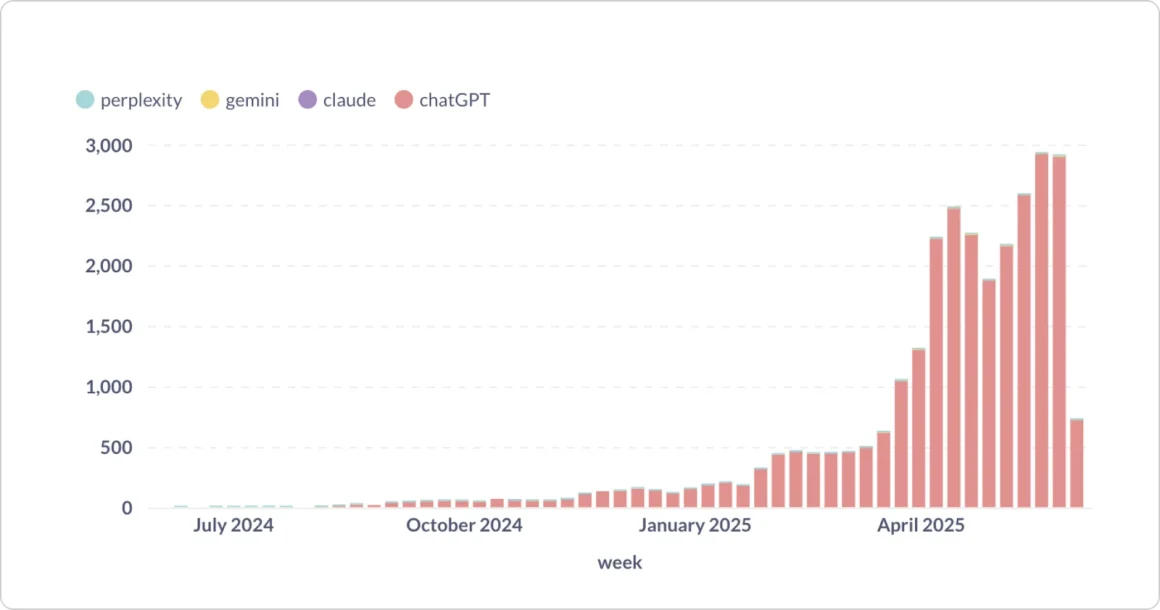
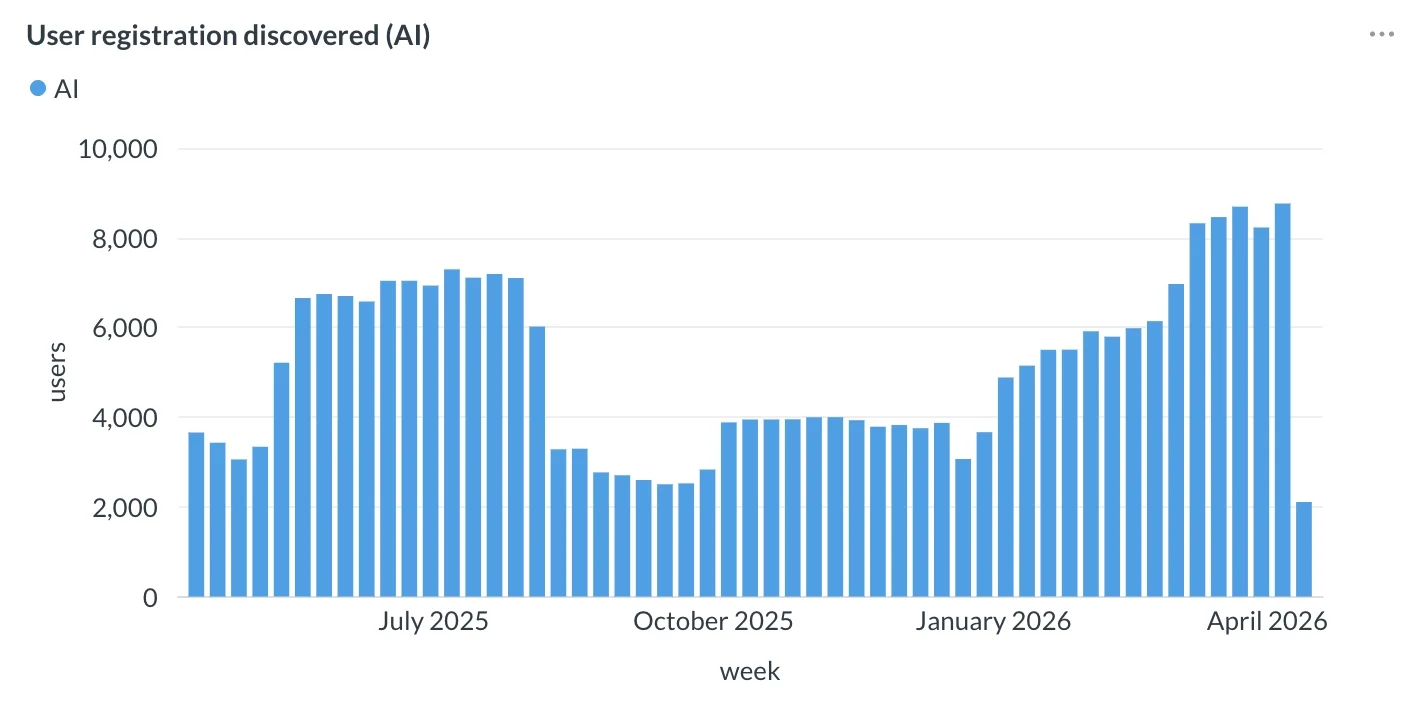
In April 2026, at $5M ARR, they wrote that their viral loop “is no longer our biggest acquisition channel. AI-powered search is.”
By September, Tally had crossed $6M ARR and 2.5 million users with a team of 10, and 43% of new users were discovering it through ChatGPT, Claude, Gemini, Perplexity and other AI assistants.
That’s a tiny team winning attention in the place where buyers now make decisions. And the way they did it is good news for every founder who can’t afford a content team.
The tiny-team advantage in AI search
Early-stage founders tend to assume AI search belongs to big brands with big budgets. But the data points somewhere more encouraging.
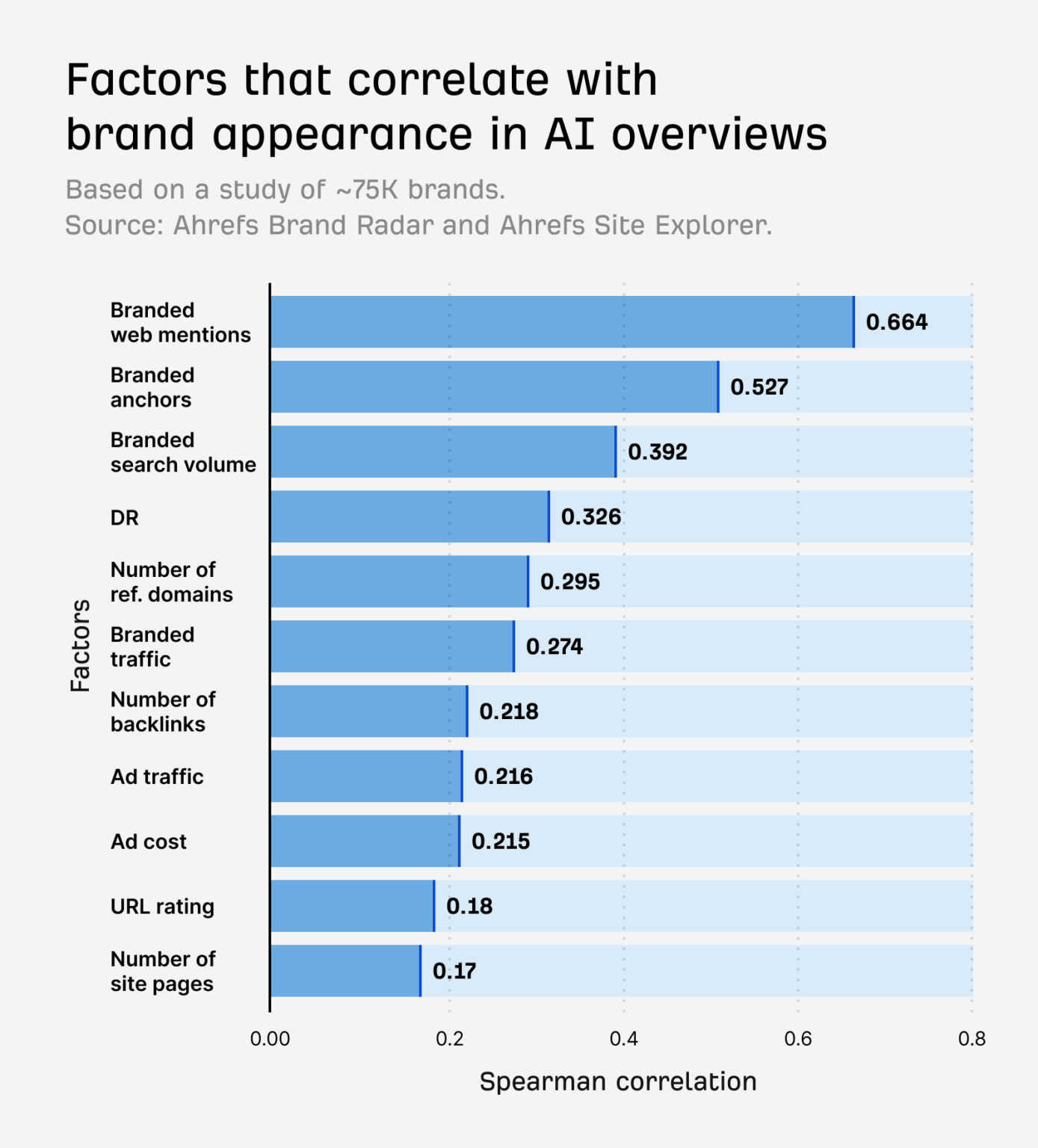
In 2025, Ahrefs studied 75,000 brands to see what correlates with how often a brand shows up in Google’s AI Overviews. The strongest signal was branded web mentions, meaning how often people talk about you across the web, with or without a link. Backlinks, the thing founders used to pay agencies for, came in far lower at 0.218.
There’s a second reason to start now. In 2025, University of Toronto researchers asked 4 AI assistants the same questions and compared their answers. For well-known brands, the assistants recommended the same names 76% to 81% of the time. For niche players, that dropped to 71% to 76%.
For a startup, that gap is a huge opening: AI’s picture of smaller players is less settled, so what you publish and what people say about you this year can still shape it. (The study is a preprint that hasn’t been peer reviewed, so treat the numbers as a rough guide.)
Being talked about is something you earn by being useful to people, one conversation at a time, and that’s work a founder can do better than any agency.
Founders often ask me for the trick to showing up in AI answers. I always give them the same one:
Become the most helpful brand on the internet for your ICP.
Google’s own guidance lands in the same place. Its guide to AI search boils everything down to one question for site owners: “Is this content that my visitors would find satisfying?”
Be where your users ask
Tally’s team spent years showing up in the forums, Reddit threads and blogs where people asked about forms and survey tools.
In their words, they “invested for years in showing up in those places by sharing what we learn, answering questions, and being human.”
When ChatGPT’s spring 2025 update turned web browsing on by default, all of that history became source material. In Tally’s view, those years of real recommendations are why AI tools started sending people their way.
Their April 2026 update says it best:
“Both of these channels, word of mouth and AI search, are powered by the same thing: our community. Happy users sharing the word, recommending us on Reddit, supporting us online, and now even organizing meetups.”
The mix keeps widening, too: Tally says ChatGPT, Claude, Gemini and AI Overviews “continue to grow as referral sources.”
The lesson for founders is simple. The conversations you join today become the answers AI gives tomorrow. Google is clear that faking this doesn’t work: its guide says that seeking inauthentic mentions across the web “isn’t as helpful as it might seem.”
So skip the paid Reddit posts and the review swaps. Answer real questions, as yourself, under your own name.
Publish what only you know
The second thing small teams have is data nobody else has seen.
Tally has shared its numbers in public almost from day 1. Every milestone goes on its blog, from a revenue table that starts at $0 in September 2020 to its upgrade rate (about 1% of badge signups eventually pay). In 2021, the founders told Failory that building in public helped them get noticed by other founders.
AI search rewards the same thing. First-party data gives AI tools information they can’t get elsewhere, and a reason to cite you. Your help center counts too: Tally audits its own “so the content stays accurate and helpful.”
Google’s guide tells site owners to avoid anything a generative AI model could easily produce. If ChatGPT could write your post, it has no reason to send anyone to read yours.
Start with what you already have: onboarding data, churn reasons and the questions customers ask on every demo call.
Make your product easy for AI to read and use
Getting recommended by AI is the first win. Tally also made its product easy for AI tools to read and use.
Its site has an llms.txt file, a plain-text map written for AI tools. It describes Tally in 2 sentences, then points to the help center, the API docs, pricing and integration guides. Its developer docs go further: they’re available as a single plain-text file, so an AI agent can read the whole API reference in one go.
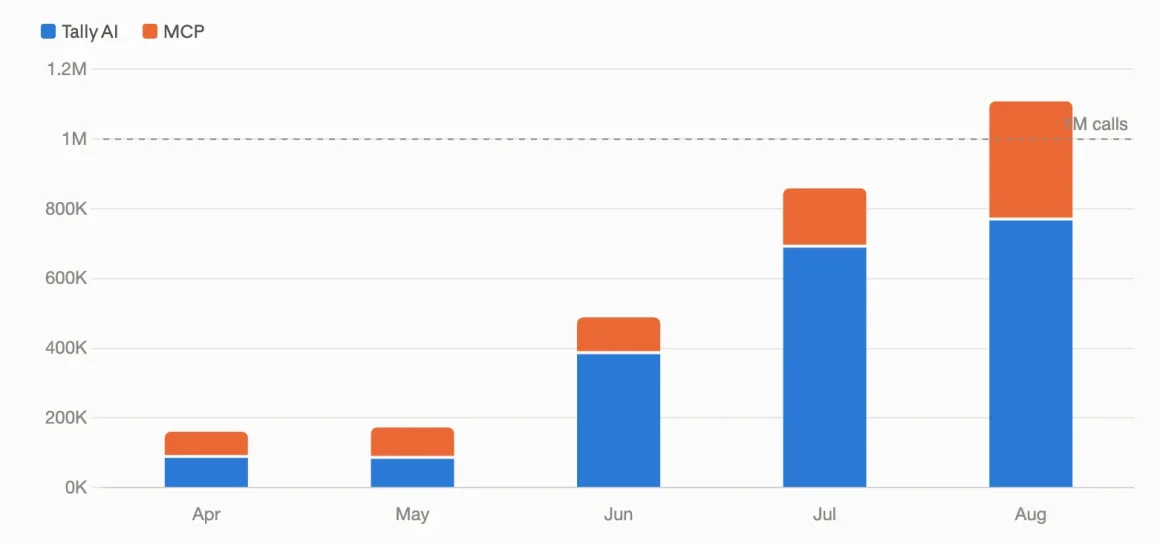
Then Tally let AI assistants use the product directly. Its free MCP server, along with connectors for Claude and ChatGPT, lets people create forms, edit them and pull in responses without opening Tally.
In August 2026, Tally crossed 1 million AI tool calls in a single month across Tally AI and its MCP server.
One caveat before you spend a sprint on this. Google’s guide says Google Search ignores llms.txt and similar files, so they won’t move your Google rankings. Treat them as a bonus for the other AI tools and agents that read them.
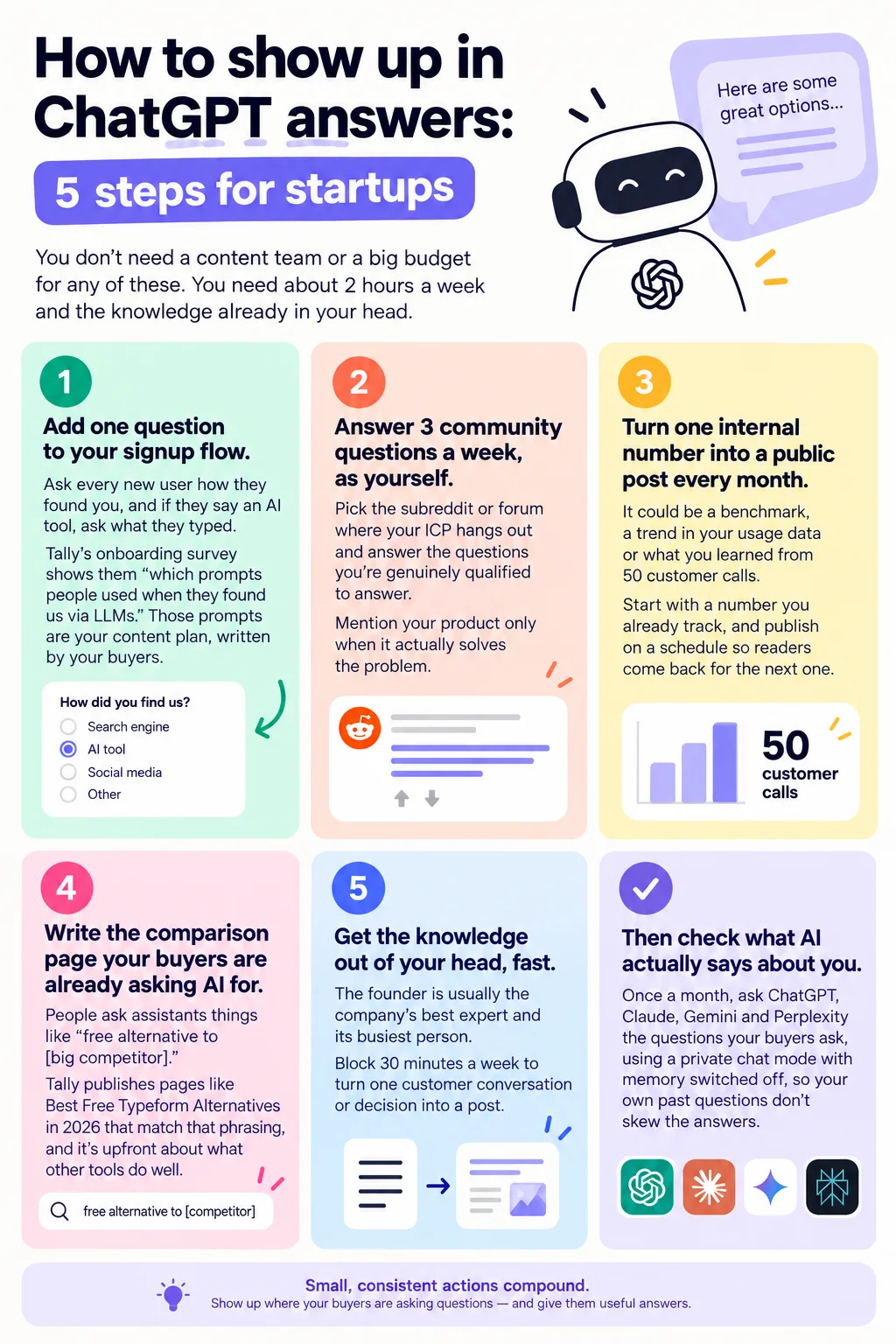
How to show up in ChatGPT answers: 5 steps for startups
You don’t need a content team or a big budget for any of these. You need about 2 hours a week and the knowledge already in your head.
- Add one question to your signup flow. Ask every new user how they found you, and if they say an AI tool, ask what they typed. Tally’s onboarding survey shows them “which prompts people used when they found us via LLMs.” Those prompts are your content plan, written by your buyers.
- Answer 3 community questions a week, as yourself. Pick the subreddit or forum where your ICP hangs out and answer the questions you’re genuinely qualified to answer. Mention your product only when it actually solves the problem.
- Turn one internal number into a public post every month. It could be a benchmark, a trend in your usage data or what you learned from 50 customer calls. Start with a number you already track, and publish on a schedule so readers come back for the next one.
- Write the comparison page your buyers are already asking AI for. People ask assistants things like “free alternative to [big competitor].” Tally publishes pages like Best Free Typeform Alternatives in 2026 that match that phrasing, and it’s upfront about what other tools do well.
- Get the knowledge out of your head, fast. The founder is usually the company’s best expert and its busiest person. Block 30 minutes a week to turn one customer conversation or decision into a post.
Then check what AI actually says about you. Once a month, ask ChatGPT, Claude, Gemini and Perplexity the questions your buyers ask, using a private chat mode with memory switched off, so your own past questions don’t skew the answers.
Become the answer AI gives your buyers
Big companies have budgets, content teams and, often, agencies. Early-stage startups have something more useful in AI search: founders who talk to customers every day and know things nobody else has written down.
In 2020, Tally was 2 founders in Ghent with a free form builder and no investors. Today, 43% of its new users arrive because an AI assistant recommended it.
None of that took a big team or a big budget. It took years of answering community questions, sharing numbers only Tally had and making the product easy for AI to read and use. You can start on all of it this week with the knowledge already in your head.
And if you keep showing up, AI search won’t be able to leave your product out.