Written by Assel Beglinova
On May 12, 2026, Cal-Maine Foods, the largest egg company in the United States, announced its acquisition of the Van’s Foods brand from Sara Lee Frozen Bakery, a Kohlberg portfolio company. Van’s holds the top position in gluten-free waffles. If you’re the CFO of a consumer brand doing $5 million to $50 million, the release is worth reading closely. A strategic buyer explains, in its own words, what it values in a brand and what it brings to one.
Cal-Maine points to Van’s category leadership, its devoted “Van’s Fans” and its broad retail distribution. Its announcement projected that Van’s would add about 10% to prepared foods sales and about 6% to volume. Divide 10 by 6, and each unit of Van’s volume would bring in roughly 1.67 times the sales of an average unit in the existing business. Both figures are pro forma projections, and the math assumes they’re comparable, so it says nothing about margin. On Cal-Maine’s own numbers, though, Van’s brings in more per unit than its existing prepared foods business.
Cal-Maine, in turn, brings scale to improve cost efficiency, quality control and supply reliability, along with its distribution network and R&D. At your size, no parent company supplies that reliability. Your capital structure has to supply it, through how much you draw, when you draw it and how much of your business each provider can see.
Key Takeaways
- Traditional commercial banks often decline $5 million to $7 million direct-to-consumer brands because asset-heavy underwriting models undervalue digital customer networks and misclassify marketing spend as a pure expense.
- Rushing inventory restocks by air freight and funding customer win-back campaigns after an e-commerce stockout can reduce a brand’s overall margins by 20% to 30%.
- Revenue-based financing without remittance caps, such as Shopify Capital, penalizes growth by proportionally increasing daily loan repayments during high-sales periods when brands need working capital for restocking.
- Splitting supply chain capital draws into a 20% to 30% upfront factory deposit tranche and a deferred 60-day final payment tranche prevents e-commerce brands from paying interest on unused funds.
- Omnichannel consumer brands must consolidate financing with a single whole-business underwriter to prevent channel-specific lenders from triggering a systemic cash crunch during a platform-specific sales slowdown.
- E-commerce brands generating over $5 million in revenue should fund recurring inventory orders exclusively with non-dilutive debt to avoid the founder dilution caused by using equity for routine purchase orders.
Why Do Traditional Commercial Loans Undervalue DTC Customer Networks Versus Hard Collateral?
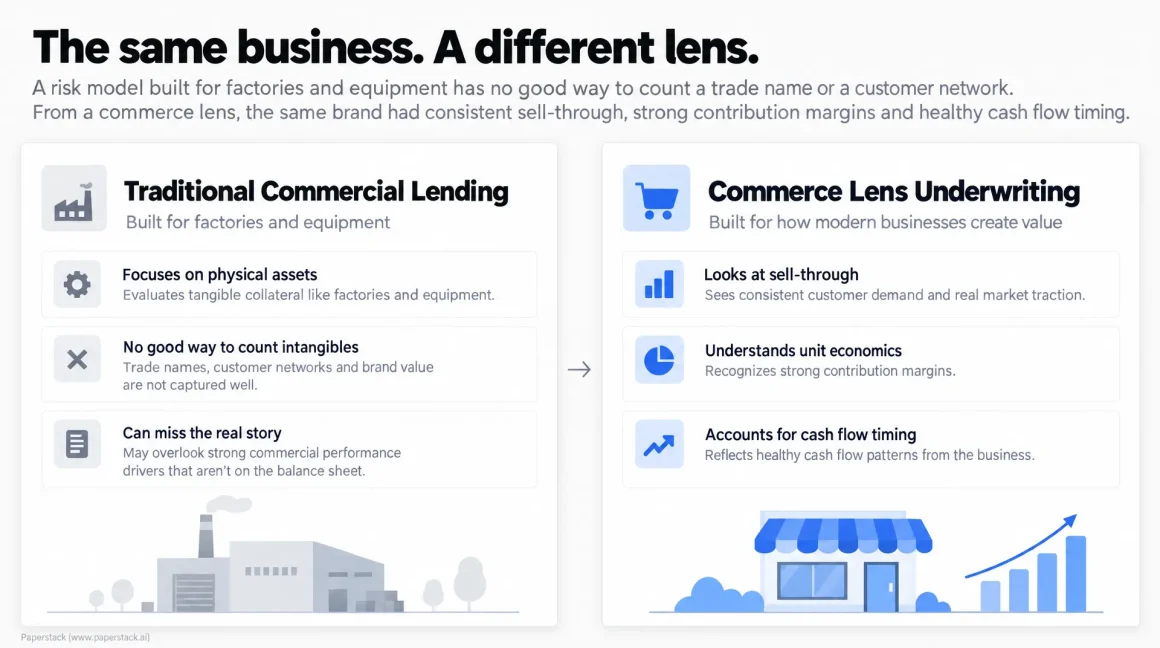
Cal-Maine’s annual filing puts the price at about $24.8 million, for assets that included trademarks and trade names, customer networks and inventory. A risk model built for factories and equipment has no good way to count a trade name or a customer network. It does count inventory. Under an “inventory on hand” covenant, though, the bank wants that stock sitting in the warehouse as collateral, while you need it moving to make money.
When I worked in banking, I kept seeing strong, growing consumer brands get declined because the underwriting was built for asset-heavy industries. One DTC beverage brand was doing over $3 million in annual revenue, with customers who loved them, healthy margins and steady cash flow. The bank saw no hard assets, since manufacturing was outsourced. It saw seasonal swings from summer demand, and it read their marketing spend as an expense instead of an investment in growth. From a commerce lens, the same brand had consistent sell-through, strong contribution margins and healthy cash flow timing.
That systemic lending gap is still there. Brands at $5 million to $7 million in revenue are often deemed too asset-light for a commercial loan because they rely on 3PLs and overseas manufacturing. Bank loans for CPG brands also typically demand personal guarantees and take months to process and disburse.
Growing e-commerce brands typically put 15% to 25% of revenue into marketing. Cal-Maine describes its plans for Van’s as “investing to support future growth,” and a proven marketing budget is an investment engine in that same sense. The capital worth choosing measures cash flow quality, meaning the predictability, timing and sustainability of how money moves through your business. Loyal customers and steady sell-through show up in that cash flow, so a lender who underwrites it sees much of what a buyer sees.
What Are the Financial and Operational Costs of Inventory Stockouts for E-Commerce Brands?

Supply reliability is part of the first synergy Cal-Maine lists. For a brand that outsources manufacturing, much of that reliability comes down to having the cash for the next purchase order when the deposit is due. It’s easy to forget that selling out isn’t always a win. I treat a sellout as a financial or operational failure, even when it looks like a celebration from the outside.
A $5 million wellness brand went viral and sold out on Amazon. The stockout dropped its search ranking and made visibility hard to regain. Rushing a restock by air and spending to win back disappointed customers can take another 20% to 30% off overall margins. CAC climbs too, often because community members feel left out when they couldn’t get the product at the same time as their friends. Meanwhile, warehouse rent keeps accruing, campaigns that were working get halted, and the CFO scrambles to finance emergency purchase orders.
It’s like driving a customer all the way to your store and having nothing on the shelf when they arrive. Then you have to rebuild the relationship. A planned limited-edition drop can build hype, as long as your core products stay predictably available.
How Should DTC Finance Leaders Manage Supply Chain Delays Versus Import Tariffs?

Staying stocked while others hesitate can win share. When new import tariffs raised one brand’s landed costs overnight, most finance leaders in their position were cutting marketing and freezing inventory orders. That reflex shows up well beyond tariffs. In the 2026 CMO Survey, when profits came in below expectations and companies went after costs, marketing was cut 45.4% of the time.
I ran scenarios with the brand for tariffs holding, dropping or expanding, and aligned a flexible capital plan that could adjust to whichever case played out. That gave the team the confidence to keep ordering at scale and maintain supplier relationships. When the market stabilized, they were one of the few brands still fully stocked, and they captured meaningful market share as others scrambled to restock.
A delay is a different problem. I advised an apparel business caught in a supply chain delay to cut its promotional discounts. Margins went up, and the extra margin paid for expediting replacement inventory by air from a different manufacturer. What separates the two cases is whether stock can still reach you. Under the tariffs it could, at a higher landed cost. In a delay it can’t arrive in time. Slowing promotions then stretches what’s in the warehouse and makes each sale more profitable until the new shipment lands.
How Can E-Commerce Financing Structures Like Asset-Based Lending Cause Inventory Stockouts?
Some stockouts are built into the financing. Asset-based lending runs off a borrowing base of receivables and inventory. For a seasonal brand, that base shrinks as you sell through at peak, which is exactly when you need working capital for fixed costs and new production. One founder had a multi-million-dollar loan limit and still couldn’t access the capital to rebuild stock after a busy season. Availability was tied to a percentage of depleted inventory and receivables.
The OCC’s handbook on asset-based lending notes that a facility can include a preapproved seasonal over-advance during an inventory build. The case for one rests on your own history, especially your lowest and highest inventory levels over time.
Revenue-based financing without a remittance cap squeezes you from the other side, because the payments grow as sales surge. Under Shopify Capital’s U.S. terms, you owe a set total payment amount, the loan plus its cost. You repay it through a percentage of daily sales that varies by offer, and the daily dollars aren’t capped. At a 17% rate, for instance, a month where sales double means the cash leaving each day doubles too. You’re getting penalized for your own growth right when a sellout leaves you with an emergency purchase order to fund. Shopify’s new loans also carry minimum repayment thresholds of 30% by month six and 60% by month 12. Check whether minimums like those are sustainable in your slower months.
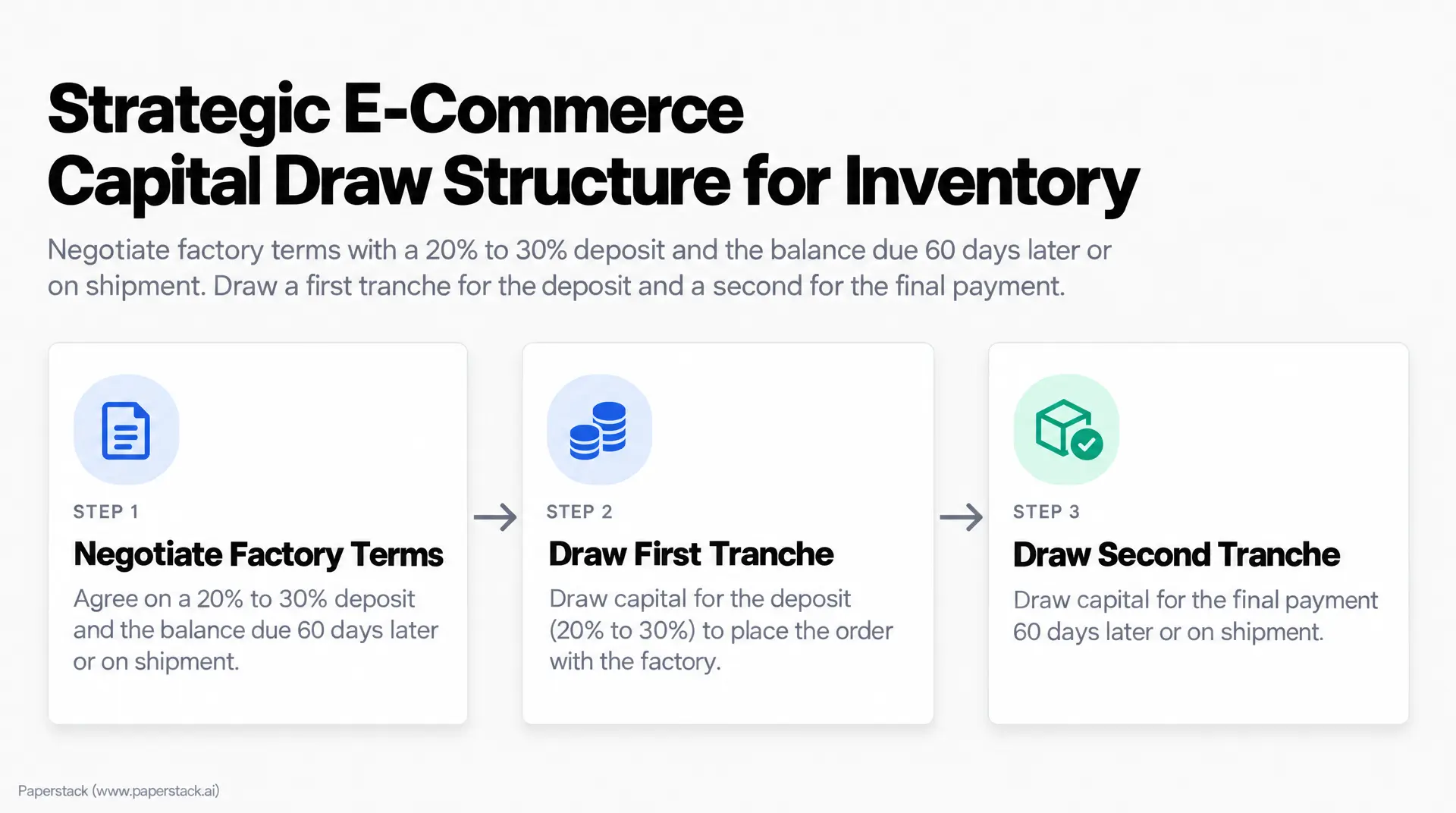
The structure I push for lines up accounts payable with capital draws. Negotiate factory terms with a 20% to 30% deposit and the balance due 60 days later or on shipment. Draw a first tranche for the deposit and a second for the final payment. The remittance percentages blend as you go, say from 3% to 5% once the second draw is in. Hold off on marketing capital until the goods arrive. Run ad spend on a corporate card with a 30- to 60-day float so those bills come due once the new stock is selling.
Taking the full approved amount as a security blanket works against you twice. You start paying for capital the moment you take it. The outstanding balance also stays on your books, which can make it harder to raise more when an emergency purchase order comes up. If you are not using capital in the next 30 to 45 days, you shouldn’t be taking it up front. For a $10 million apparel brand, I structured a facility of slightly over $1 million. Of that, $300,000 went out immediately and the rest was deferred for 60 to 90 days. That saved the business from carrying capital costs on money it didn’t need yet.
Why Should Omnichannel DTC Brands Consolidate Lenders for Whole-Business Underwriting?
Cal-Maine frames the deal as diversification. It plans to use its distribution network to optimize Van’s logistics across retail and direct-to-consumer. For a brand your size, the concentration that worries me most is the calendar. I’m ultimately not a huge fan of betting 70 or 80% of your revenue on a month or two of the year. One accessory brand deliberately diversified into retail, wholesale and B2B to avoid relying on a Q4 viral sellout. If that spike had never come, the result could have been a 9- to 10-month cash crunch.
Diversification creates its own financing problem when each lender sees one channel. I worked with a CPG brand whose constraint was timing. They paid suppliers 60 days before receiving inventory and waited weeks for Amazon payouts. Revenue was spread across Amazon, Shopify and wholesale, and each provider they tried would only underwrite one channel or offer factoring on wholesale orders. They ended up with three or four lenders on separate repayment schedules.
Once their capital was based on the total performance of the business, they consolidated into one source. Around the same time, they faced a choice. They could take on a few strategic retail partnerships, or hold inventory for DTC and cut marketing to conserve cash. With financing sized to the whole business, they could do both.
A lender that sees only one channel can panic over a slowdown there. The extra stress on cash flow can then have a domino effect on your other providers. From the outside, a business with several capital providers can look riskier than it is. A provider underwriting the whole business understands that slowing one channel while scaling another can be a net positive. Ask whether they include all your sales channels. If Shopify is 30% of your revenue and that’s all they see, they’re missing 70% of your performance. Ask, too, whether wholesale revenue counts when a draft order is created in Shopify or only when the payment lands in your bank account.
Why Should DTC Brands Finance Recurring E-Commerce Inventory with Debt Rather Than Equity?
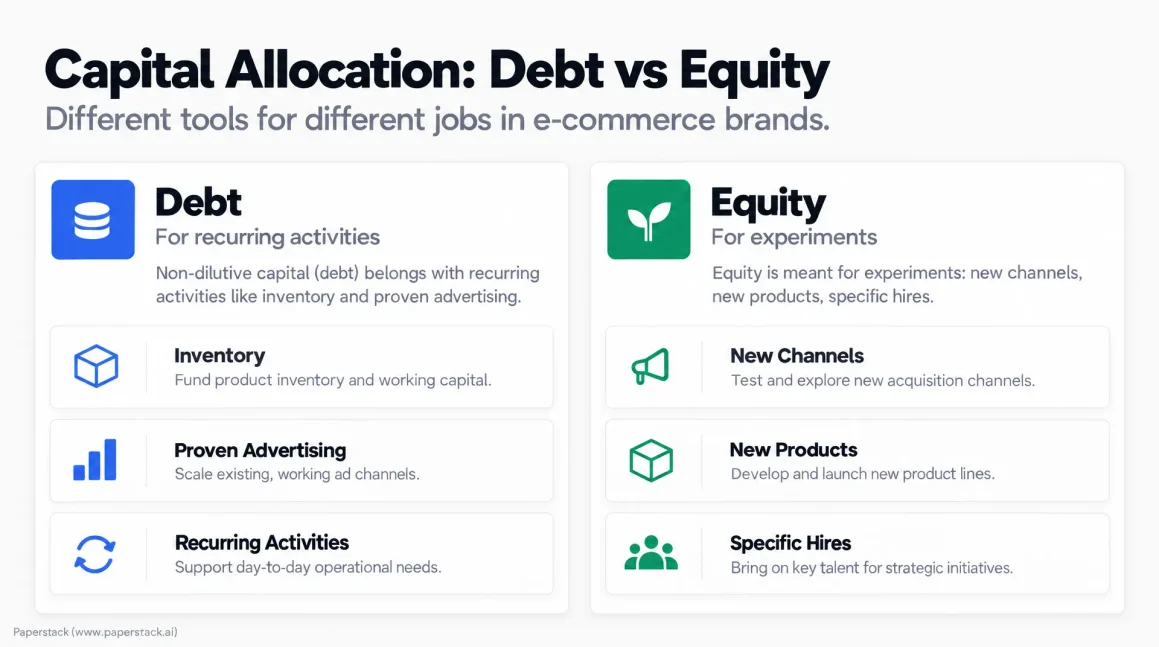
Sara Lee’s CEO said the company sold Van’s to sharpen its focus on the core brands it’s investing in for the long term. He called it part of “making disciplined decisions about where we compete.” For an independent brand, the same discipline means deciding what each kind of capital is for. Equity is the most expensive capital you can put into inventory or predictable marketing. It’s meant for experiments: new channels, new products, specific hires, international expansion. Non-dilutive capital belongs with recurring activities where you know the costs and the return, like inventory and proven advertising. Brands typically place inventory orders two or three times a year, so funding them with equity means fresh dilution every time.
One founder used venture capital for early inventory. They owned less than 20% of the company while it was doing a few million in revenue, too little to raise the larger round needed to scale. Another founder negotiated favorable payment terms with their manufacturer and funded inventory only with debt. At $10 million in revenue, that founder still had majority ownership and was well positioned to raise venture capital to scale toward $100 million. Early-stage brands still hunting for a hero product may need to mix debt and equity for inventory. Once you’re at several million to over $10 million in revenue, with the data lenders need, inventory belongs on non-dilutive capital.
How Can Independent E-Commerce Brands Protect Intangible Assets Through Data-Driven Capital Decisions?

I’m unapologetically optimistic about brands at your stage. The assets Cal-Maine paid for included trademarks, customer networks and inventory. You’re building the same kinds of assets without a parent’s scale behind you. What protects them is a series of ordinary capital decisions, from when you draw the next tranche to whether equity ever pays for a purchase order. Most of the evidence for those decisions already sits in your own history. That includes your lowest and highest inventory levels across the year, how ROAS held up at each revenue milestone as you scaled ad spend, and how cash moved through each channel. Put those numbers in front of every capital provider you talk to, so the draws, caps and covenants you sign are built around how your business actually moves.
About the Author

Assel Beglinova writes about ecommerce and DTC trends, growth strategy for consumer brands, and how sellers fund their expansion and manage cash flow as they scale. Her work covers the financing questions every consumer brand founder runs into, from revenue-based financing to inventory planning to keeping enough working capital on hand to act on growth opportunities. Assel is the CEO and co-founder of Paperstack, a platform that provides working capital for consumer brands.
.