Written by Assel Beglinova
One founder funded early inventory with venture capital. While the company was still generating only a few million dollars in revenue, that founder owned less than 20% of it, which was too little equity to raise the larger round the business needed to scale. Another brand, also doing a few million in revenue, negotiated favorable payment terms with its manufacturer and used debt exclusively for inventory. At $10 million in revenue, its founder still held majority ownership and was well positioned to raise venture capital for the run to $100 million.
Working capital gets trued up when a brand sells. SRS Acquiom’s working capital study found purchase price adjustment provisions in 92% of the deals it studied that closed from 2022 through the third quarter of 2024. Buyers’ initial claims against sellers came to a median of 0.26% of transaction value and an average of 0.88%. Even the average is small next to the gap between owning under 20% of a company and owning a majority of it, and that gap opened years before anyone calculated a closing adjustment.
I work on the capital side of e-commerce and CPG. From there, my view is that a profitable exit gets structured in working capital long before there’s a buyer. How you finance inventory, marketing and the stretch between paying suppliers and getting paid decides four things: what the owners keep, what’s owed against the company, what margins its history shows, and how complicated it looks from the outside.
Key Takeaways
- According to SRS Acquiom’s transaction study, 92% of acquisitions between 2022 and 2024 included purchase price adjustment provisions, with buyers claiming an average of 0.88% of the transaction value.
- Funding recurring e-commerce inventory with equity contributes to physical-product founders retaining a median ownership of just 30.5%, compared to 37.5% for digital founders, according to Carta data.
- The true cost of venture debt warrants scales directly with valuation, meaning a 2% penny warrant priced at $200,000 during a $10 million valuation exceeds $2 million at a $100 million exit.
- E-commerce brands experiencing unplanned inventory sell-outs often lose 20% to 30% of their overall profit margins when forced to expedite replacement stock through expensive air freight.
- The Federal Reserve Banks’ 2025 Small Business Credit Survey reveals that 60% of firms utilizing online lenders experience higher-than-expected borrowing costs compared to just 37% of small-bank borrowers.
- Because banks typically advance a maximum of 65% of eligible inventory book value, seasonal e-commerce brands utilizing asset-based lending frequently encounter shrinking borrowing bases immediately after peak sales periods.
- Aligning credit draws with factory terms, such as taking an initial tranche for a 30% deposit and deferring the remainder for 60 days, prevents e-commerce businesses from paying interest on idle capital.
How Does E-Commerce Inventory Financing Impact the Cap Table and Founder Ownership?
The most expensive capital you can use for inventory or predictable marketing is equity. E-commerce brands typically place inventory orders two to three times a year, so paying for them with equity means selling ownership again and again for the same recurring expense. Debt for a production run gets repaid from the sales that inventory generates. Equity sold for the same run comes permanently off the owners’ share of whatever the company is eventually worth. Physical-product founders also tend to hold less after a Series A. Carta’s Founder Ownership Report 2026 puts median founder ownership at 30.5% in physical industries, against 37.5% in digital ones.
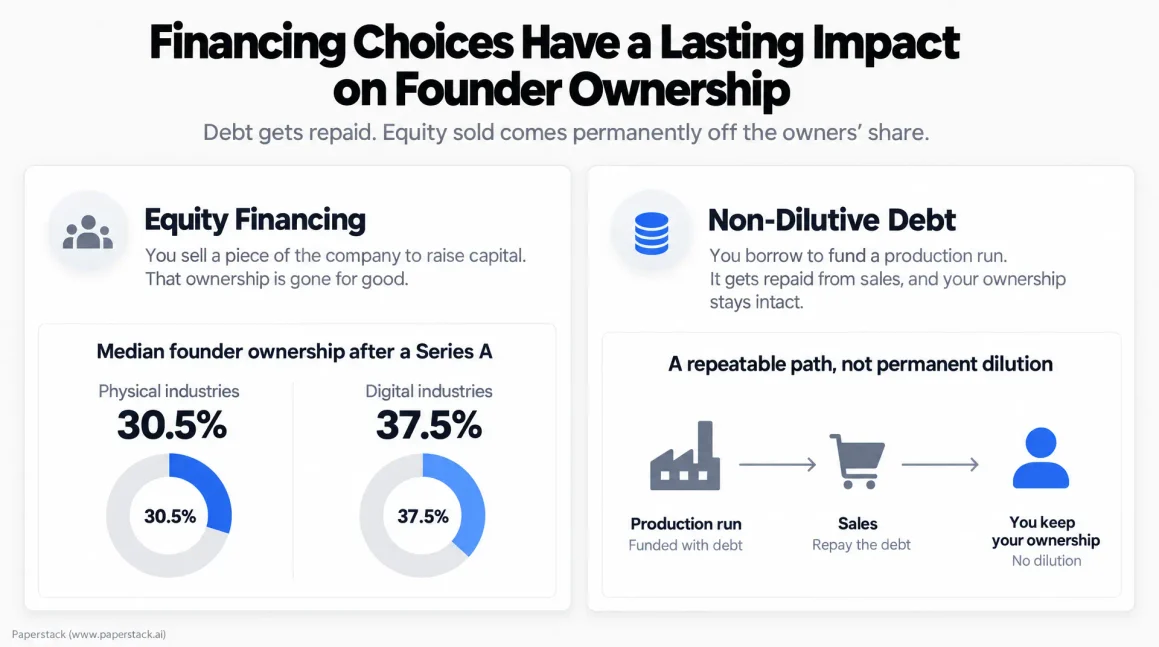
Equity has been created for you to experiment and try, so I’d reserve it for new channels, new products, specific hires and international expansion. Inventory and advertising with a predictable return are repeatable activities where you know exactly what they cost, and I’d fund them with non-dilutive capital. An early-stage brand still searching for its hero product may need to mix debt and equity for inventory while it experiments. Once a brand reaches several million to over $10 million in revenue and has enough data for lenders, I’d move inventory fully to non-dilutive capital. At $5 million to $50 million, you’re past that point.
Why Should E-Commerce Founders Price Venture Debt Warrants at Exit Value?

Part of what you pay for venture debt is equity, so part of its cost only shows up at exit. Venture debt works best right after an equity raise, because lenders size it against the round you just closed. It usually sits as the senior facility with a first-lien position, so any junior capital you add later sits behind it.
The interest is fixed and easy to model. To find the true cost of capital for a venture debt deal, you also need a dollar figure for the warrants. With penny warrants, you get that figure by forecasting your equity value. A 2% warrant costs you $200,000 at a $10 million valuation. If the company grows past a $100 million valuation in five years, the same 2% costs more than $2 million when you sell.
These facilities also usually carry covenants on cash balances, revenue milestones or burn rate. Make sure each one is livable in an ordinary month as well as a strong one. Tie the facility to a specific growth milestone so you know what the warrant is buying.
What Are the Financial Risks of Taking Unused Upfront Capital in E-Commerce?
Founders often take the full pre-approved amount purely for a sense of security, which I compare to maxing out a personal credit card. It’s easy to forget that the moment you take capital upfront is the moment you start paying for it. Brands that take the maximum without an immediate use can end up remitting 20%, 25% or even 30% of daily sales while the money sits idle. That hurts most in slower seasons, and those months go into the financial history a buyer will eventually read.
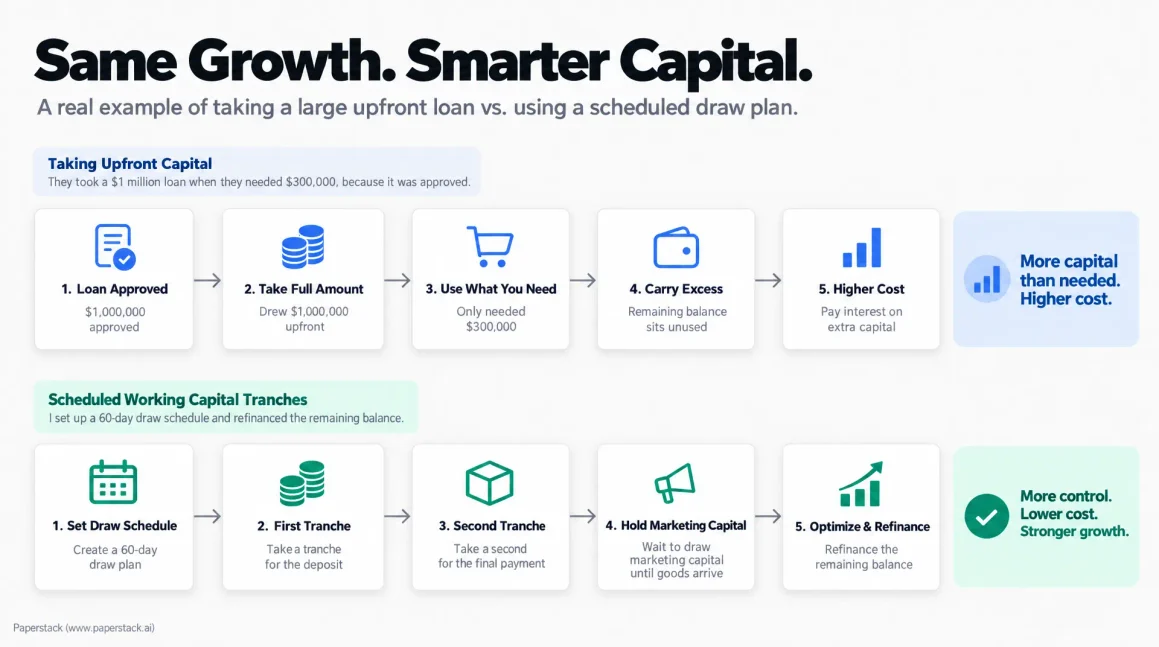
One rapidly growing brand took a $1 million loan when it needed $300,000, because it was approved and optimistically assumed its growth would cover it. It was remitting 25% to 27% of daily sales, and that remittance quickly doubled from $250,000 to $500,000 while the brand paid heavily for capital it wasn’t using. A consumer brand doing more than $20 million took excess capital just in case. Its daily remittances drained the bank account and trapped it in a cycle of needing to borrow more.
I analyzed the cash flow of an apparel brand that was struggling to remit 25% of its daily sales toward a million-dollar loan. I set up a 60-day draw schedule and refinanced the remaining balance over a longer payback period. The remittance wasn’t as severe after that, and the business kept more cash in its bank account.
Before you accept the next offer, ask what you’ll do with the cash. If you do nothing with it, work out how much it costs your business to keep it in the bank account. If you are not using that capital in the next 30 to 45 days, you shouldn’t be taking it upfront. A large cushion only makes sense when it’s deployed right away, for example to negotiate bulk discounts on raw materials.
How Should E-Commerce Brands Negotiate Working Capital Terms and Remittance Caps?
Line up your accounts payable with your capital flows. Say your factory terms ask for a 20% to 30% deposit, with the remainder due 60 days later or on shipment. Take a first tranche for the deposit and a second for the final payment, and hold off on drawing marketing capital until the goods arrive. For a $10 million apparel brand, I structured a credit facility of slightly over $1 million. We deployed $300,000 immediately and deferred the remainder for 60 to 90 days, which saved the business from carrying capital costs it didn’t need yet.
Remittance caps matter most when you’re growing fast. Shopify Capital sets its daily payment percentage by each borrower’s risk profile, and there’s no cap on the remittance. A brand paying 17% of daily sales can watch that payment double in dollars during a growth period, which penalizes it for its own growth. With any provider, ask whether the minimum is sustainable in slower months and how the maximum is calculated. Then negotiate the cap with your own historical data as the evidence.
The biggest mistake we see is evaluating capital partners purely on headline terms. In the Federal Reserve Banks’ 2025 Small Business Credit Survey, 60% of employer firms borrowing from online lenders said their costs came in higher than expected, against 37% of small-bank borrowers. Origination, underwriting and admin fees, wire fees and fees for changing your bank account all belong in the total cost before you compare offers. Check whether the funds are restricted to marketing only or inventory only. Check, too, whether wholesale revenue counts when a draft order is created in Shopify or only once payment lands. For a production run, a flat fee is often more useful than an APR, because knowing the true dollar cost upfront lets you confirm the run is profitable before you place it.
How Do Unplanned Inventory Sell-Outs Impact E-Commerce Margins and Operations?

A sell-out might look like a celebration from the outside, but from the inside it puts massive operational pressure on the team. A $5 million wellness brand went viral and sold out on Amazon, which dropped its search ranking and made visibility hard to regain. A wellness brand at about $10 million had a marketing agency so efficient that inventory sold faster than anticipated. The company had to order restocks urgently and pause all expansion into new channels to keep enough stock for its core DTC customers. I count an unplanned sell-out as a financial failure. Rushing a restock by air and spending extra to win back disappointed customers can slash another 20% to 30% off overall margins.
When ads outperform and stock drains faster than planned, slow down some promotions to preserve the inventory while you make each sale more profitable. During a supply chain delay, I advised an apparel business to cut its promotional discounts. The higher margins let it afford expediting replacement inventory by air from a different manufacturer.
Unapologetic optimism, the way I mean it, is the discipline of preparing for volatility without letting it paralyze decisions. New import tariffs once raised landed costs overnight for one of our brand partners. Most finance leaders in that position were cutting marketing and freezing inventory orders. We modeled the tariffs holding, dropping or expanding, and aligned a flexible capital plan that could adjust to each outcome, so the team kept ordering at scale. When the market stabilized, it was one of the few brands still fully stocked, and it captured meaningful market share while others scrambled to restock.
How Does a Consolidated Capital Stack Reduce Risk for E-Commerce Lenders and Buyers?
From the outside, a business with several capital providers can look riskier than it is in reality. One CPG brand we worked with sold across Amazon, Shopify and wholesale. Each capital provider it tried would underwrite only one channel or offer factoring on wholesale orders. That left it with three or four lenders, each with its own repayment schedule. Once its capital was based on the total performance of the business, it consolidated into one source. It could then say yes to a few strategic retail partnerships without giving up the inventory it held for DTC.
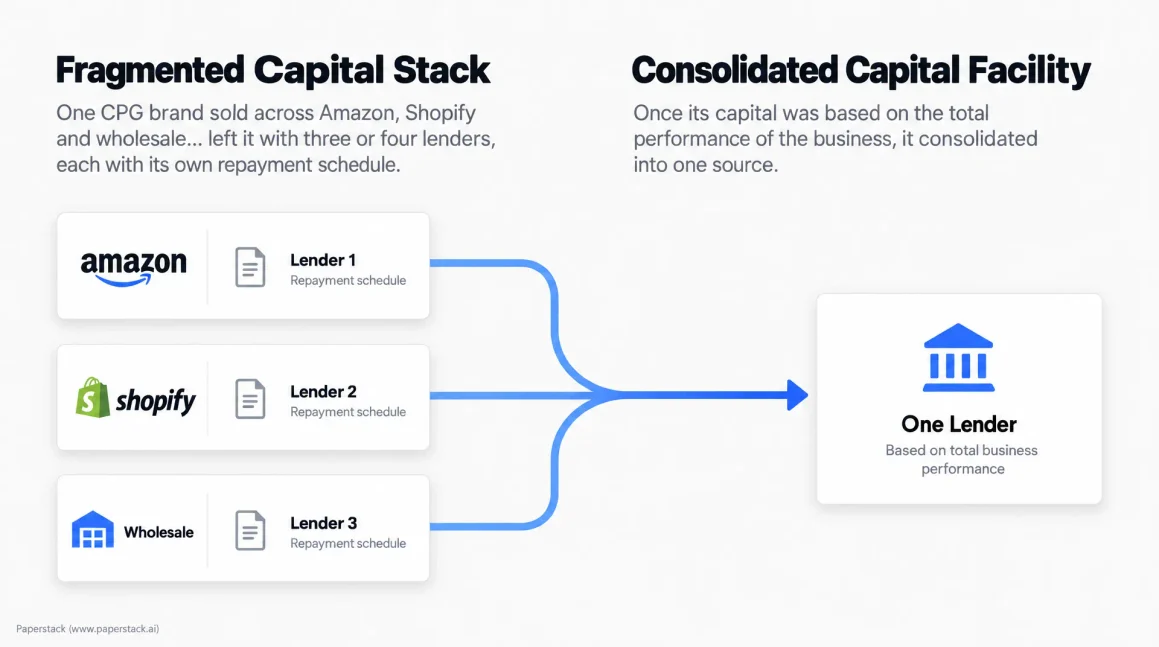
A channel-specific lender can panic over a slowdown in its own channel, put additional stress on your cash flow and set off a domino effect with your other providers. If Shopify is 30% of your revenue, a provider underwriting only Shopify is missing 70% of your performance. Consolidating can lower your borrowing cost, but it creates a severe operational vulnerability if the single lender doesn’t understand how your cash moves. Quarterly subscription payouts and the unprofitable months you expect in the off-season are the kinds of patterns it has to understand.
Asset-based lending suits wholesale- and retail-heavy brands. For a seasonal brand, though, the borrowing base shrinks as you sell through peak, at the exact moment you need working capital for fixed costs and new production. One founder had a multi-million-dollar limit and still couldn’t access the capital to rebuild stock after a busy season, because availability was tied to a percentage of depleted inventory and receivables. Banks typically advance up to 65% of eligible inventory’s book value, according to the OCC, so the limit on a term sheet can sit far from what you can draw in a given month. Some facilities add a preapproved seasonal over-advance ahead of peak. All of those scenarios have to be discussed with your lender, backed with historical performance, down to your lowest and highest inventory levels through the year.
What Financial Data Do Lenders Require to Evaluate E-Commerce Cash Flow Quality?

All of these structures depend on a lender reading your business correctly. In banking, I kept seeing systemic lending gaps. A DTC beverage brand doing over $3 million in revenue was declined despite healthy margins and steady cash flow. The bank saw no hard assets, since the brand outsourced manufacturing. It also saw seasonal swings from summer demand and marketing spend that looked like an expense. To a risk model designed for factories and equipment, the brand looked unstable. Through a commerce lens, it had consistent sell-through, strong contribution margins and healthy cash flow timing.
What I look for is cash flow quality: the predictability, timing and sustainability of how money moves through a business. Growing brands typically put 15% to 25% of annual revenue into marketing, a top-three cost alongside inventory and shipping, so you have to show that spend working as an investment engine. Bring two to 10 years of history showing it’s a deliberate, long-term allocation that consistently generates profitable sales after all costs. Show how ROAS behaved at different milestones, say at $5 million versus $25 million in revenue, and know the minimum ROAS that still yields a profitable sale. Depending on product, AOV and subscription model, some brands stay profitable at 2x or 2.5x. If scaling the budget drove ROAS down to where new sales lost money, a lender is right to push back.
How Can E-Commerce Brands Restructure Their Existing Capital Stack Before an Exit?
At $5 million to $50 million, you’ve already made most of these decisions at least once. Your cap table, your daily remittances and your lender list show which way they went. The equity already sold stays sold, but the next production run doesn’t have to come out of it. The remittances and the lenders can still change before a buyer looks. The apparel brand remitting 25% of its daily sales moved onto a 60-day draw schedule, and the CPG brand went from three or four lenders to one.
About the Author

Assel Beglinova writes about ecommerce and DTC trends, growth strategy for consumer brands, and how sellers fund their expansion and manage cash flow as they scale. Her work covers the financing questions every consumer brand founder runs into, from revenue-based financing to inventory planning to keeping enough working capital on hand to act on growth opportunities. Assel is the CEO and co-founder of Paperstack, a platform that provides working capital for consumer brands.