
Written by Randeep Purewal
Running out of money is almost never what kills a company. It is the last thing that happens, the visible end of a failure that set in months earlier, when no one was tracking the burn.
CB Insights read more than 400 startup post-mortems and found ‘ran out of capital’ in 70% of them – a figure most founders mistake for a cause when it only marks the time of death.
Your board’s fix for this is a full-time CFO, hired under deadline pressure for a job you cannot still describe. The collapse behind that number belongs to companies where everyone was still looking in the rearview mirror.
Key Takeaways
- CB Insights data from 400 startup post-mortems reveals that running out of capital, cited in 70% of failures, is a lagging indicator of untracked burn rates rather than a root cause.
- Reflexively hiring a full-time CFO introduces severe costs and delays, as executive searches exceed the SHRM 39-day median time-to-fill and demand a $186,910 mean base wage plus 30% in benefits.
- The National Venture Capital Association model Investors’ Rights Agreement mandates quarterly financial statements within 45 days and monthly forward-looking budgets, forcing startups beyond the capabilities of historical bookkeeping.
- Startups require specific financial modeling to navigate disparate market conditions, highlighted by Carta Q1 2026 data showing a $300 million median Series A valuation for AI startups versus $55 million for non-AI companies.
- Fractional CFOs mitigate startup control gaps, which the ACFE 2024 fraud study identifies as severe vulnerabilities by noting that 32% of cases involve missing internal controls and 19% involve overridden controls.
What Are the Risks of Reflexively Hiring a Full-Time CFO for Startups?
Start with what actually happens when you follow the standard advice.
You post the role. You interview a lot of candidates. Weeks turn into months. Even for nonexecutive roles, SHRM’s benchmarking puts the median time-to-fill at 39 calendar days. Executive searches run longer and cost more. All that time, the board is still waiting on the reporting that started the conversation.
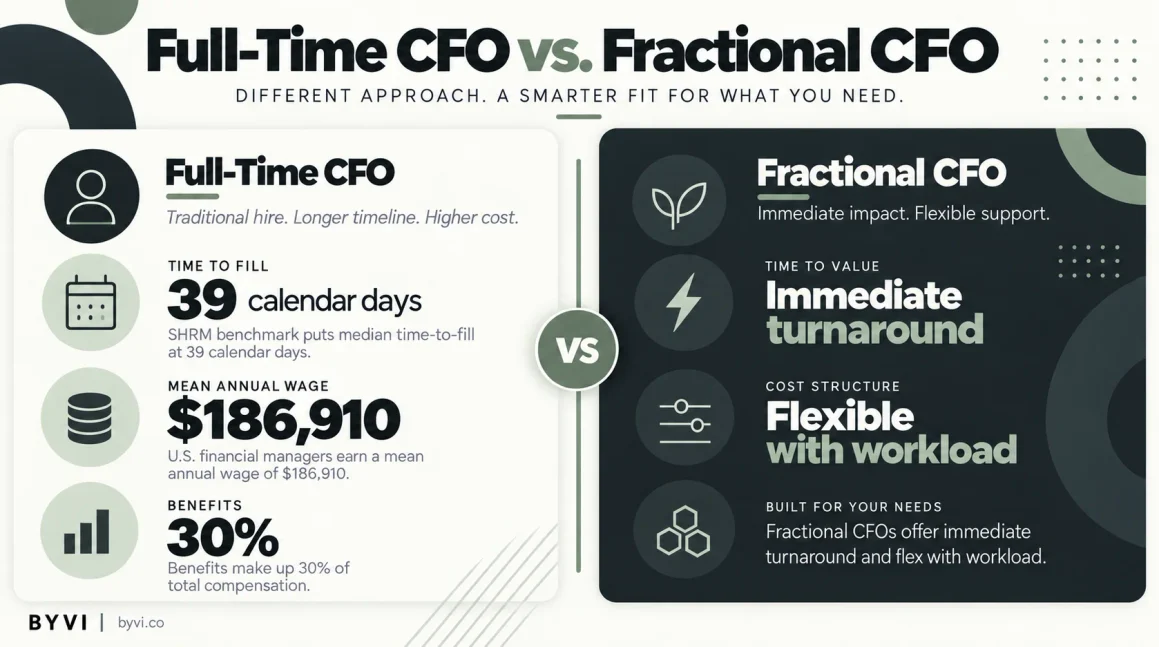
Then you land someone, and the real commitment starts. In May 2025, U.S. financial managers earned a mean annual wage of $186,910. A true CFO sits well above that line. Benefits alone make up about 30% of total compensation costs. Then there’s bonus. Then equity, which you cannot take back.
Now the question I’d push you on. What kind of CFO do you actually need?
How Can Startups Match Fractional CFO Expertise to Specific Financial Problems?
Do you need an operational CFO who builds systems and controls? A strategic CFO already thinking about the next round? Someone with M&A experience? Due diligence? AI? Most founders six weeks after a raise can’t answer that with confidence. That’s normal. You’ve never been at this stage before.

And the honest answer keeps changing. The company that just closed and needs clean reporting is a different company from the one looking at an acquisition 18 months later. A full-time hire locks in one profile. A fractional CFO lets you adjust accordingly.
The turnaround is short. You could literally have someone start next week. The arrangement flexes with the workload. And you are not married to this individual. Worst case, you swap them for a fractional CFO with a different specialty. Best case, they know exactly what’s required to reach your next milestone, and they take you there.
What Core Value Does a Fractional CFO Provide to Tech Startups?
I like to break value into simple pieces. Founders don’t have time for abstractions.
What you are gaining is certainty, financial discipline, and direction.
Financial discipline is risk mitigation. That’s the defense side of things. Covenants tracked. Controls in place. Payroll, taxes, and the bank handled without drama.
Direction is the offense. Okay, what’s the game plan here? Where does the money go, and what does it need to produce by when?
This split also explains the gap between a bookkeeper and a CFO. Founders tend to misjudge that gap until it costs them. A bookkeeper manages your day-to-day transactions. A controller keeps the historical records tight. Both are looking in the rearview mirror. That’s the job, and you need it done well.
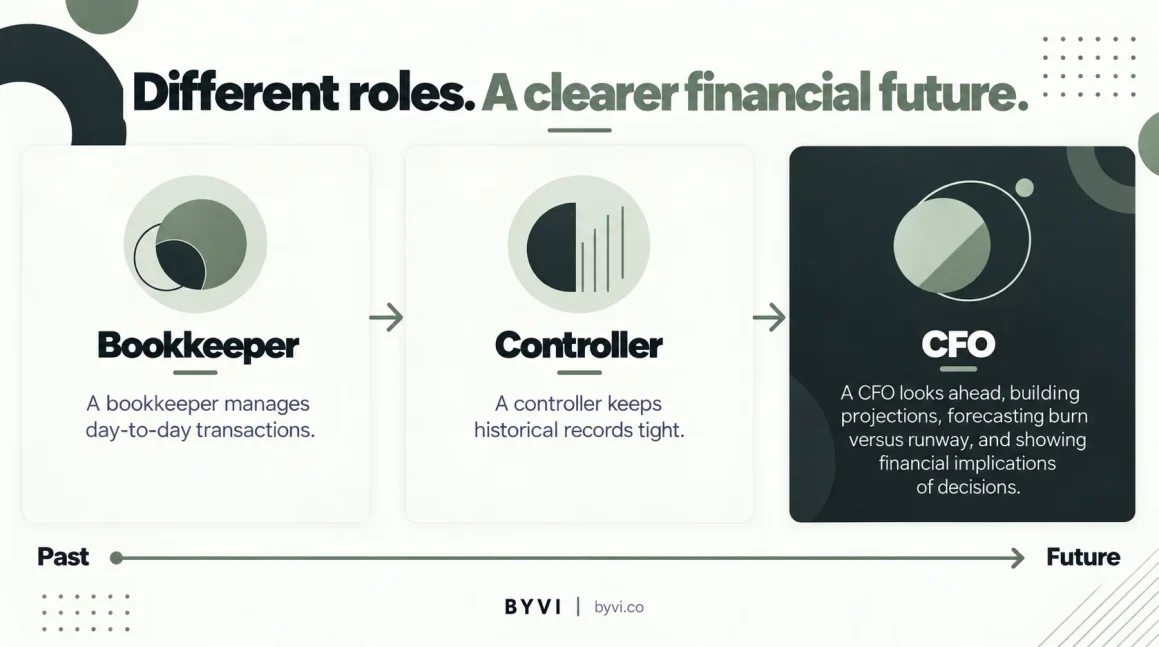
A CFO is looking ahead. They build a model on projections and forecasting. They give you a line of sight on burn versus runway. They show you the financial implications of the decisions you’re about to make, across every function in the business.
You need both views. But when a board member leans in with a question, they want to know where this is going and whether you can prove it.
What Are the Key Trigger Events for Hiring a Fractional CFO?
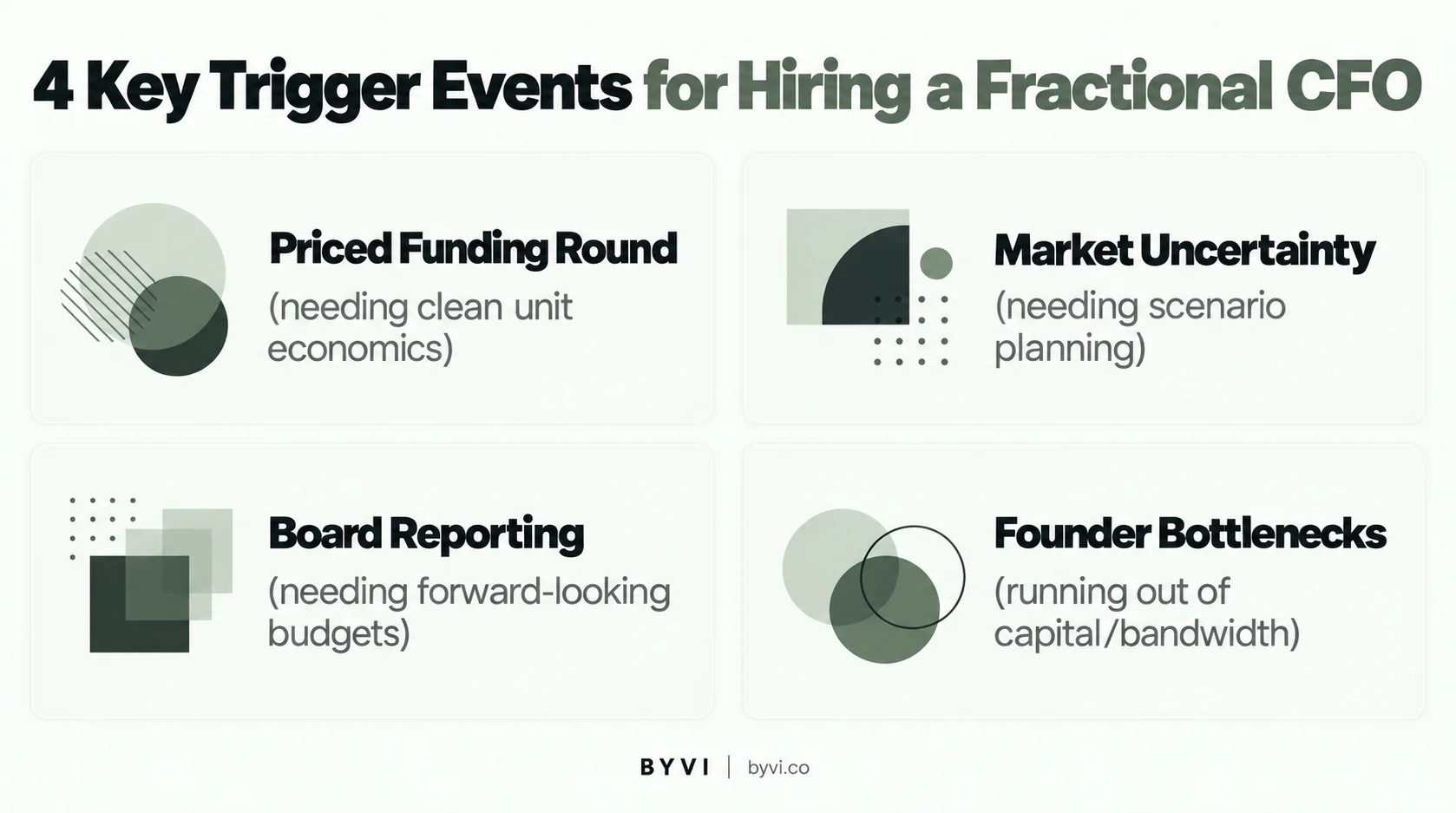
In my experience, founders realize they’ve outgrown their bookkeeper way too late. Almost every time, a specific event forces it. Here are the ones that should get your attention before the pain does.
Why Is a Priced Funding Round a Trigger for Hiring a Fractional CFO?
This one is non-negotiable in my view. Going into a priced round, you need a defensible model, clean unit economics, and a data room that holds up. Every assumption gets questioned. Margins. Hiring plan. The path to the next raise. A CFO has fielded those questions before and knows which ones a round turns on. A bookkeeper, through no fault of their own, has not.
How Does Market Uncertainty Trigger the Need for a Fractional CFO?
In stable markets, founders definitely have more leverage. Capital is easier to find, terms are friendlier, and mistakes get absorbed. In uncertain ones, you need solid financial instruments. Forecasting. Scenario planning. Real discipline around runway.
And be careful reading the headlines. U.S. startups raised more than $400 billion in the first half of 2026, more than any full year on record. But that money sits with a small number of companies and funds. Carta’s Q1 2026 data shows the gap. An AI foundational-model startup at Series A had a $300 million median valuation. A non-AI startup at the same stage came in at $55 million. So “strong market” depends heavily on which market you’re in. A CFO helps you build a plan around the one you actually compete in.
I spent over a decade at RBC before this work, including time in commercial markets. Lenders and investors run on numbers they can trust. When a company can’t produce them, the conversation gets harder fast.
How Do Board Reporting Requirements Trigger the Need for a Fractional CFO?

If you’ve raised money, the board expects reporting. And this is written into your documents. The NVCA’s model Investors’ Rights Agreement requires quarterly income statements, cash-flow statements, and balance sheets within 45 days of quarter-end. It also calls for an annual budget and business plan built month by month.
That second requirement is the one to notice. A monthly budget and forward plan is forecasting work. It’s exactly where a bookkeeper setup usually cracks, because you’re asking a historical function to answer forward-looking questions. If producing the package takes heroics the night before the meeting, that’s your signal.
Why Should Founder Bottlenecks Trigger the Hiring of a Fractional CFO?
A founder can carry a company to a certain milestone on instinct and hustle. After that point, your purpose should be to grow the company. Full stop.
If you’re the one rebuilding the model at midnight, reconciling numbers before a board call, and doing the runway math alone, you are the bottleneck. And that math matters. CB Insights studied more than 400 startup post-mortems and found “ran out of capital” in 70% of them. Their read, which matches what I see, is that running out of money is usually the last thing that happens. The real problem started earlier, when nobody had a clear line of sight on burn.
A fractional CFO becomes your sounding board. You make decisions collectively, as partners. I’ve been a founder myself, and I know how few people you can say the hard things to. Not your investors. Not your team. A financial partner who has seen this before, and who has no stake in you looking like you’re crushing it, is worth more than the reporting.
How Do Fractional CFOs Resolve Financial Control Crises in Startups?
Let me ground this in a real situation. Theory only matters if it holds under pressure.

We were introduced to an ad tech company because their CFO had left abruptly. Unfortunately, this happens more often than anyone likes to admit.
The departing CFO had not set up proper systems and controls. Access to financial information was restricted to that one person, so the team struggled to even see their own numbers. On top of that, the books were not up to date. There were discrepancies. The covenants were outdated. Tons of issues, all at once, with a bank relationship to manage.
We got a CFO in there within a couple of days.
What stuck with me was the tone. Calm prevailed. Cool heads. They looked at everything objectively and built a roadmap. Which deliverables were high priority? Which could wait? Then they worked the list. Books brought up to date. The bank brought back into the loop. Payroll and taxes confirmed. Every stakeholder who needed a call got one.
The beauty of a fractional CFO in a moment like that is the contributions are immediate. They’ve been there, done that. Onboarding is pretty much not applicable.
There’s a lesson in the controls piece too. ACFE’s 2024 fraud study found that 32% of cases involved a lack of internal controls, and another 19% involved someone overriding controls that existed. Nothing suggested fraud at that company. But when one person holds every key, you have a control gap, and control gaps are where problems hide. That’s the defense side. Discipline first. Then direction.
Under What Circumstances Should Startups Avoid Hiring a Fractional CFO?
I run a business that places fractional CFOs. You’d expect me to say everyone needs one. I don’t believe that. The model has a right time and a wrong time.

Why Should Early-Stage Startups Rely on Bookkeepers Instead of Fractional CFOs?
A bookkeeper manages your day-to-day transactions. That is the role. At a certain stage, that is the whole need. Say you’re very early. No raise on the horizon, no board reporting, and a burn rate you can see clearly on one spreadsheet. Don’t pay for forecasting horsepower you won’t use still.
Just keep the triggers in view. The mistake I see runs almost entirely in one direction. Founders wait until the priced round is already in motion or the board has lost patience. Then they’re hiring under pressure, and pressure makes for bad hires.
When Do Startups Outgrow a Fractional CFO and Need a Full-Time Hire?
This is the part people miss. Full-time CFOs are the right answer for plenty of companies. My issue is with hiring one hastily.
At The CFO Centre, what we recommend is building your finance function top-down. Put strategic leadership in first. Get the model and the discipline in place. Then build the layers underneath with a clear picture of what each one needs to do. A good fractional CFO knows what kind of full-time CFO your company will need next, and they help you get there. That’s part of the job.
So look for the real signals. The finance function has grown into a team. The complexity demands someone in the seat every day. Your fractional CFO is the one telling you it’s time. When you see those, hire full-time. You’ll be hiring for a role you can finally define. And you’ll have someone who understands it sitting beside you in the interviews.
Why Is Hiring a Fractional CFO Merely to Check a Board Box Ineffective?
Some founders hear “the board wants a CFO” and go looking for someone to produce a deck every quarter and otherwise stay out of the way. The fractional model can technically do that. You’ll get a fraction of the value.
The engagements that work are partnerships. The CFO has access to the information. They’re in the room for the big calls. You use them as a sounding board and decide together. If you’re not ready to open that door still, a CFO of any kind is going to disappoint you.
How Does a Fractional CFO Manage Post-Raise Startup Financial Obligations?

Here’s the reframe I’d offer any founder staring at a fresh cap table.
The headline says you won. What you actually signed up for is a new set of obligations. Covenants. Reporting deadlines. Milestones with dates attached. Capital that has to turn into something the board can measure.
That’s exactly when financial leadership matters most. But financial leadership and a full-time hire are two different decisions. You can have the first without committing to the second. You can hit your next milestone faster. And you can figure out what permanent role you truly need along the way.
Certainty, financial discipline, and direction. Defense and offense. Someone looking ahead while the bookkeeper looks in the rearview mirror.
Get that in place, and you’re free to do the one thing only you can do. Grow the company.
Planning For a Year Nobody Can Predict
Every founder I talk to right now has more on their mind than they did 2 years ago. AI is changing how teams get built, companies are rethinking how work gets done, and tariffs, trade deals, and geopolitics seem to shift every week. That’s probably how things will be for a while.
What I’ve seen work is pretty unglamorous: a few versions of the forecast, a clear sense of what you’d change if things go sideways, and a runway number you trust. The founders I work with who have that in place still feel the uncertainty, but they make decisions faster when things change. That’s a real edge right now, and it’s within reach for any founder willing to look ahead.
FAQs
The savings are substantial. A full-time financial manager averages $186,910 annually – before equity, bonuses, and heavy benefit burdens. A fractional CFO eliminates these massive fixed costs and grueling executive searches, delivering immediate, targeted strategic value on a flexible basis tailored to your current cash burn.
Founders typically track gross cash. Fractional CFOs model stress-tested buffer days. The JPMorgan Chase Institute notes median businesses hold just 27 cash buffer days. A CFO builds forward-looking scenarios to ensure your capital allocation aligns perfectly with your next funding milestone, aggressively eliminating blind spots.
No, sophisticated investors care about defensible models, not titles. Going into a Series B, a fractional CFO ensures your unit economics are bulletproof and your data room holds up to rigorous diligence. That exact precision is what actually drives your valuation and protects your negotiating leverage.
Yes, they build compensation models that balance equity and cash to attract A-players without destroying your runway. With benefits making up 30.0% of compensation costs, a fractional CFO ensures your offers are fiercely competitive still financially sustainable, setting you apart in a crowded market.
They deploy defensive guardrails almost immediately. A fractional CFO separates duties and enforces audits before minor control gaps become critical threats. Implementing these proactive controls is proven to trigger a 50% or greater reduction in financial risk, actively protecting the capital you just fought to raise.
About the Author

Randeep Purewal, MBA is the Regional Director for Toronto at The CFO Centre Canada – where she leads a team of experienced CFOs supporting growing and mid-market businesses through strategic financial leadership, M&A transactions, and innovative transformation while applying a variety of use cases and mandates. With a background spanning consulting, technology, banking and the future of work – Randeep is particularly interested in how emerging technologies such as AI are reshaping business models, job architecture, and the role of the modern finance function.