
Written by Darko Butina, founder at RELIABL.IT
Large US companies run an average of 183 AI tools and platforms. Only 15% of their AI investments operate as a unified system, and one in four of these companies admits that no one is accountable for coordinating AI across the business.
The numbers come from a white paper by WSJ Intelligence and Code and Theory. It is based on a survey of 801 CEOs, technology chiefs and marketing chiefs at US companies with at least $500 million in annual revenue. WSJ Intelligence describes itself as a unit of the Wall Street Journal’s advertising department, and the Journal’s newsroom wasn’t involved in the report.
None of those numbers describes a startup’s AI tool sprawl. Still, startups can very soon start to build the same mess. The difference is that in a startup the mess is kind of expected, and startups probably deal with it a bit better because they accept the messiness.
Key Takeaways
- Large US companies run an average of 183 AI tools, but only 15% of these investments operate as a unified system according to WSJ Intelligence data.
- Embedded AI agents complicate software management by independently accessing corporate data, with only 18% of organizations holding these agents to human-level governance and accountability standards.
- OpenAI utilizes content from individual Free, Plus, and Pro subscriptions for model training by default, necessitating strict corporate privacy guardrails for employee generative AI usage.
- A study of 5,172 customer-support agents at a Fortune 500 company found that AI assistance increased issue resolution rates by 15.2% without significantly changing customer satisfaction.
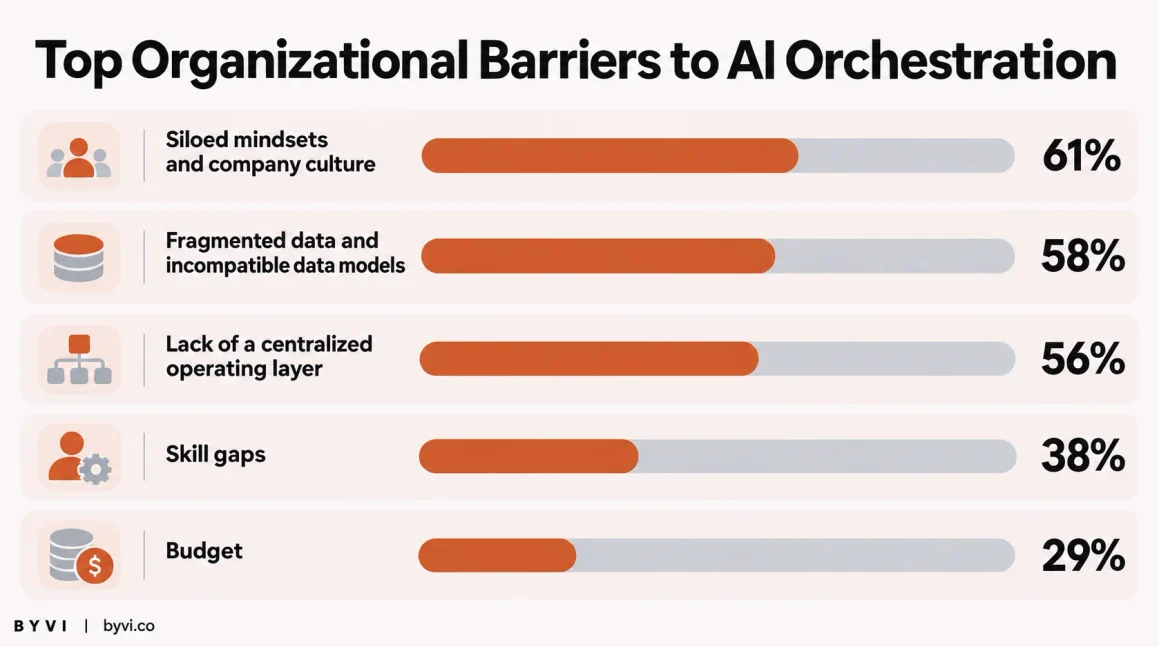
- Enterprise leaders rank siloed mindsets and company culture as the top barrier to AI orchestration at 61%, significantly outranking both employee skill gaps and budget constraints.
- Chief Executive Officers must directly own AI orchestration to align technology with corporate strategy, resolving current organizational confusion where 57% of technology leaders claim the role.
Why Must Scaling Startups Eliminate AI Data Fragmentation for Investor Reporting?

Once a startup reaches a certain size, or onboards proper institutional investors, it needs to start producing reports. Usually that’s the moment when accepted messiness suddenly stops being accepted. It becomes an issue. Soon the company has to approach running things differently, so that it has the right insights at the right time and things are connected with each other. A startup doesn’t have the luxury of simply hiring more people to connect the dots, do the administration and stitch numbers together.
Take the monthly investor update at a startup that has just closed its Series A. Pipeline sits in the CRM, revenue in billing and usage in product analytics, and each of those tools may already come with its own AI assistant. Give the person who writes the update a chat model and they get faster. The update still depends on someone stitching three systems together every month.
Even companies with half a billion dollars in revenue struggle with that. In the study’s list of barriers, two of the top three are about connecting things. Fragmented data and incompatible data models are cited by 58%, and the lack of a centralized operating layer to glue systems together by 56%. A startup can’t hire its way around the stitching, so it has to build the connections into the way it runs things.
Why Do Embedded AI Agents Make Software Sprawl Harder to Manage Than SaaS?

I was the very first investor in Cleanshelf, back when it was still called Squrb. I advised its founder from the beginning in 2016 until the company was sold to LeanIX in 2021. Cleanshelf was initially focused on managing SaaS subscriptions, and from there it evolved into finding wasted and duplicate software. So when two-thirds of the companies in the study say they routinely uncover redundant AI investments, that’s a very familiar problem to me.
I think the SaaS overwhelm is even worse in the age of AI, simply because the offering out there in the market and the way companies understand AI are flawed. People, managers and companies treat AI as if it were just another piece of software. They deploy it to solve certain issues and problems the same way they used SaaS before, or on-prem and cloud-based software like ERPs. In my view, that’s how you arrive at a number like 183.
The trick is that with AI, each solution has its own agent running in it. Suddenly you have two problems: how to connect all of it together, and the fact that those agents are diving into your data.
They need access to this, and that, and that, so it becomes super messy, super fast. Only 18% of respondents say their organizations hold AI agents to the same governance and accountability standards as human leaders. I believe this part needs to be properly managed from the beginning, while a startup can still decide which agent gets into which data.
Why Must Corporate Strategy and Process Redesign Precede AI Tool Selection?
I’ve had the luxury of leading a variety of companies, or being part of their leadership teams. They range from startups built from the ground up with zero euros in revenue to companies with 500 million euros, and everything in between. What I observed at the end of 2022, when AI really started to become a tool you could use on a daily basis, went into a book, Management in AI Powered World.
In it I argued that if you want to use AI properly and successfully, you need to understand that what it enables you to do is change your processes. And if your processes change, you need to revisit your strategy. You need some idea of what you want to achieve, and whether it’s written down or not, that is strategy.
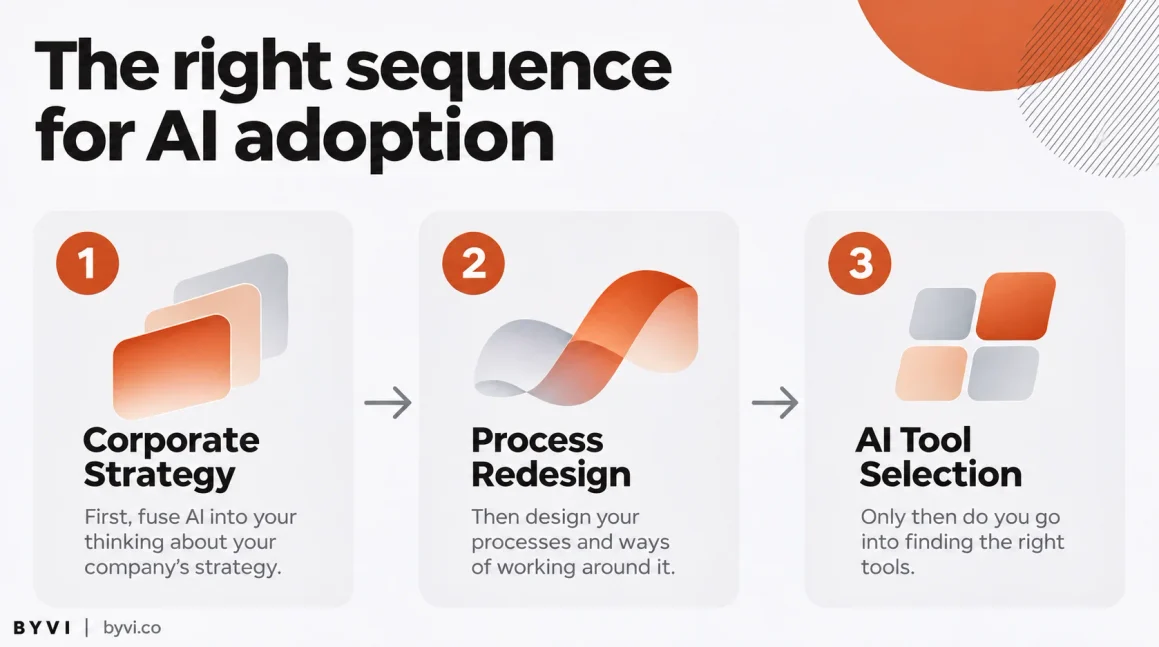
So you first fuse AI into your thinking about your company’s strategy and design your processes and ways of working around it. Only then do you go into finding the right tools, technology and implementation, AI tools or not. That’s how you end up using AI efficiently and successfully, with everything interconnected, and that last part is what the big companies in the study are mostly missing.
RELIABL.IT, the startup I founded and run as CEO, came out of those same observations and tries to make that sequence a reality.
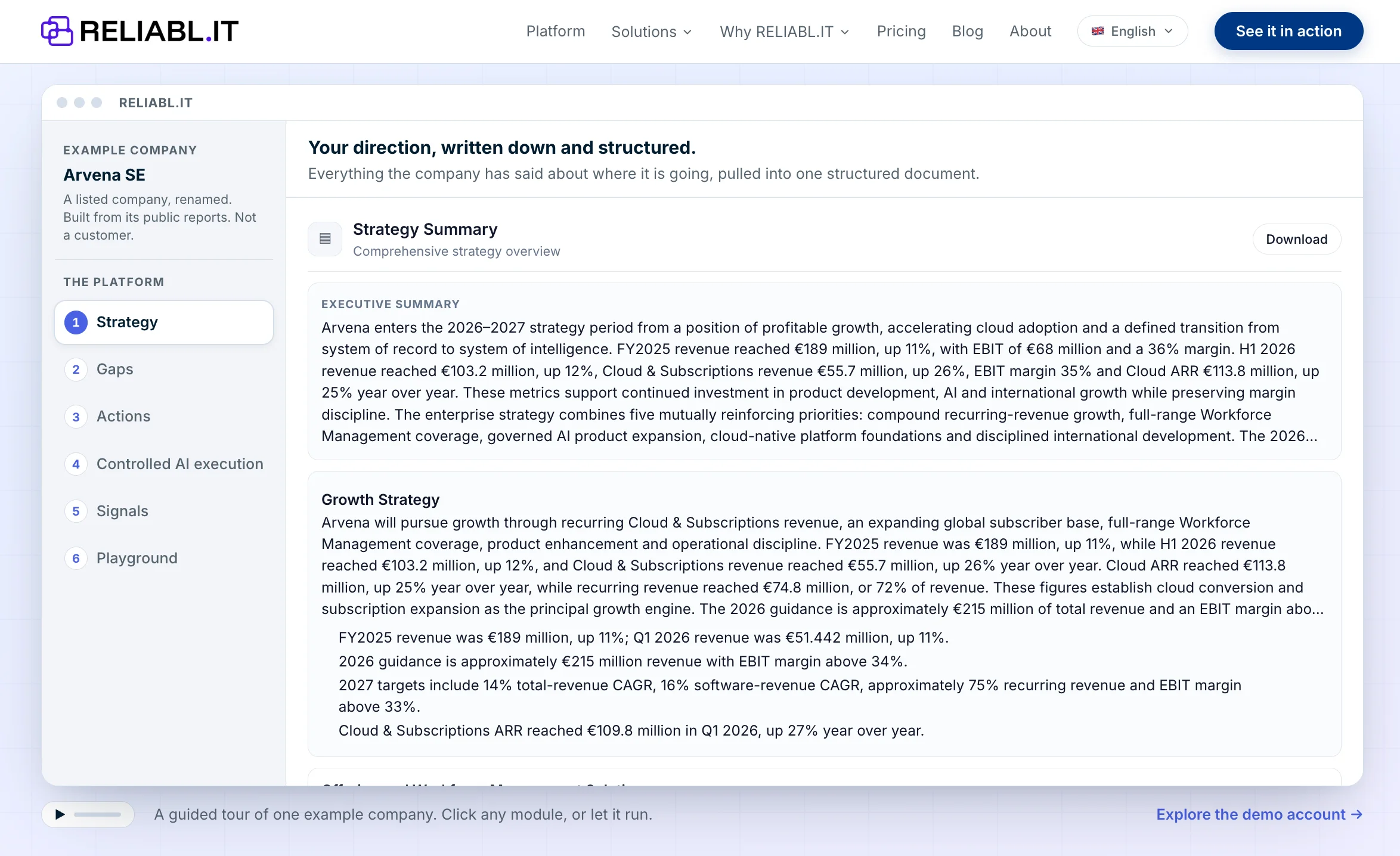
In that investor update, the strategy tells you which handful of numbers the company actually runs on. The redesigned process says where each of them comes from and which agent pulls them together every month, so nobody stitches them by hand. The tools come last, picked because they fit that process.
Of six common AI rollout approaches, only a CEO-led strategy and process redesign picks tools last, while the others feed AI tool sprawl or leave company results unchanged.
| AI rollout approach | Who usually drives it | Typical outcome | Key evidence |
|---|---|---|---|
| Buy a separate AI tool for each problem (treating AI like SaaS) | Department heads | AI tool sprawl, redundant tools, embedded agents with broad data access | 183 AI tools on average, only 15% of AI investments unified (US companies with $500M+ revenue, June 2026 survey) |
| Let employees use AI chatbots freely on personal accounts | Individual employees | Company gains only in a handful-of-people startup, data and privacy exposure as it grows | ChatGPT Free, Plus and Pro content may be used to improve OpenAI’s models, depending on settings |
| Give every employee access to one AI assistant | IT | Individuals save time, P&L doesn’t move | 15.2% more issues resolved per hour, no economically significant change in customer satisfaction (5,172 support agents, one Fortune 500 software company) |
| Prompt training for all staff | HR | Some tasks get faster, company results unchanged | 38% of executives cite skill gaps as a barrier vs 61% for siloed mindsets and culture (US companies with $500M+ revenue, 2026) |
| IT-led AI pilots and proofs of concept | IT or CTO | Technically sound pilots that stay pilots, not tied to strategy | Average organization scrapped 46% of AI proofs of concept before production (North America and Europe, 2024 survey) |
| Redesign strategy and processes first, then choose AI tools | CEO | Connected systems, no manual stitching, tools picked to fit processes | Only 42% of CEOs vs 57% of tech leaders say they own AI orchestration (US companies with $500M+ revenue, 2026) |
Why Do Scaling Startups Need Privacy Guardrails for Large Language Model Usage?
The advice to let every team try AI tools freely and see what sticks breaks down, I think, for any company, startup or not, with one exception. In an early-stage startup it can work, if what you encourage is the use of LLMs in general, through the chat interfaces of any or all of the popular models. There, personal productivity does equal company productivity. When the whole company is a handful of people, what each of them gets done is what the company gets done.
As soon as the startup becomes a bit larger, it needs the other approach. Once you have an organization and certain processes in place, have found product-market fit and are really scaling, you go back to the strategy and understand how AI changes your processes. You redesign them, or design them around AI, and then use the right tools to support that.
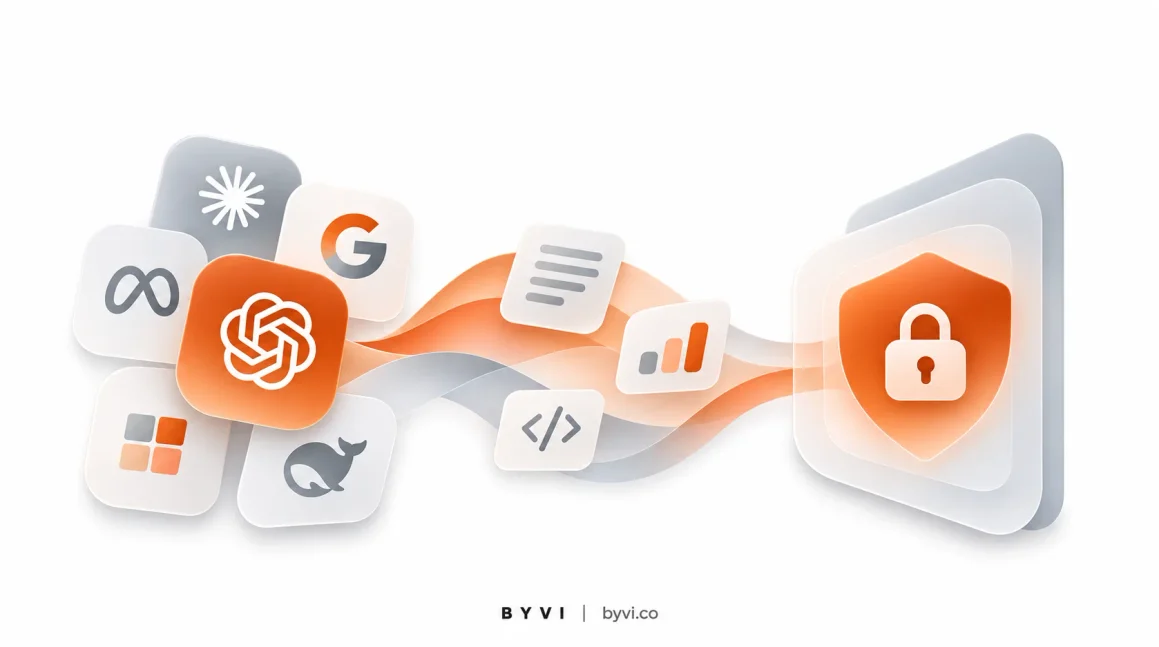
You need guardrails at any time, whatever the stage, for a variety of reasons. Whenever you’re dealing with business data, proprietary data or privacy-related data, you simply need to be on top of what goes into these tools, if only for compliance reasons. Depending on the service, what you put in may be used to train the models. OpenAI’s own policy says content from its individual Free, Plus and Pro plans may be used to improve its models, depending on settings. ChatGPT Business, Enterprise and API data are excluded by default. So an employee’s personal Plus or Pro subscription falls under the same policy as the free plan, and every vendor sets its own terms. You should be driving which tools get used in your company in any case, AI tools or not.
Why Do Individual AI Productivity Gains Fail to Improve Corporate Profitability?
In an interview, one of Microsoft’s executives said, as I understood it, that the company had given Copilot access to everybody. It didn’t really move the needle for the company as such. That matches what I observe in the market. On the P&L level nothing moves. On the level of individuals, people tend to be happier and more satisfied, and I attribute that to them having more time. AI does help them do what they need to do in a shorter amount of time, so they have more time for coffee breaks, cigarettes, talking to their colleagues and doing things at a more leisurely pace. They save the time, but they don’t turn that saving into higher productivity for the whole company.
When you judge an AI rollout, remember that even well-measured individual gains can leave the company’s outcomes where they were. A study of 5,172 customer-support agents at one Fortune 500 software company found that AI assistance raised issues resolved per hour by 15.2%. Customer satisfaction showed no economically significant change.
Microsoft basically admitted that giving everybody access was not the right approach. Internally, they started to rewire the ways of working. The examples they presented showed the most benefit where they really redesigned a process around AI. I believe that confirms the thesis that you go back to the strategy, identify and rewire the processes, and only then choose the right tools to agentify your work.
Why Must the Chief Executive Officer Own Corporate AI Orchestration and Strategy?

The same survey found that 42% of CEOs say they’re directly responsible for AI orchestration, while 57% of technology leaders claim exactly the same role. Those numbers show the confusion without settling who should own it. For me the answer, in any company and certainly in a startup, is the CEO. Implementing and using AI connects directly with the strategy and with how the company operates, which makes it a top management thing. IT needs to implement it, of course, the technical part, but they are not the ones to own it. Between a founder and a CTO, that means the founder, as CEO, owns the strategy and so needs to own the whole AI topic.
What happens otherwise is quite a standard case, and I see it in the market constantly, with a variety of companies. Sometimes the IT guys say they understand the technology and will help. Even more often, the CEO is under pressure from the board and decides the company needs to do something with AI. The CEO asks who understands the technology, lands on the geeks in IT and tells them to do something. POCs and pilots get built, done perfectly from a technological perspective, and maybe they even move a needle in the business to a certain degree. But they aren’t connected with the strategic direction of the company, so they remain pilots and POCs.
The other version is an HR person telling the CEO not to worry, because they can teach everybody how to prompt and then everybody will be a lot more productive. It doesn’t work, for the same reason free access doesn’t. Some people do certain things faster and people in general are happier at work. But unless you also redesign the processes around AI, nothing moves on the level of the company. Siloed mindsets and company culture top the study’s ranking of barriers, at 61%. Skill gaps, the thing prompting classes are meant to fix, come in at 38%. Budget, the one barrier a fresh round takes care of, comes in lowest, at 29%.
These approaches are simply flawed, and they’re connected with the fact that nobody really clearly owns AI. It has to start at the top, with the strategy, and trickle down from there. You can appoint somebody to help orchestrate everything, sure, but the buck begins and starts with the CEO.
As a VC-backed founder, you already have institutional investors on board, so the reporting that turns accepted messiness into a problem is either here or close. You’re also still at a size where the person who owns the strategy can decide which processes get rewired around AI before the tools and their agents pile up. The companies in that study have to make the same decision with an average of 183 tools already running.
FAQs
Start by freezing new deployments and mapping exactly what agents are touching your data. Studies show two-thirds of organizations routinely uncover redundant AI investments. You cannot afford that cash burn. Audit your stack by mapping tools directly to core processes, and ruthlessly cut anything operating in a silo.
No. Throwing cash at fragmented tools accelerates the mess. Research shows budget is the lowest barrier to AI success at just 29%. The real killers are siloed mindsets (61%) and fragmented data (58%). Use capital to build a centralized operating layer first, rather than funding a bloated tool stack.
Absolutely. AI is no silver bullet. An Organization Science study found users were 19% less likely to correctly solve complex managerial tasks using AI. Depending on sprawled, uncoordinated tools for critical operational decisions introduces massive blind spots into your leadership.
Don’t confuse operational speed with customer love. A Quarterly Journal of Economics study found AI increased support issue resolution by 15.2%, but produced no significant change in customer satisfaction. Sprawling AI tools might clear your ticket queue faster, but they won’t automatically build a brand people actually love.
It starts when high-performers optimize for personal speed without organizational guardrails. If you lack a clear AI owner – like one in four companies do – your teams will independently adopt tools. Soon, 85% of your stack lacks shared intelligence, and your startup inevitably stalls in data integration hell.
About the Author

Darko Butina is the CEO and founder of RELIABL.IT, the management operating system for the AI-powered company. The platform turns a company’s goals into 1 action plan for both its people and its AI agents, so every department moves toward measurable results, and the plan adapts as the market changes. Over his career he’s held CEO, CxO and board roles and worked as an investor and advisor. His focus has been on growth and scalability through digital transformation, new business models, operational excellence and M&A. He has led teams in Switzerland, the UK, the UAE and Slovenia, and worked across Europe, Asia and the US. Darko is the author of Management in AI Powered World (2023), AI Powered Leader (2025) and Dynamic Strategy (2026).