By Daniel Zhao, Head of Finance at Landbase, previously co-founder at LavaReach (acquired)
The hardest part of building something new is never the part everyone assumes will be hard. I keep coming back to this, and Travis Kalanick’s new venture is the cleanest example I’ve seen in a while.
After roughly 8 years of near-total stealth following his 2017 exit from Uber, Kalanick’s company Atoms just raised $1.7 billion in a round led by Andreessen Horowitz, with Uber (the company whose investors forced him out) joining as an investor and Ben Horowitz taking a board seat.
The pitch is enormous: use software, sensors, and robotics to automate the physical economy across food, mining, and logistics
Travis Kalanick is back.
— a16z (@a16z) July 22, 2026
After 8 years of building in stealth, he joins Ben Horowitz and Erik Torenberg to tell the story of his latest company, Atoms, and its vision to digitize the physical world one industry at a time:
01:32 The a16z & Uber backstory
15:36 Different… https://t.co/CmHLuzWYBR pic.twitter.com/hjzHk1vkBf
Ask most people what the hard part of an automated kitchen is, and you’ll hear the same list:
- The computer vision.
- The robotic arms.
- The supply chain.
- The capital.
Every one of these sounds hard because it is hard, and because it’s what makes it into the pitch deck. So that’s where the money and the engineering attention go.
The hard part turned out to be everything nobody puts on a slide.
The machine that slows down when it has to bag your food
Atoms’ flagship food system, the Bowl Builder, takes an order straight off the point-of-sale, dispenses and weighs ingredients, adds sauce, lids the bowl, labels it, drops in utensils, and closes the bag. On paper it can assemble up to 300 bowls per hour.
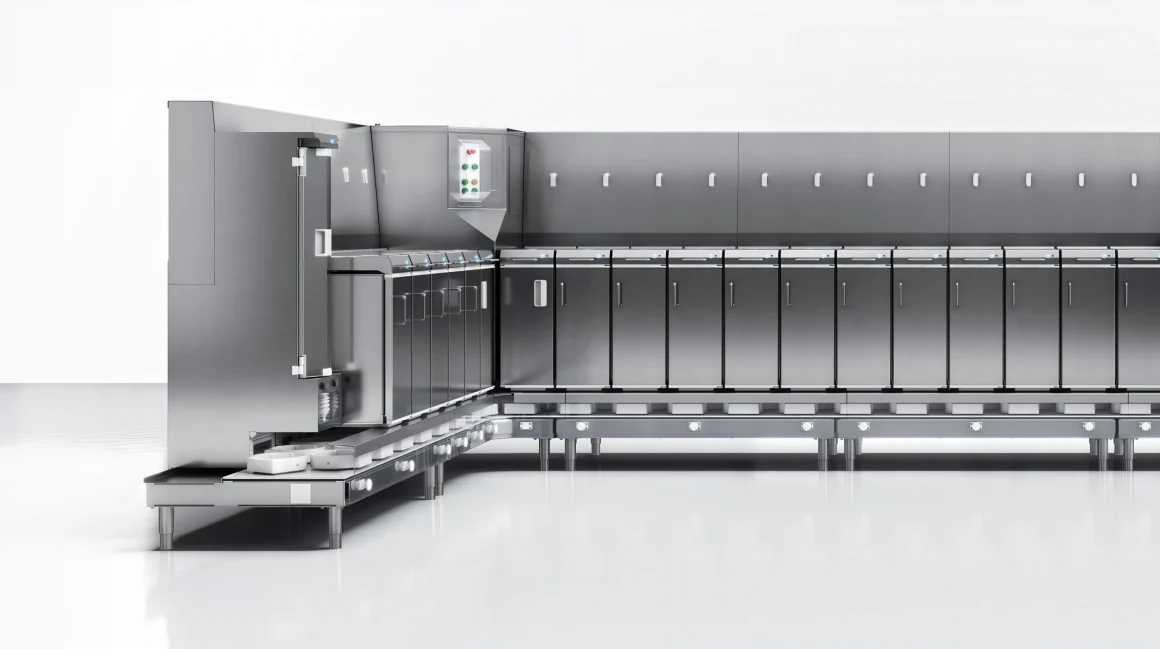
Except it can’t, not when it also has to bag them. The moment bagging enters the workflow, throughput drops to about 200 bowls per hour. Kalanick’s own word for the bagging problem, on the TBPN podcast, was that it’s “surprisingly hard.”
Look at what that means. A company that just pulled $1.7 billion in a single round, run by one of the most operationally aggressive founders of his generation, loses a third of its output to the most unexpected step in the whole process. And it’s not the sensing. Not the dispensing. Not even the sauce. It’s the bag.
That’s the “fries in the bag” problem: the step so ordinary nobody budgets it any respect, right up until it’s the exact thing standing between you and shipping.
Why the boring problems are the hard ones
There’s a reason this pattern repeats. The glamorous problems attract attention, talent, and money precisely because everyone can see them coming. They get scoped, staffed, and de-risked. The boring problems don’t get that treatment, so they arrive undefended, and they arrive late, usually after you’ve already committed to a timeline and a number.
A bowl is a rigid, predictable object. A plastic bag is not. It’s floppy, it clings to itself, it doesn’t hold its shape, and no two are quite alike. Everything a robot is good at (precision, repetition, hard geometry) is exactly what the bag refuses to give it.
This is what quietly reshaped how I think about leadership, and about finance specifically.
The leadership lesson hiding in the bag
It’s tempting to treat “hard problems” as the big strategic ones, the market, the model, the fundraise, and hand the messy operational stuff to someone else. That instinct feels like leverage. It’s usually the opposite.
The leaders who actually ship are the ones who stayed close enough to the work to know where the real friction is.
Not because they insist on doing everything themselves; that doesn’t scale and it isn’t the point. It’s that you cannot fix what you’ve never gotten close enough to see. Kalanick knows his throughput drops on the bagging step because someone in that organization got close enough to the machine to watch it happen and put a number on it.
Delegation doesn’t work against this. Good delegation is how you build a company. But hand off a problem before you understand it and all you’ve really done is arrange for someone else to discover it for you, later, and usually at far more cost to the business than if you’d caught it early.
I sit in finance, which makes this personal in a specific way. Every model I’ve ever built has a “fries in the bag” line item: the assumption everyone waved through because it seemed too small to matter. The onboarding step that quietly determines whether a customer ever activates. The reconciliation process that works fine at 50 transactions and breaks at 5,000. The manual handoff between two teams that no dashboard captures because it lives in the gap between them.

On a spreadsheet these look like rounding errors. In the business they’re the difference between a plan that holds and one that doesn’t.
The costliest surprises I’ve seen were never the risks we named and argued about in the boardroom. We had those covered; that’s what boardrooms are for. The expensive ones were the steps so ordinary nobody thought to ask whether they’d actually work at scale.
What Atoms actually confirms
It would be easy to read the Atoms story as a victory lap: stealth genius resurfaces, raises a fortune, takes on the physical world. And maybe it turns into that. Horowitz is betting that reshaping the old, heavy parts of the economy needs a founder with range across software and mechanical engineering, and that Kalanick is that founder.
But the part of the story I keep pointing people to is the honesty about the bag, not the $1.7 billion. A founder with that much capital and conviction telling you, plainly, that the humble step is the one giving him trouble. Read it the right way and that’s a good sign: someone got close enough to the friction to name it before it showed up in the numbers on its own.
The strategic bets are real, and they’ve earned the attention they get. But the thing most likely to cost you a third of your output is usually sitting one step downstream of where everyone is looking, dressed up as a task too simple to fail.
Before I sign off on any plan now, I ask myself one thing, and I’d pass it to you:
What’s your “fries in the bag” problem, the boring step you’ve already handed off, assuming it would sort itself out?
Better to go find it yourself than to read about it later in the P&L.
About the Author

Daniel Zhao is Head of Finance at Landbase and a multiple-time founder, most recently co-founder of LavaReach (acquired). He started his career as a CPA, building the financial rigor that still shapes how he operates, then moved from the ledger into the parts of a company where the numbers are actually made or lost: revenue, operations, and go-to-market. That path, from accounting fundamentals to B2B revenue leadership, gives him a rare vantage point on how startups really grow, and where they quietly break.