Written by Lidia Vijga
On July 30 LinkedIn started letting anyone flag your post as “AI slop” with two taps, then feed that flag straight into a model that decides who sees you next. For founders who treat LinkedIn as their main distribution channel, that little button quietly rewrote the rules of what earns reach.
Here’s what actually shipped, why it lands on us harder than on anyone else, and how to post so the button never gets pointed at you.
What LinkedIn actually shipped
Open LinkedIn, scroll for 30 seconds, and you’ll spot them by their tics. “This isn’t just a product update. It’s a masterclass in resilience.” “What a 4-hour flight delay taught me about scaling a Series A.” The “Let that sink in.” And the “Agree?” at the end of each post. And of course one of my favorites: the “Unpopular opinion:” that is, in fact, the most popular opinion on the platform.
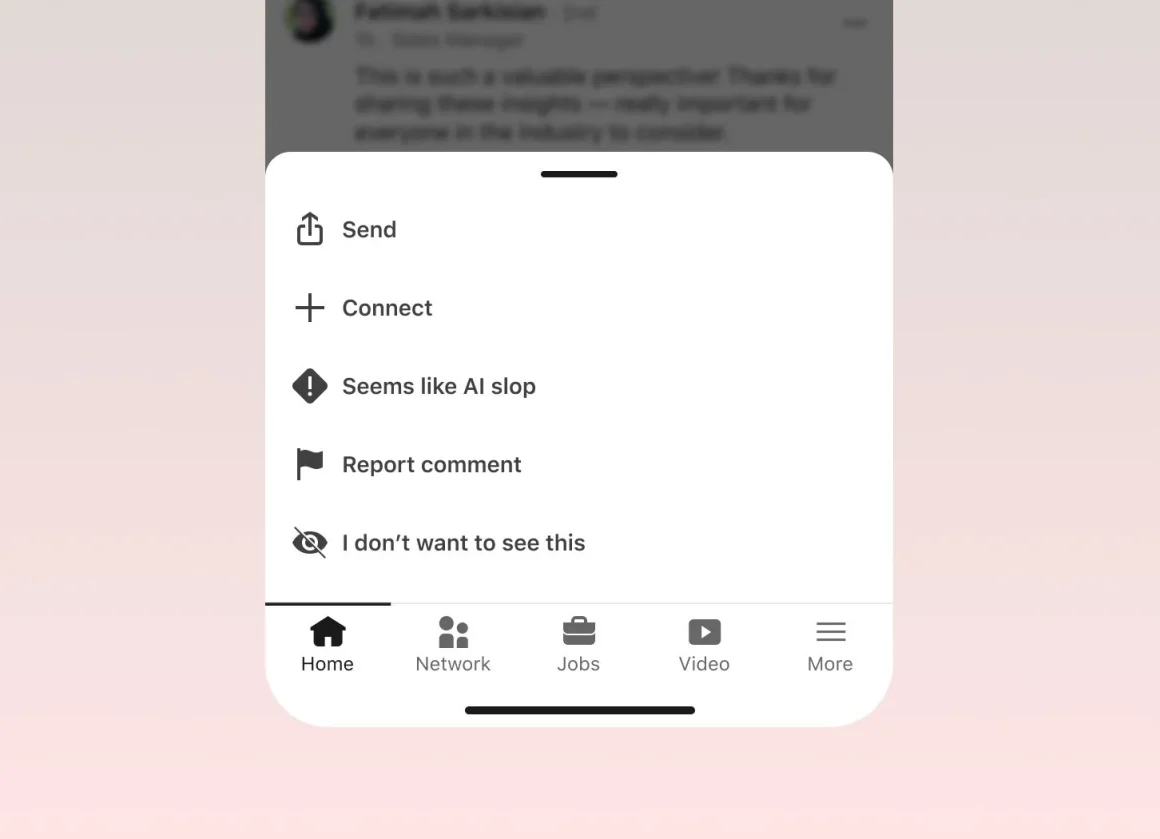
That specific flavor of nothing now has a button attached to it. Tap the three-dots menu on any post or comment and you’ll find a “Seems like AI slop” option, as Chief Product Officer Hari Srinivasan showed in his own post announcing the change.
“AI slop is a top priority for all of us. We really care about this. People come to LinkedIn to connect with real people and share their real perspectives, ideas and expertise.”

Hari Srinivasan, Chief Product Officer, LinkedIn Ecosystem
The button isn’t just a mute switch. Srinivasan said the flags feed LinkedIn’s classifiers directly: “We are ramping the ability for members to tell us if they believe a post or comment seems like AI slop. Slop is hard to define and the definition changes; this lets us tune our models and make better feeds.”
In plainer terms, every report is a training signal, and posts the crowd tags as slop get less algorithmic reach, especially in the suggested content LinkedIn pushes to people outside your network.
Three other moves came in the same announcement, and each one matters for how you show up.
- LinkedIn is pulling its own “enhance your post” AI writer and replacing it with a tool that, in Srinivasan’s words, “proofreads your words, but does not change your voice.” (Yes, the company that sold you the polish is now quietly taking it back. Awkward.)
- It’s adding a private flag in your analytics dashboard that warns you when readers feel a post came off as inauthentic or over-reliant on AI.
- On the automation side, LinkedIn now blocks “hundreds of thousands” of automated comment attempts every day.
Why the sudden urgency? Because the numbers are genuinely embarrassing.
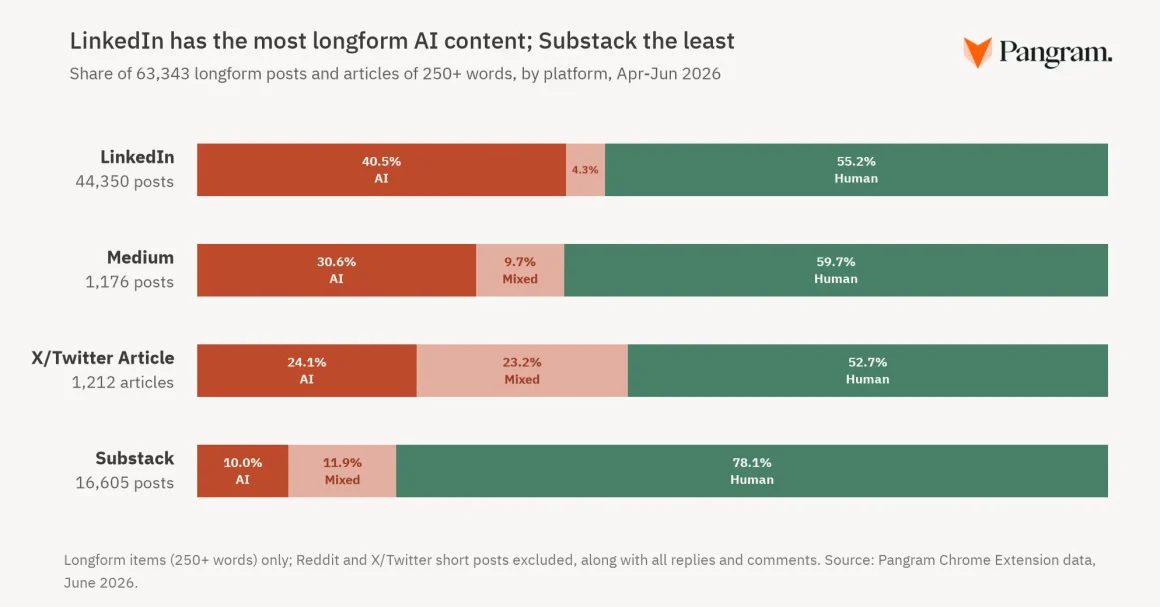
AI detection firm Pangram scanned more than 1 million social posts and found LinkedIn was the most AI-saturated platform of all: over 40% of its long-form posts flagged as fully AI-generated, and while LinkedIn made up only a third of everything Pangram scanned, it accounted for 62% of all the AI content the firm flagged.
Why this lands on founders harder than anyone
LinkedIn is where a lot of us go to raise, hire, and sell before we have the logos to do it the easy way. For an early-stage founder, our feed is the pitch deck that runs 24/7.
Let’s start with the obvious risk. If you’ve been scaling your “thought leadership” by feeding bullet points into a model and posting whatever came out, you were already living in the 40%.
Now the readers you’re trying to win, the ones who were going to remember your name at fundraise time, can label that output slop in two taps, and the algorithm will believe them.
The channel you leaned on to look credible can now make you look generic. And unlike a paid campaign you can pause, a reputation for slop compounds quietly: the classifier remembers, and your reach decreases before you notice the flag in your dashboard.
The deeper shift is what LinkedIn is protecting. Srinivasan said the goal is to let “members get feedback from real humans on what sounds authentic.” That’s a trust economy, and trust is the one asset a pre-revenue founder actually has to trade.
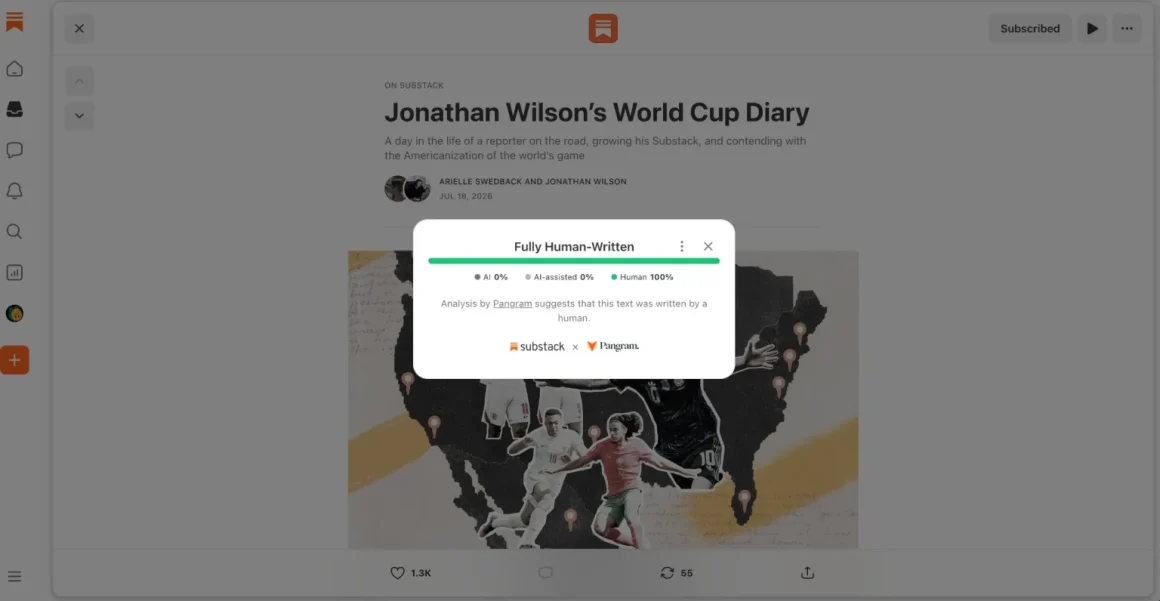
And no, this isn’t a LinkedIn-only tantrum. Substack just shipped a tool with Pangram that tells readers when a newsletter was written by AI.
Pinterest added toggles to cut AI content from feeds, and Snapchat said it will stop recommending AI slop outright. Pangram itself raised $9 million to chase this problem across the web.
The direction of travel is one way: every platform a founder uses to reach people is turning “written by a human” into a ranking factor.
The LinkedIn posts I’d publish now
The slop button punishes exactly the content that was never going to convert anyone anyway. So your authentic, specific, founder-voiced posts just caught a tailwind.
Write the post only you could write.
The fastest tell of slop is that literally anyone could have posted it. Your defense is proprietary: a real churn number, a deal that face-planted and why, a metric nobody else can touch.
Look at how Tom Hunt (I’m a huge fan) writes about his company Fame: they ship around 1,000 client assets a week, the reviews that used to need people now run on AI, and a job that once meant a high-paying hire is “now a $7 API call.”
You can’t prompt that post into existence, because the numbers only live inside his business. A model can fake your tone all day. But it can’t come up with specific figures you pulled from your own Stripe account.
Kill the AI polish pass.
LinkedIn just deleted its own “enhance your post” button because the polish was the problem, so take the hint. Draft in your own words, then use AI the way LinkedIn’s replacement tool now does: to proofread, not to rewrite.
The second a model buffs your sentences into that smooth, generic filler, you’ve traded your voice (the thing that survives the new ranking) for the thing it now punishes.
If you don’t want to use LinkedIn’s proofreader, try this prompt below with any AI model. It edits like a line editor, not a ghostwriter, protects your numbers, and strips every tell up top without flattening your voice.
ROLE. You are my line editor, not my ghostwriter. Make my draft cleaner and clearer while keeping it unmistakably mine. The test: if someone who knows my writing couldn't tell I wrote it, you failed. When in doubt, do less.

VOICE PRIMING (optional, recommended). Before editing, study 2 to 3 of my past posts (pasted below) for my sentence length, rhythm, the words I reach for and the ones I never use. Match that fingerprint. Do not average me toward "good LinkedIn writing."

YOU MAY: fix grammar, spelling, punctuation, and typos; tighten only genuinely redundant or confusing sentences (cut filler words, never ideas); point out (don't fix) any claim that reads as vague or unsupported.

YOU MAY NOT: change my word choices, rhythm, or structure to sound "more professional"; add adjectives, transitions, hype, hooks, or summary lines I didn't write; smooth out my fragments, asides, or short punchy sentences; touch any number, name, quote, or date (treat them as load-bearing); use em dashes or en dashes (use commas, colons, periods, or parentheses).

BANNED PATTERNS (remove if present, never add): "This isn't just X, it's Y" contrast framing; throat-clearers like "Here's the thing" or "In today's fast-paced world"; engagement bait like "Let that sink in," "Agree?," "Unpopular opinion:"; single sentences stacked one per line for drama; corporate gloss like "leverage," "unlock," "game-changer," "masterclass in," "humbled to announce"; emoji used as punctuation.

PROCESS: read the whole draft first to learn my voice; make the lightest edit that does the job; if a change might alter my meaning or voice, leave it and flag it.

OUTPUT: (1) the edited draft; (2) "Changes," each fix in one line with why; (3) "Flags," anything vague, unsupported, or that sounds like me on autopilot rather than at my sharpest.

MY DRAFT: [paste it here]
Put your face on it and show up with proof.
With 100 million verified profiles, LinkedIn is all-in on identity. Post from your verified personal profile and bolt on proof a machine can’t hallucinate.
- The actual customer message
- The real graph
- The awkward group shot from the offsite
- The team photo where nobody’s looking at the camera
- Imperfect behind the scene moment.
“Specificity + verified human = reach. (The algorithm’s new favorite.)
Trade cadence for evidence.
The old growth hack was volume, and volume is precisely what the automation crackdown is built to shut down. LinkedIn is already cracking down on engagement pods and automated comments, blocking hundreds of thousands of comment attempts a day. So post 3 times a week with proof instead of daily with filler. One post carrying a number you earned for sure beats 5 that sound like everyone else on LinkedIn.
Treat comments like the product.
LinkedIn is spending real engineering effort removing bot comments because fake engagement damages trust faster than fake posts do.
So do the opposite of automation: read the actual post, reply to people by name, reference the actual thing they said, argue in good faith. Real conversation in your comments is now a trust signal the platform is actively protecting, and it costs you nothing but attention.
When in doubt, use a meme.
A model can fake a paragraph. But it can’t fake taste, timing, or a joke that actually lands. A well-chosen meme is proof there’s a human with judgment behind the account, and it’s native to how people already talk on LinkedIn.
Evan Lee does this well: he pairs a meme with a sharp point about matching your ads to your funnel instead of another 400-word “here’s what I learned” essay, and it lands harder.
You don’t need to be funny every time. You need to sound like a person, and nothing says “not a bot” like a meme you actually found funny.
The bottom line on AI slop button
The slop button reads like a threat, and for the founders who outsourced their voice to a model, it is one. But I think LinkedIn just did something useful: it turned “sounds like a real person with something to say” into the biggest distribution advantage.
The same tools that made it easy to flood the LinkedIn feed just made flooding it pointless. What’s left is something founders have plenty of and big companies can’t copy: a clear point of view, backed by numbers only you can see, in a voice that’s clearly yours.