Written by Lidia Vijga
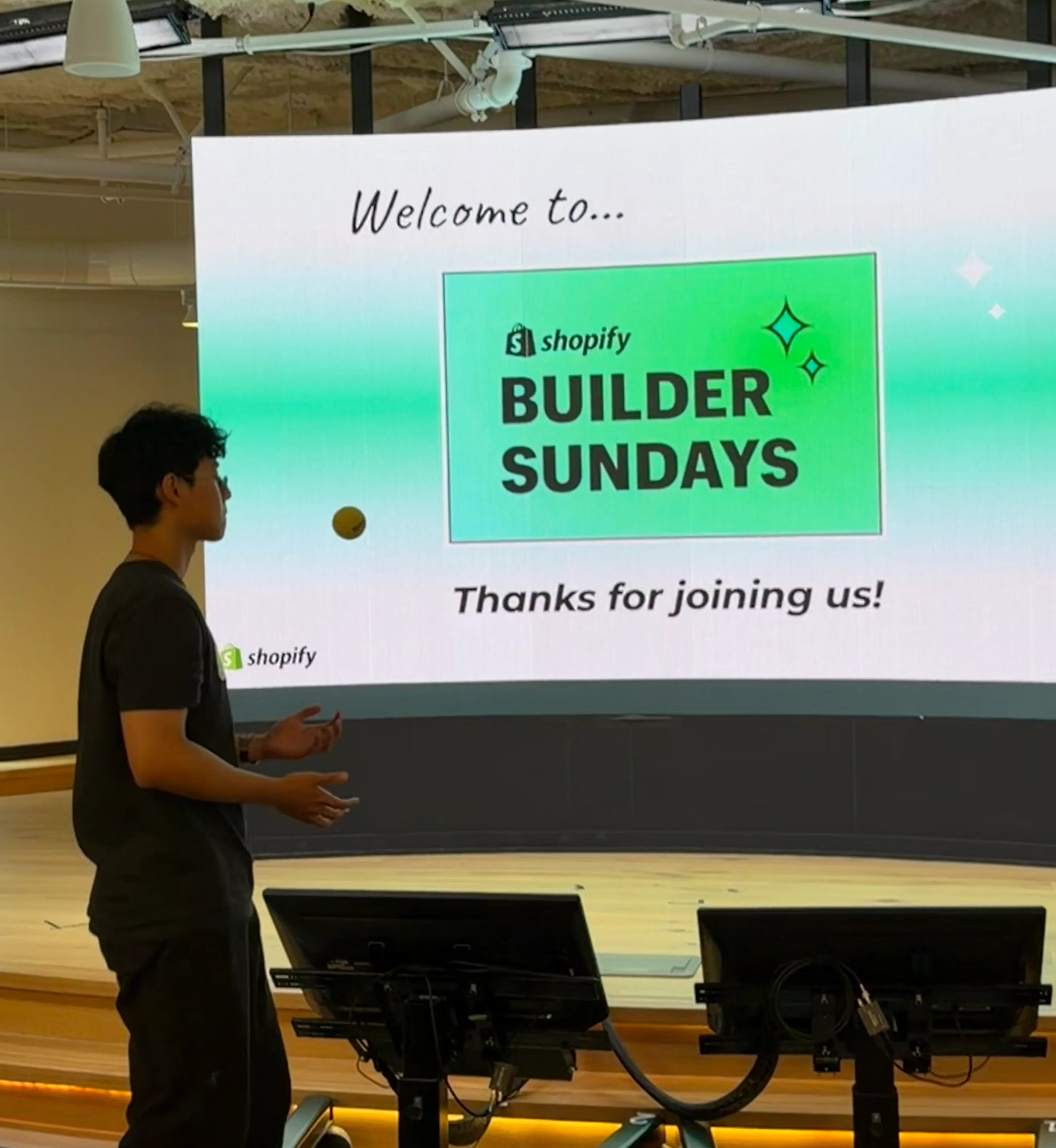
Last Sunday, I spent the afternoon at Shopify’s Ottawa office alongside a room full of founders and builders. By the end of the day, 8 of them had taken the stage to demo what they’d been working on. That’s the whole idea behind Builder Sundays, and it’s why I think every early-stage founder within driving distance should experience one at least once.
What Shopify Builder Sundays Actually Is
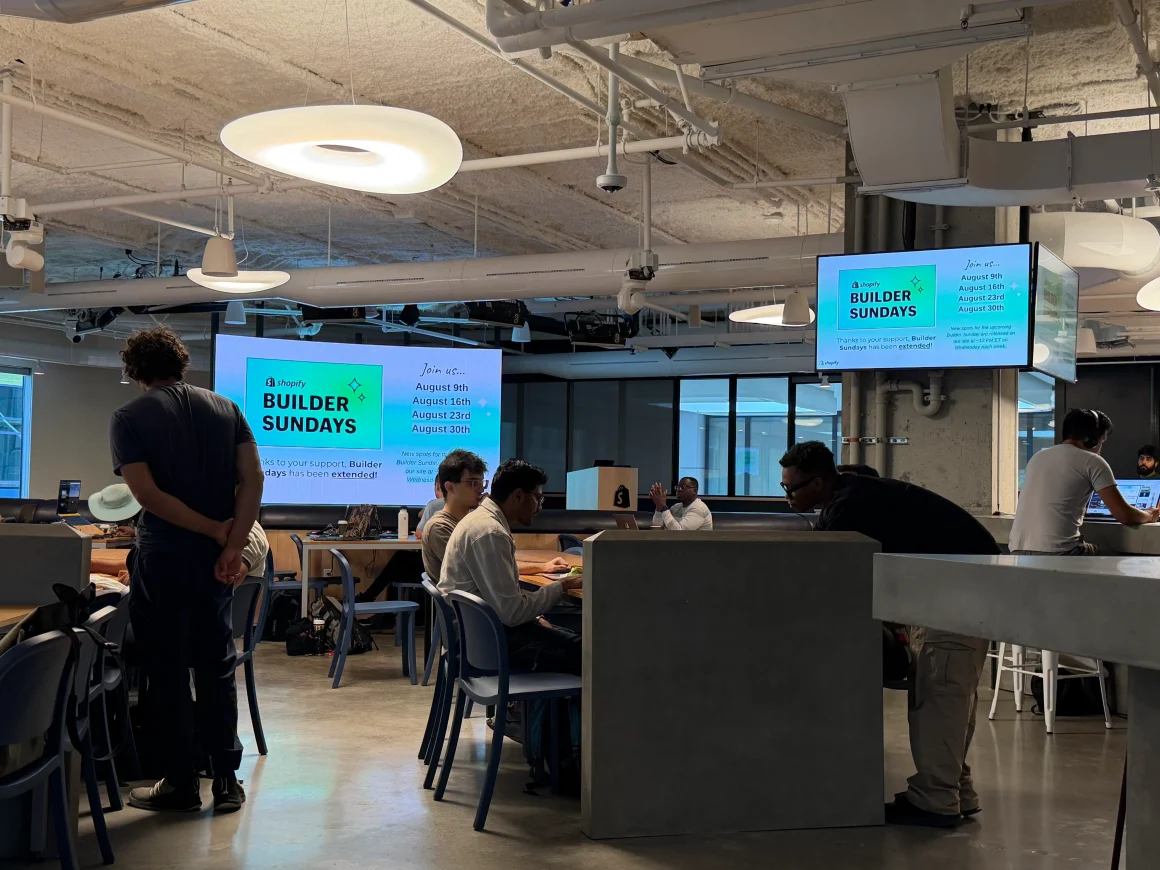
Builder Sundays is a free, drop-in deep-work session that Shopify runs every Sunday from 12pm to 5pm in Toronto, Montreal, and Ottawa. The format is simple: you bring a laptop and something you want to make progress on, work alongside other builders, and let the energy of the room do the rest. Deep work runs until around 3:30pm, followed by open demos and an hour of networking. Spots for the following Sunday are released Wednesdays at noon ET, and you register individually, including for any guests you bring.
Why Builders Should Give It a Shot
Apart from connecting with other builders in the room, Builder Sundays offer 3 things founders absolutely need to grow.
1. Practice Your Pitch
You don’t sign up to pitch ahead of time. If you want to demo, you put your name on the board that day on a first-come, first-served basis, then take the stage and show what you managed to build.
There’s no polish requirement, no committee, and no gatekeeping. You simply get up and pitch. And that’s what makes it so useful: you’re practicing in a low-stakes environment where you can experiment, get comfortable on stage, and learn what resonates.
2. Build the Habit of Shipping
A tight deadline forces you to cut scope, make decisions quickly, and actually finish something. That’s a muscle many founders lose while endlessly refining roadmaps, tweaking ideas, and planning for the “right” time to launch.
3. Get Real Feedback
You also get something that’s genuinely hard to replicate: a room full of people willing to give you immediate, honest feedback. They’ll ask questions, poke holes in your idea, test your assumptions, and point out what’s missing, all before you’ve spent weeks or months building in isolation.
8 Pitches From Builder Sundays
So you get the vibe, here’s a quick tour of the eight pitches that took the stage that afternoon.
Worth It: The Anti-Diet App Built in 2 Hours
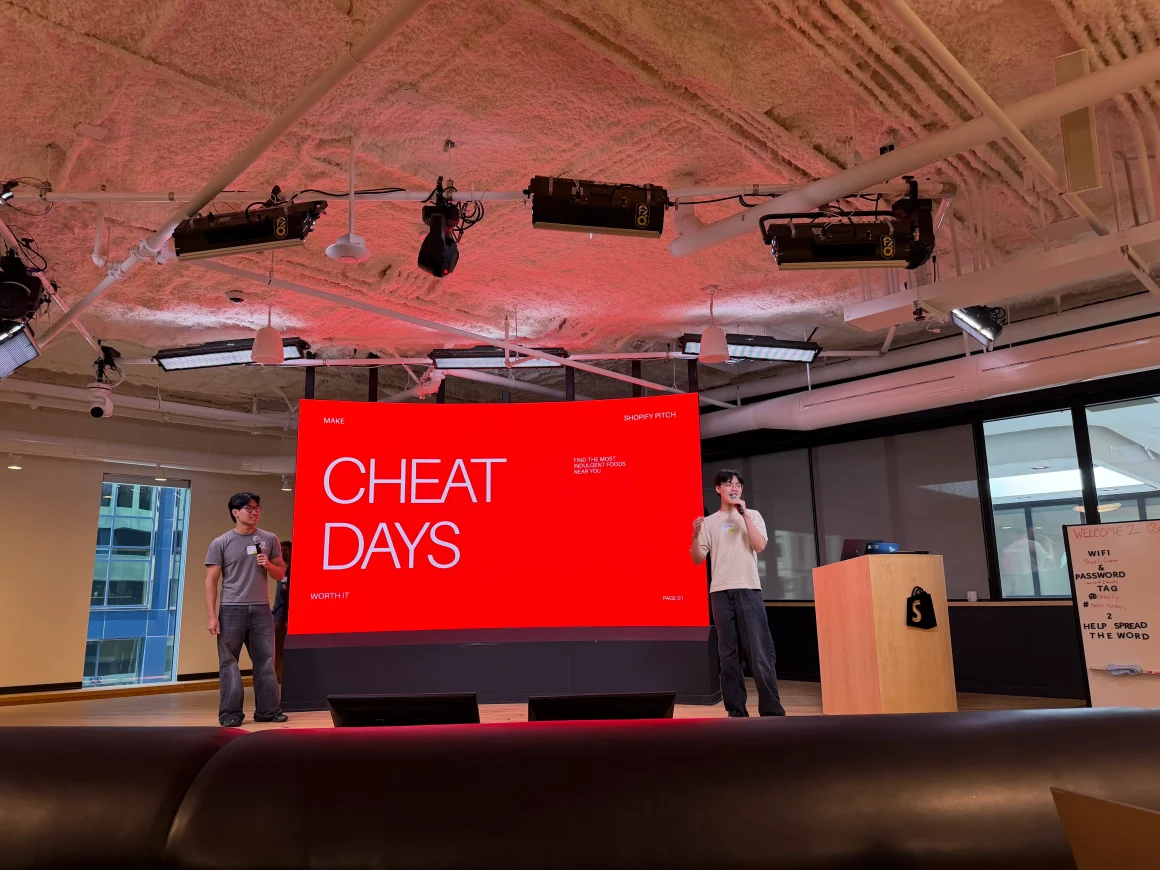
Brandon and Brian, two students heading into their first year of university, set themselves a simple challenge: build something end-to-end in two hours. The idea, presentation, and product all started around 1pm that afternoon.
Their creation, Worth It, takes the opposite approach to typical health-food apps. Instead of finding the lowest-calorie option nearby, it pulls the menus of surrounding restaurants, runs them through AI, and surfaces the highest-calorie, most worth-it foods for your cheat day.
They pointed at an $800 billion diet and wellness industry and 88 million people tracking their macros (protein, carbohydrates, and fat), then argued the disciplined crowd is exactly who wants a proper break when they take one.
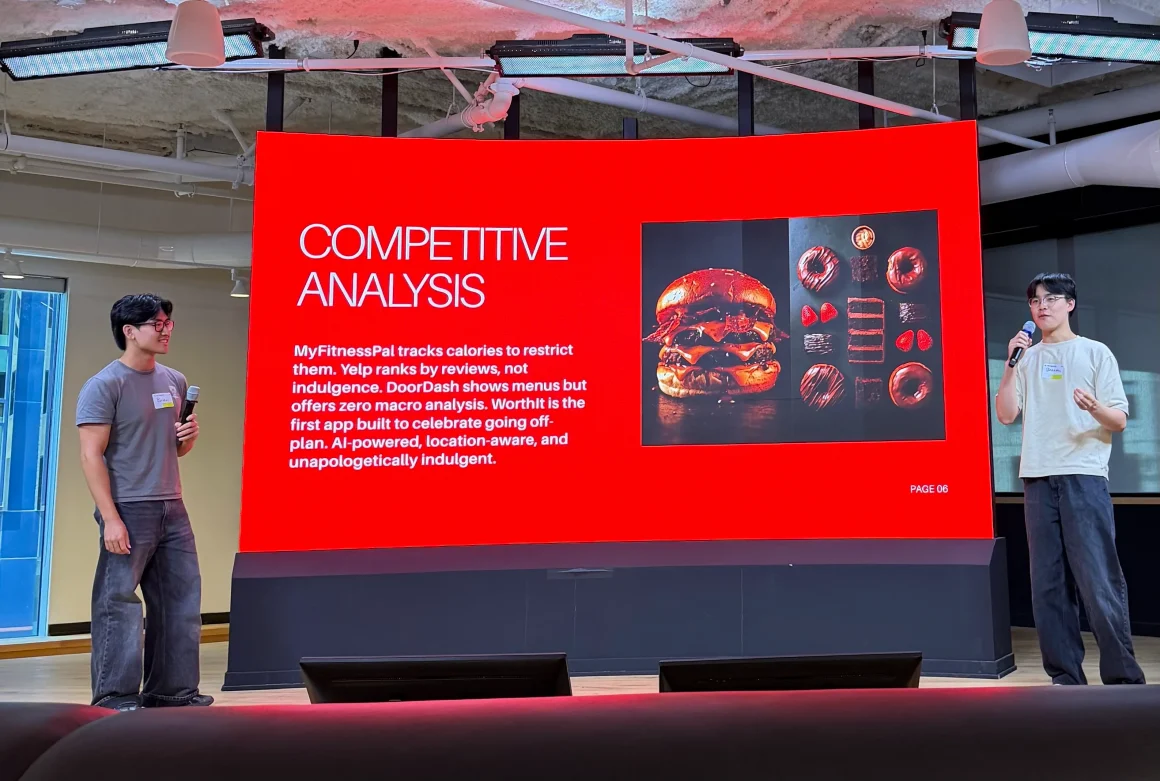
The demo found their location on O’Connor Street and served up a double bacon burger with cheddar and fries within 5km.
Built with React and TypeScript and powered by Anthropic, the app cost them just 32 cents to test. They were clear that the goal wasn’t to build a serious business, but to challenge themselves to go from idea to working product, get comfortable presenting, and see how far they could push 2 hours of focused work.
The room’s reaction summed it up: the amount of fidelity they reached in two hours was pretty crazy.
Tandem Robotics: Farm Robots Built to Work Alongside Farmers
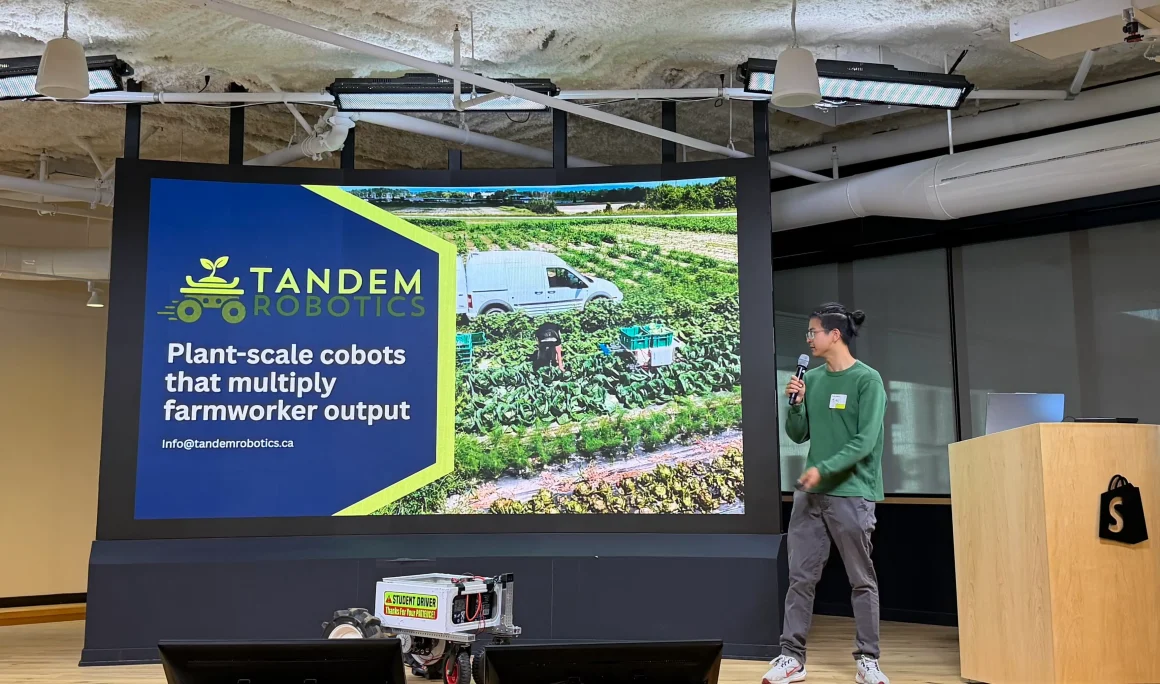
Ming and his team at Tandem Robotics started with the farmer, not the robot. After talking to growers at the Lansdowne Farmers Market, he heard the same problem over and over: they need more labor, but it’s getting harder and more expensive to find.
According to the numbers he shared, 44% of farmers can’t find the workers they need, while labor accounts for 38% of farm operating revenue. The physical toll is significant too, with 58% of farm workers experiencing lower back pain within their first 12 months.
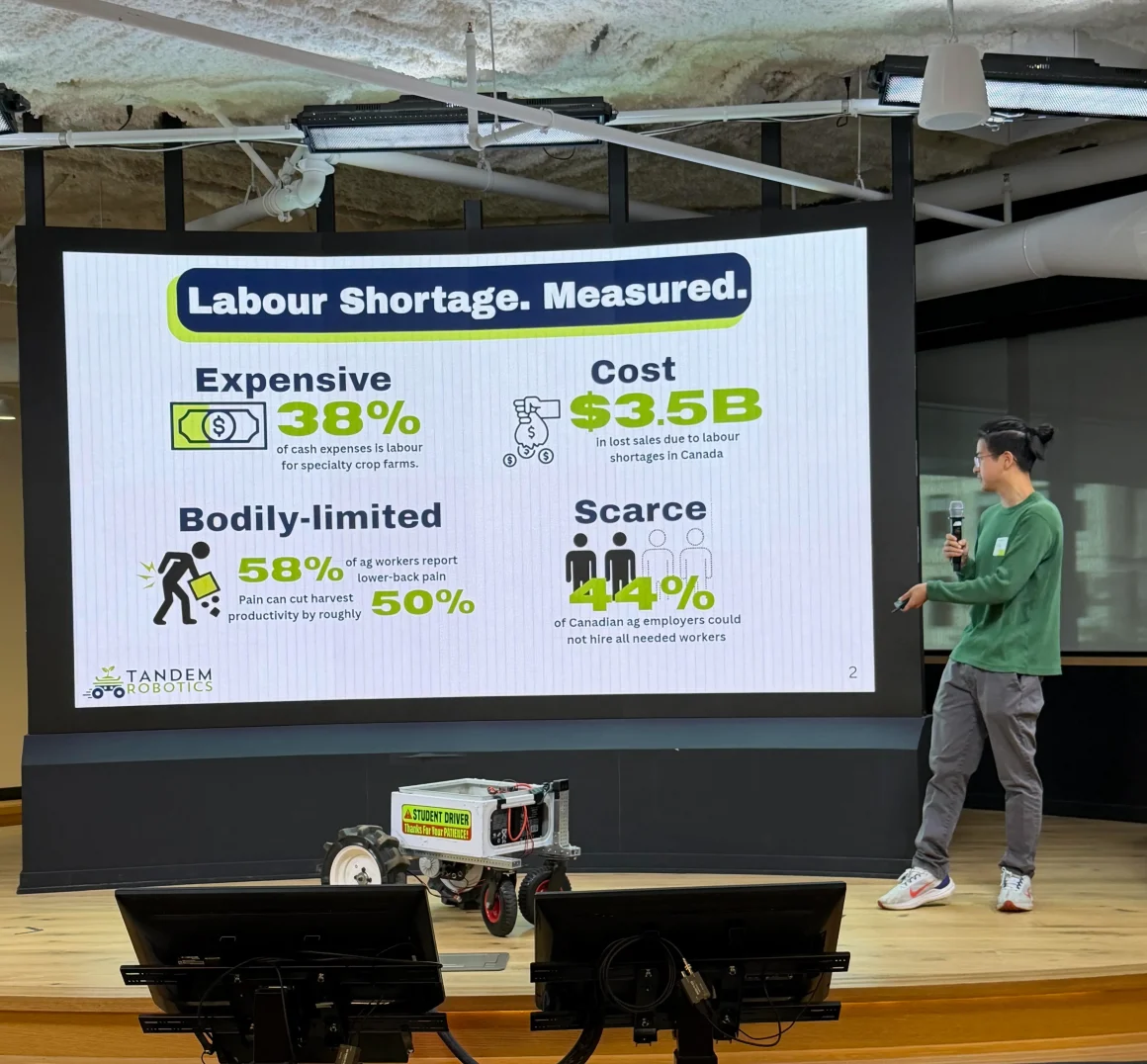
His answer is a collaborative robot designed to work alongside farmers, not replace them. The robot handles the heavy lifting and repetitive work, reducing the amount of walking, carrying, bending, and physical strain while allowing farmers to focus on what they know best. It can carry up to 300 pounds, and in early trials, the team found it could transplant 2.5 times faster and de-weed roughly four times faster than traditional methods.
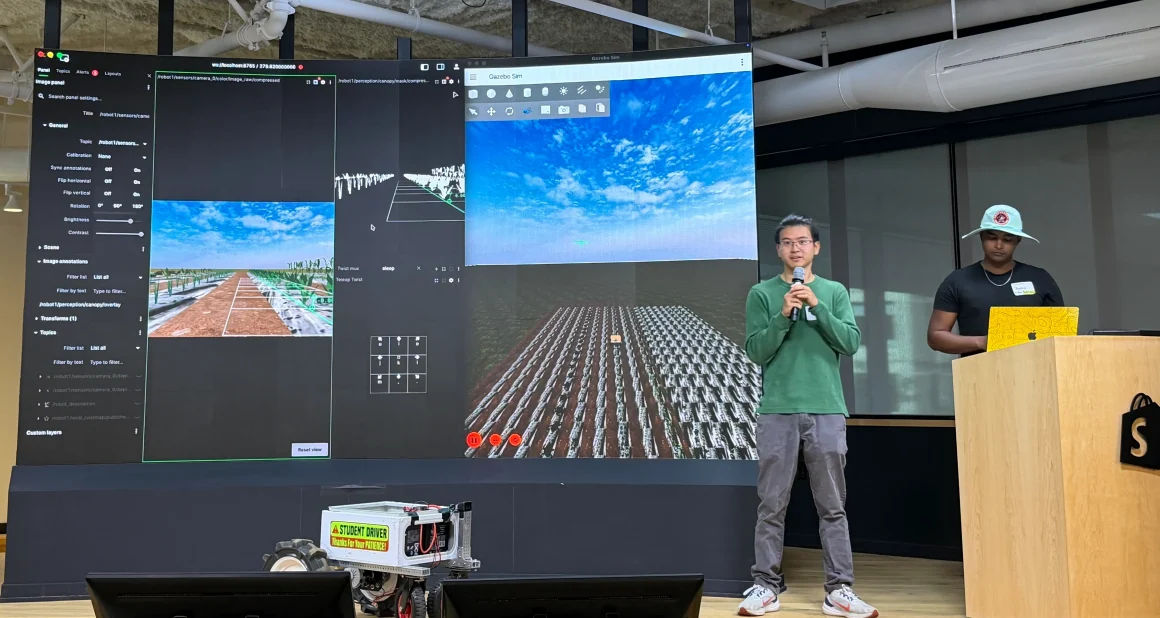
The robot has already been tested on more than 5 farms, many within 10km of Ottawa. One detail that really stood out: farmers reported zero of their usual pain while working with the robot. And when the team takes a robot away for maintenance or to move it to another farm, their biggest concern is whether they can manage without it.
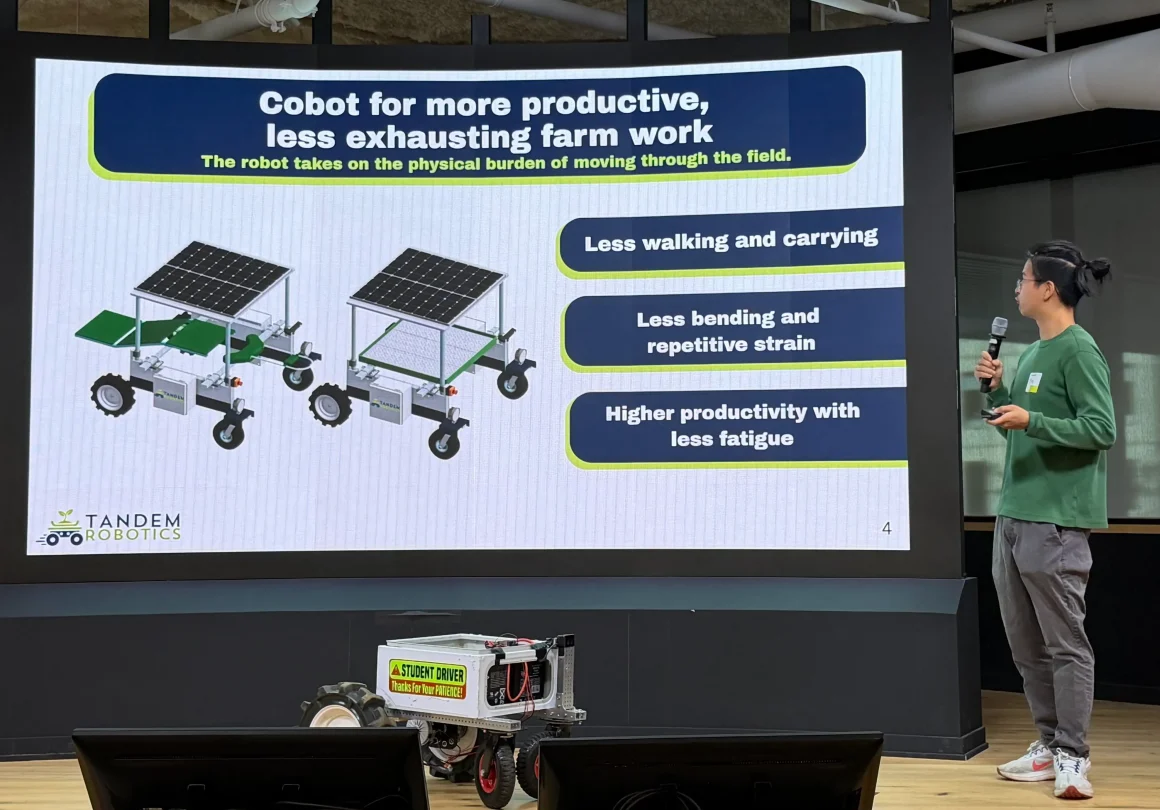
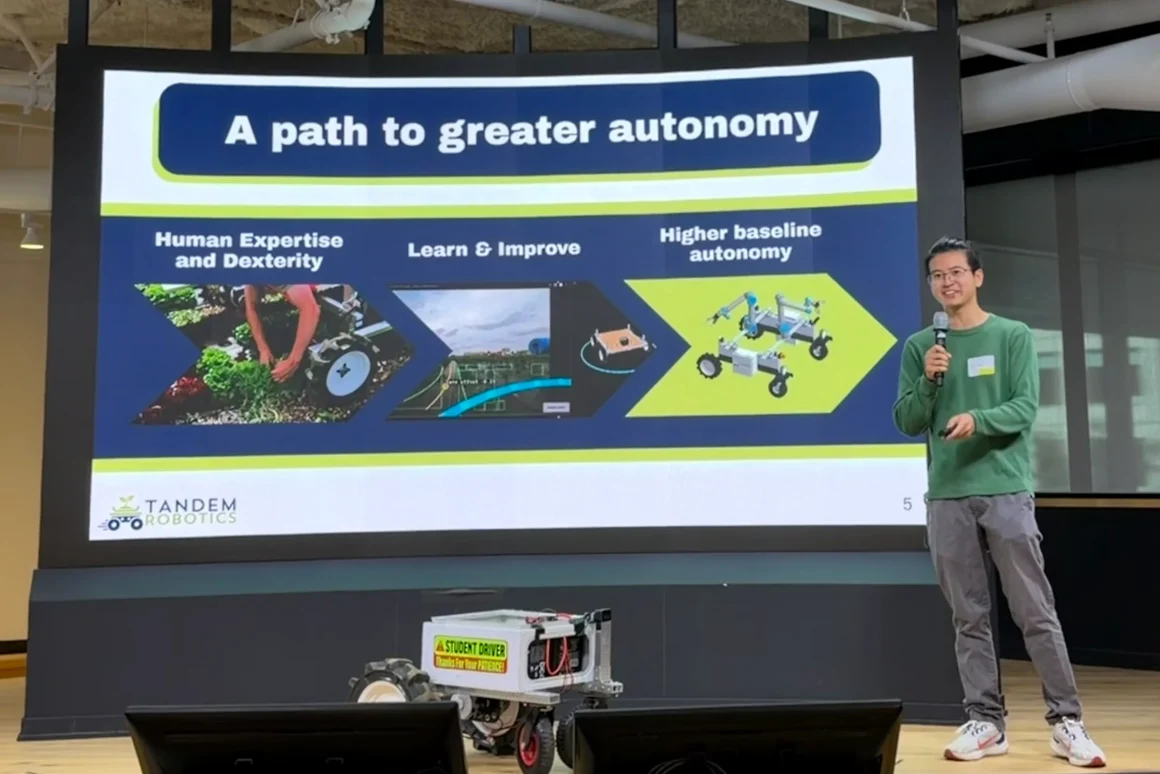
The team currently has 2 robots in the field and plans to build 20 more next year, with the goal of getting them onto 15+ farms. The larger robot is priced at $25,000, with roughly $225,000 in letters of intent already signed. The longer-term goal is mass production by 2028, with the robots eventually handling end-to-end tasks like weeding and transplanting autonomously.
The pitch wasn’t about replacing farmers. It was about giving them the tools to keep doing what they love, for longer, with less physical strain.
Keating: AI That Teaches You Without Melting Your Brain
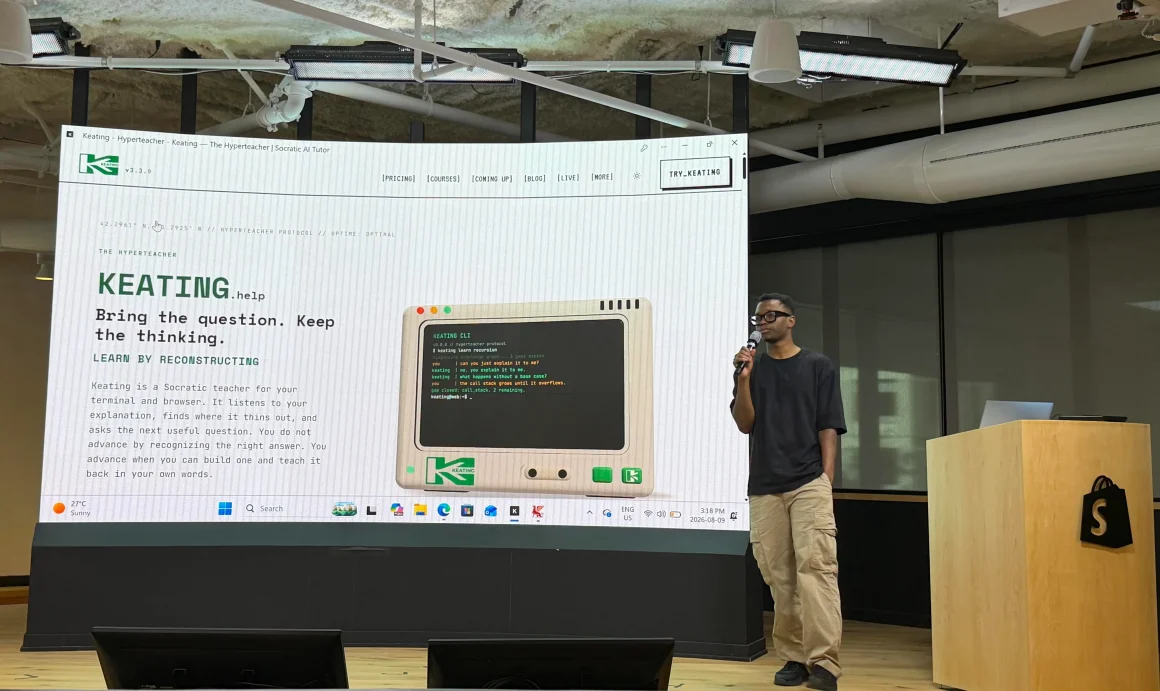
Keith opened with a simple question: who here worries about losing skills by relying too heavily on AI? A lot of hands went up.
That concern is exactly what led him to build Keating, an AI-powered teaching system designed to help people learn with AI without becoming dependent on it.
Keith has been building Keating for 3 months, and the project has already passed 2,000 npm downloads, with more than 500 weekly downloads.
Instead of giving you the usual wall of chatbot text, Keating turns AI into a more structured learning experience, with flashcards, visualizations, quizzes, and courses that users can build and share. The system also adapts to how you learn and can evolve its own code to improve the experience.
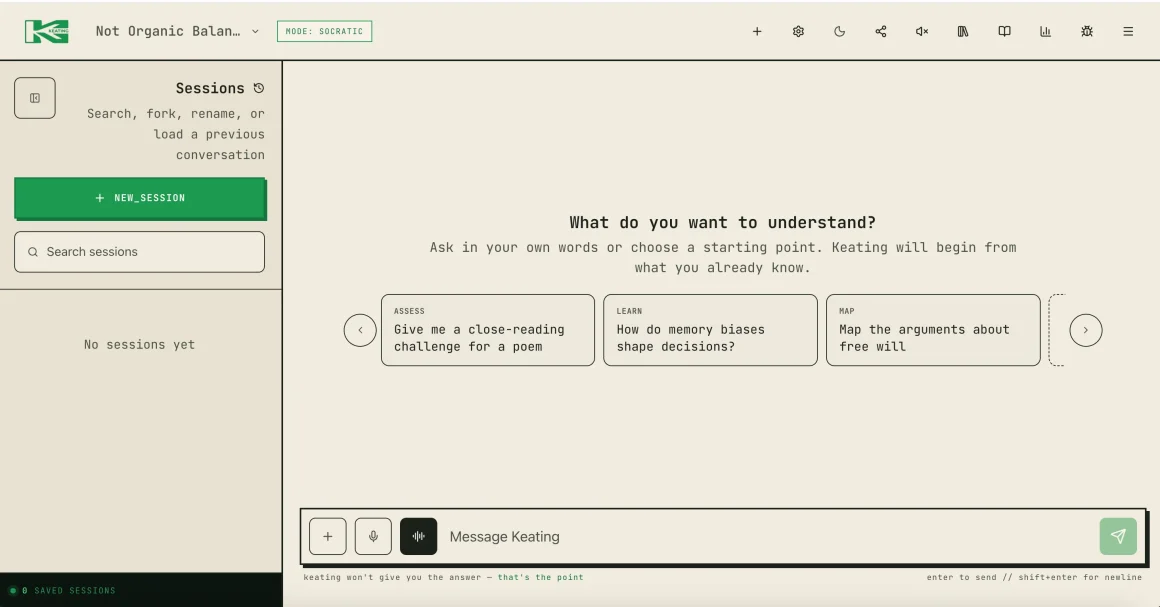
Keating is open source and runs in the browser, with your data staying under your control. You can bring your own API key, connect it to OpenAI, Anthropic, or Ollama, or even run certain models locally in the browser using WebGPU. Keith said his own AI usage for learning cost him only about $20 over three months.
The product has come a long way since Keith first demoed an early version at Builder Sundays 3 months ago. What started as an experiment has turned into a genuinely interesting take on one of AI’s biggest use cases: not just getting answers, but actually learning.
From $1,000 in 3D-Printed Signs to a Finance Student Hub
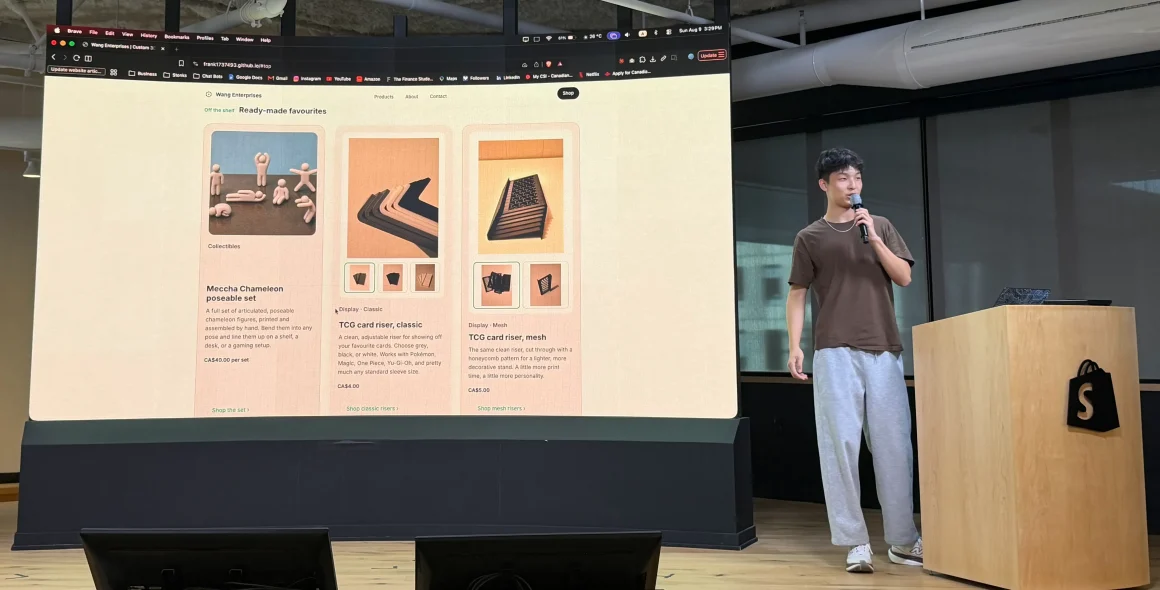
Frank came up to show 2 things he’s been building. The first is a 3D printing business he runs on Facebook Marketplace and Etsy, documented on TikTok, that cleared over $1,000 in revenue in its first month. His edge was leaning into what small shops do best: custom letters and signs where customers pick the exact thickness, color, and size, plus catching a couple of viral product trends and printing risers for trading-card displays. With just one printer and a handful of materials, he was typically shipping orders in under a week.
The second is The Finance Student, a platform he built after struggling to find a single place for finance students to discover corporate networking events, job opportunities, and other resources. And, in true Builder Sundays fashion, Frank had a little help from Claude, which he called “a GOAT.”
Ottawa is live first, with a hiring section that tracks live application deadlines across banking, wealth management, accounting, and internships.
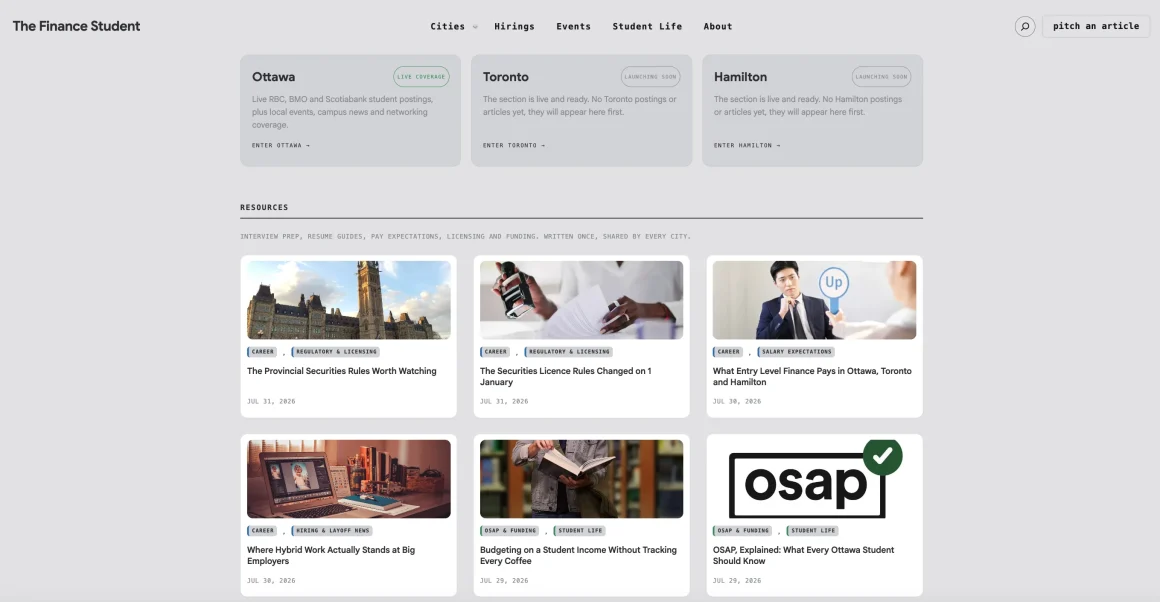
Frank ended by asking the room for help with 2 challenges: automating the process of finding and posting relevant events, and figuring out how to market the platform.
This was a perfect example of what Builder Sundays are about: build something around a problem you’ve personally experienced, then bring it to a room full of people who can help you figure out what comes next.
Colive: A Better Way to Find a Roommate
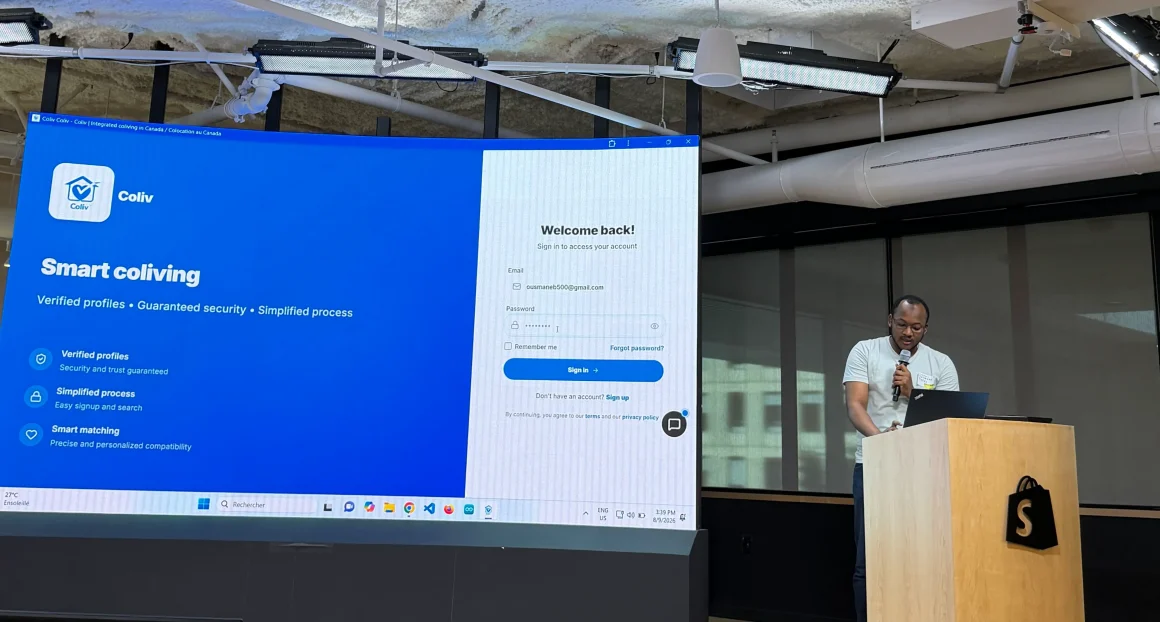
Osman came up with a simple observation: finding a roommate can be a nightmare, especially for students and newcomers. Listings are scattered across websites, Facebook Marketplace, word of mouth, and community groups, and even then, you’re never quite sure who you’re dealing with.
His solution is Colive, a roommate-matching platform he described as “the Tinder of roommates.” The idea is to match people based on lifestyle and behavioral preferences, so you can find someone who is not only looking for a room, but actually compatible with you. Users go through a verification process, and the platform also includes a community feed where newcomers and students can share advice, experiences, and local information.
Trust is a major part of the product. Users are verified through their email and Canadian phone number, with additional identity checks being tested as the platform develops. Osman emphasized that Colive is currently in beta and that he’s actively using feedback from early users to shape the product.
Opero: One Workspace to Run Your Entire Business
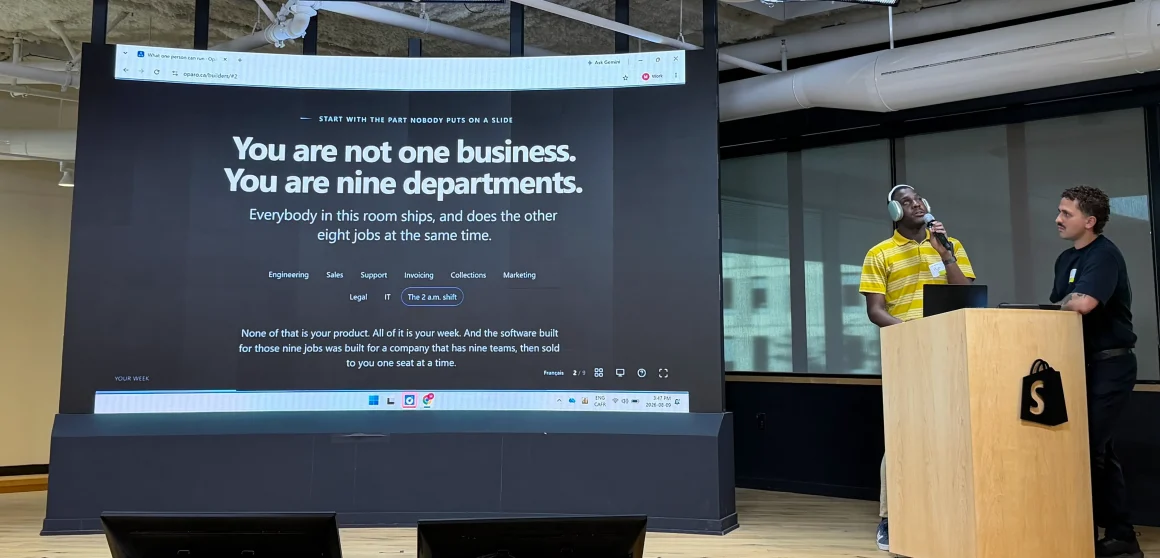
As an accessibility consultant and software developer, this founder knows firsthand how fragmented running a small business can become. A growing business can easily end up juggling 11 different jobs, 11 different tools, 11 logins, and countless data exports just to keep everything moving. Marketing, sales, invoicing, collections, project management, and operations all live in separate systems that rarely communicate with each other.
His solution is Opero, a unified workplace platform designed to bring those core business functions into one workspace, with one login and one bill. Instead of simply putting different tools side by side, Opero focuses on connecting the underlying data, so things like clients, quotes, invoices, projects, and communications can work together in context.
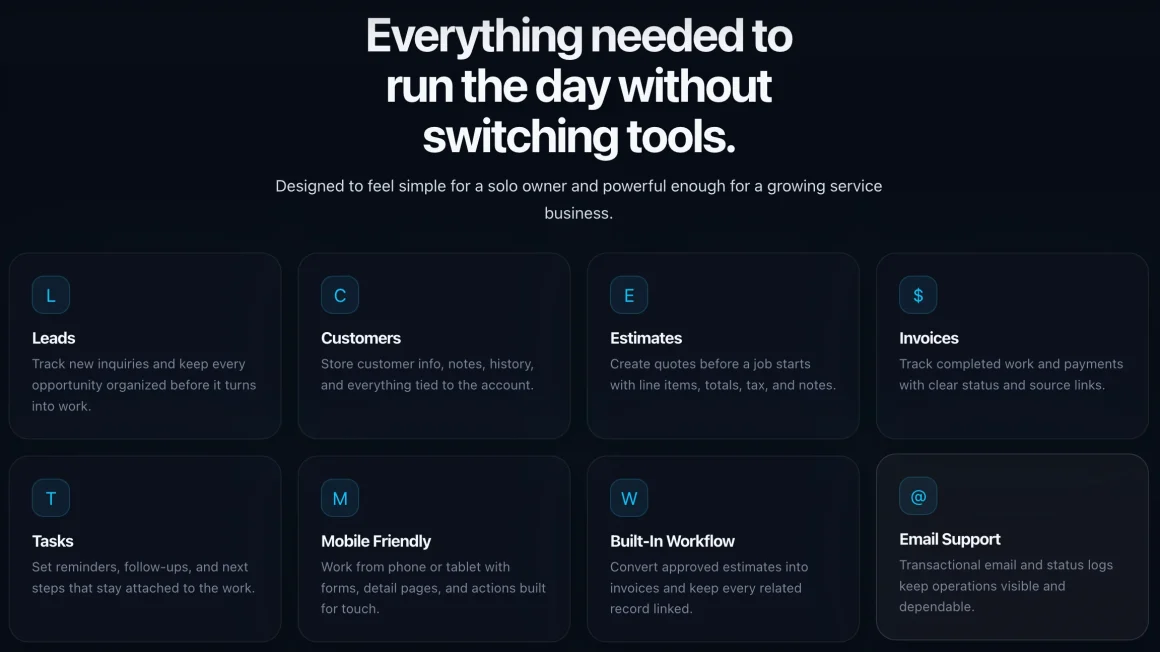
The platform has been in development for 2 years and already has 79 active workspaces, serving solo operators, independent workers, and small teams. The founder built the platform himself using React, TypeScript, PHP, and Python, initially coding it before incorporating AI agents into the development process.
His pitch was less about showing off another piece of software and more about challenging other founders in the room: if you’re building a business, how many tools are you going to need to run it?
The end goal is simple: give Canadian businesses one place to run their entire operation.
An AI Gym Coach That Roasts You Into Shape
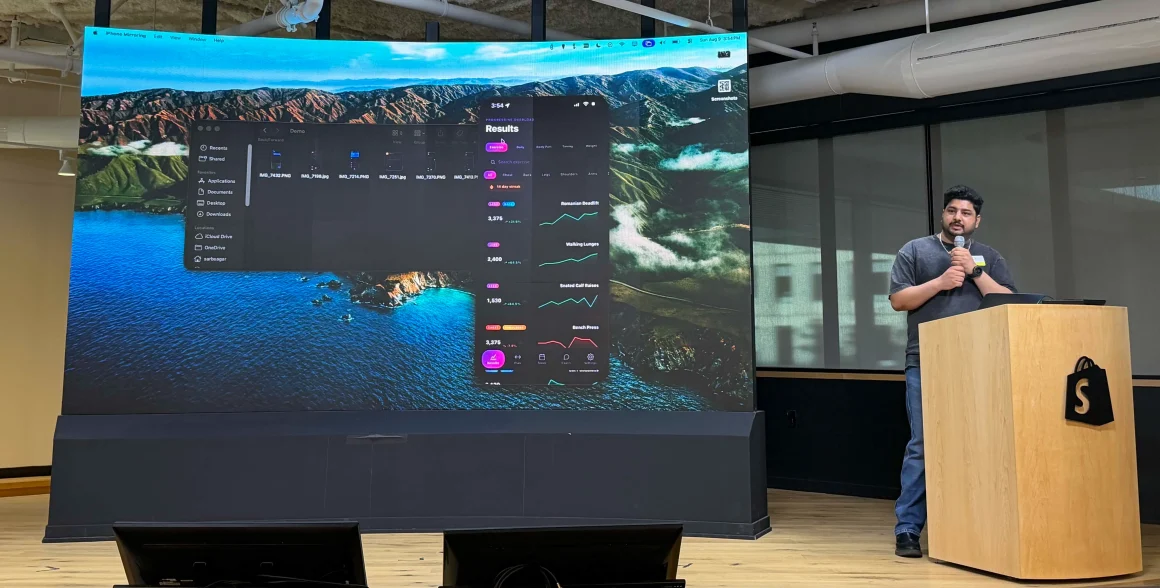
Sarbjeet came to Builder Sundays with a product he had actually built years ago. His original workout app had attracted more than 3,000 users, but he eventually stopped maintaining it because keeping the codebase going manually was too much work. This year, he decided to bring it back with a new twist: AI-powered coaching.
The app tracks workouts, progressive overload, strength, body weight, and training streaks, while remembering what you lifted in previous sessions so you don’t have to. It can also swap exercises when a machine is occupied, help design workouts, and give you feedback after each set. And if you need a little extra motivation, you can turn on “Roastmaster,” an AI coach that will call you out when you’re slacking.
The app uses a bring-your-own-key model, with support for models including OpenAI, Anthropic, and DeepSeek. It also keeps workout data and AI conversations on the user’s phone rather than storing them on a central server.
What started as a workout tracker is now becoming something closer to a personal AI training partner: one that remembers your progress, adapts to your workouts, and, if you choose Roastmaster, isn’t afraid to roast you when you start slacking.
18, Ambitious, and Just Getting Started
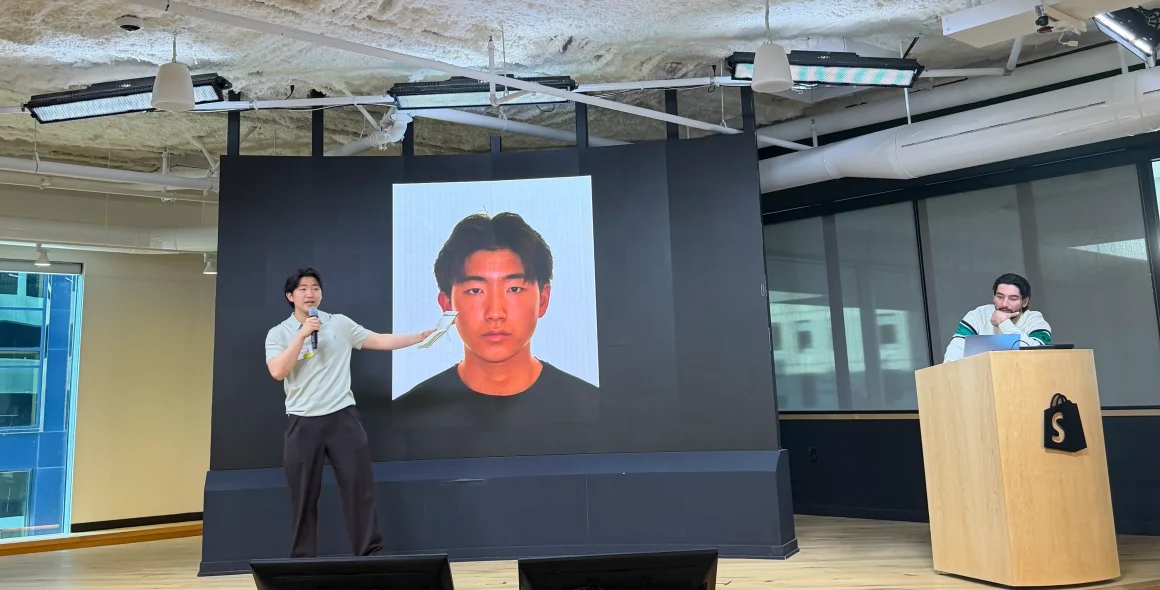
David’s pitch was a little different from the others. Instead of demoing a product, the 18-year-old got on stage to share his story and talk about where he’s headed next.
After moving from Seoul to Canada as a child, David struggled with the adjustment, and later found himself dealing with low confidence and isolation during high school. Working out, meeting new people, and pushing himself outside his comfort zone helped him turn things around. When document complications prevented him from attending his dream university just after high school, he decided to make the most of the unexpected gap year.
He took on part-time jobs, worked as a tutor, trained in Muay Thai and powerlifting, and got involved with 4 different startups. He also helped generate more than 100,000 views from a campaign at Carleton University and co-founded Pitch Tank Ottawa, where he helped sell out 4 events.
Now, he’s heading to Western University to study Management and Organizational Studies, with an advanced entry opportunity to the Ivey Business School. Rather than trying to map out the next five years, David said he wants to stay open to new experiences and opportunities. But he does know one thing for sure: “I’m going to be a millionaire.”
The Point Isn’t to Have It All Figured Out
If there was one thing I took away from Shopify Builder Sundays, it’s that none of these founders waited for the perfect idea, the perfect product, or the perfect moment to start.
They came with different ideas, different levels of experience, and very different reasons for building. But they all had one thing in common: they were willing to put something into the world before they had all the answers.
And that’s what makes Builder Sundays worth experiencing.
Some of these ideas will become companies. Some will pivot. And some will change completely after a few more Sundays. But each founder now has momentum, feedback, and a room full of people who’ve seen what they’re building.
For anyone building from Ottawa, that’s a pretty powerful place to start. You don’t need a pitch deck, a team, a five-year plan, or a billion-dollar idea. You just need something you’re willing to build, and of course, the courage to show it to others.