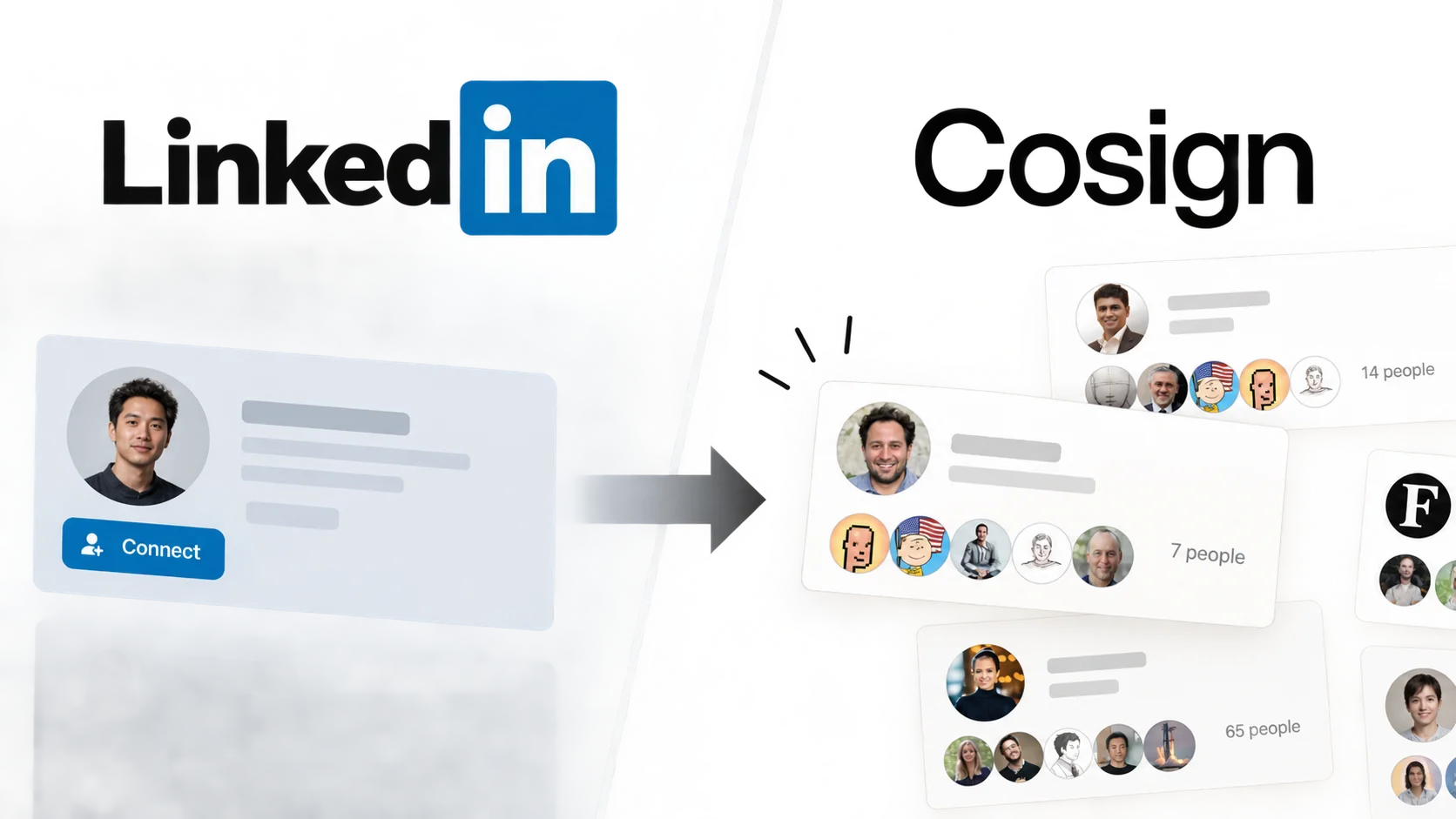
LinkedIn tells you who’s connected. a16z’s new Cosign wants to tell you who would actually vouch for you, and in startups, that kind of trust is the most valuable currency there is. I don’t think it replaces LinkedIn, but it could fill a gap LinkedIn was never built for, and founders who show up early will feel the benefits first.
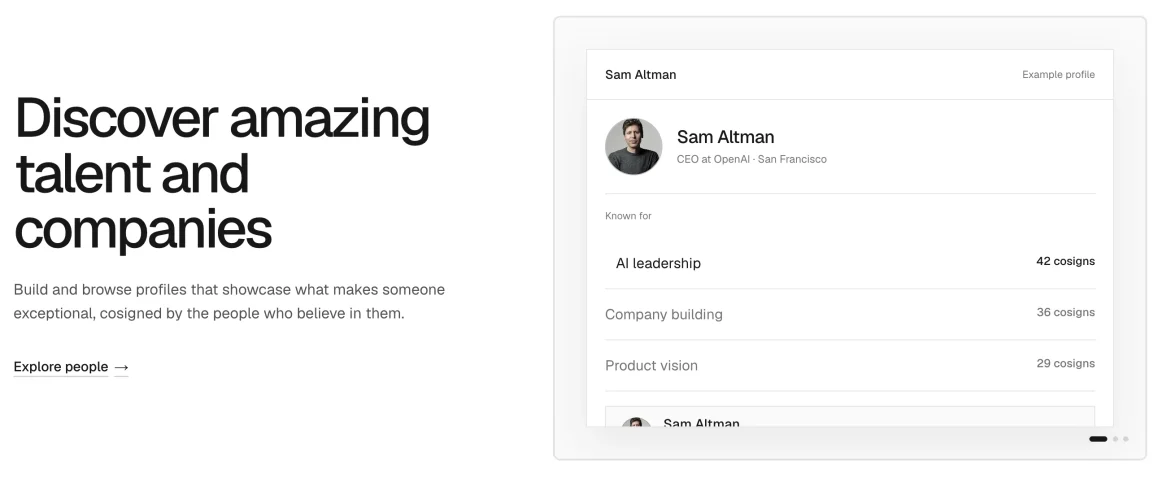
The sample profile on Cosign’s homepage belongs to Sam Altman, with 42 cosigns for AI leadership. Cosign couldn’t have picked a better poster child. Back in 2009, years before OpenAI, Paul Graham put a 23-year-old Altman in his Five Founders essay, on the same list as Steve Jobs and Google’s Larry Page and Sergey Brin. That single public vouch did more for Altman’s reputation than any résumé line could, and the team behind Cosign points to it directly in their launch essay.
Most vouches never get that stage. They happen in backchannels, over dinner, in a DM that says “you have to meet her.” a16z partner Olivia Moore summed up why that matters:
“The most valuable data in all of Silicon Valley is who has conviction in whom.”

Olivia Moore, Partner at Andreessen Horowitz
On September 25, a16z launched Cosign to put that data on a profile page. The obvious question is whether it becomes the next LinkedIn for tech.
My take: it won’t dethrone a 1.3 billion member giant, but it has a real shot at becoming the place startup people check before they hire, invest or join.
What is Cosign? a16z’s new professional network
What Cosign actually does
Cosign calls itself a curated professional network for the people and companies that drive the startup ecosystem. The mechanics are simple. You build a profile, and people who worked with you attach cosigns to specific strengths (“company building,” “product vision”), each with context about how they know you.
The announcement draws the line against LinkedIn: a LinkedIn connection tells you two people clicked “accept,” while Cosign tries to show who worked side by side or who shaped someone’s career as a mentor or advisor.
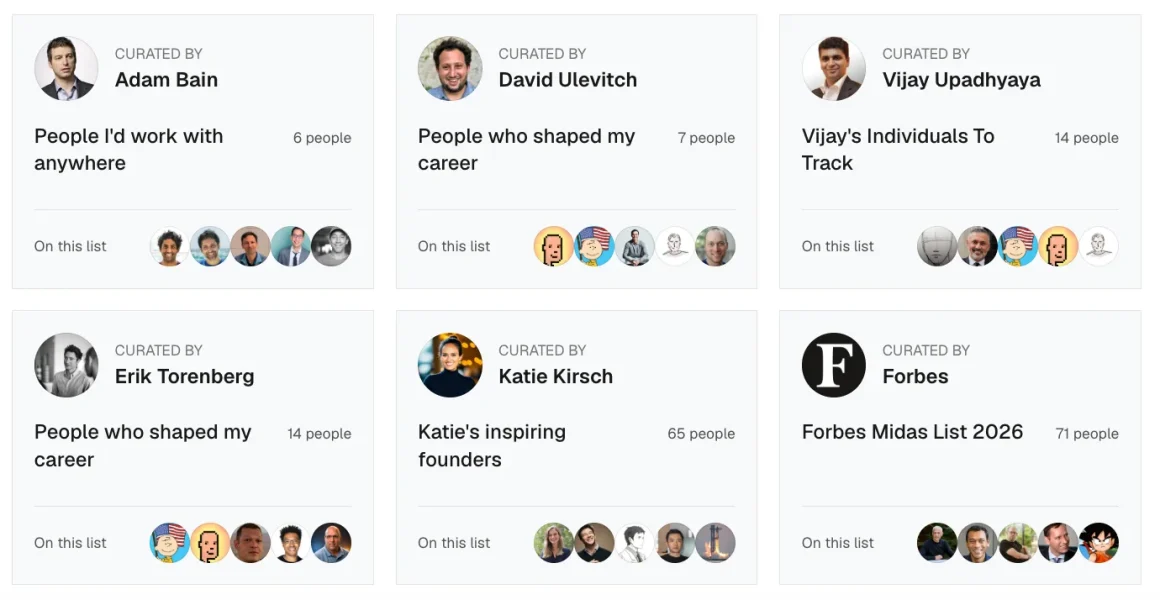
It goes further than people. You can cosign companies and build public lists, like investor and writer Packy McCormick’s companies he’d tell a new grad to join. Cosign then surfaces open roles at those companies automatically.
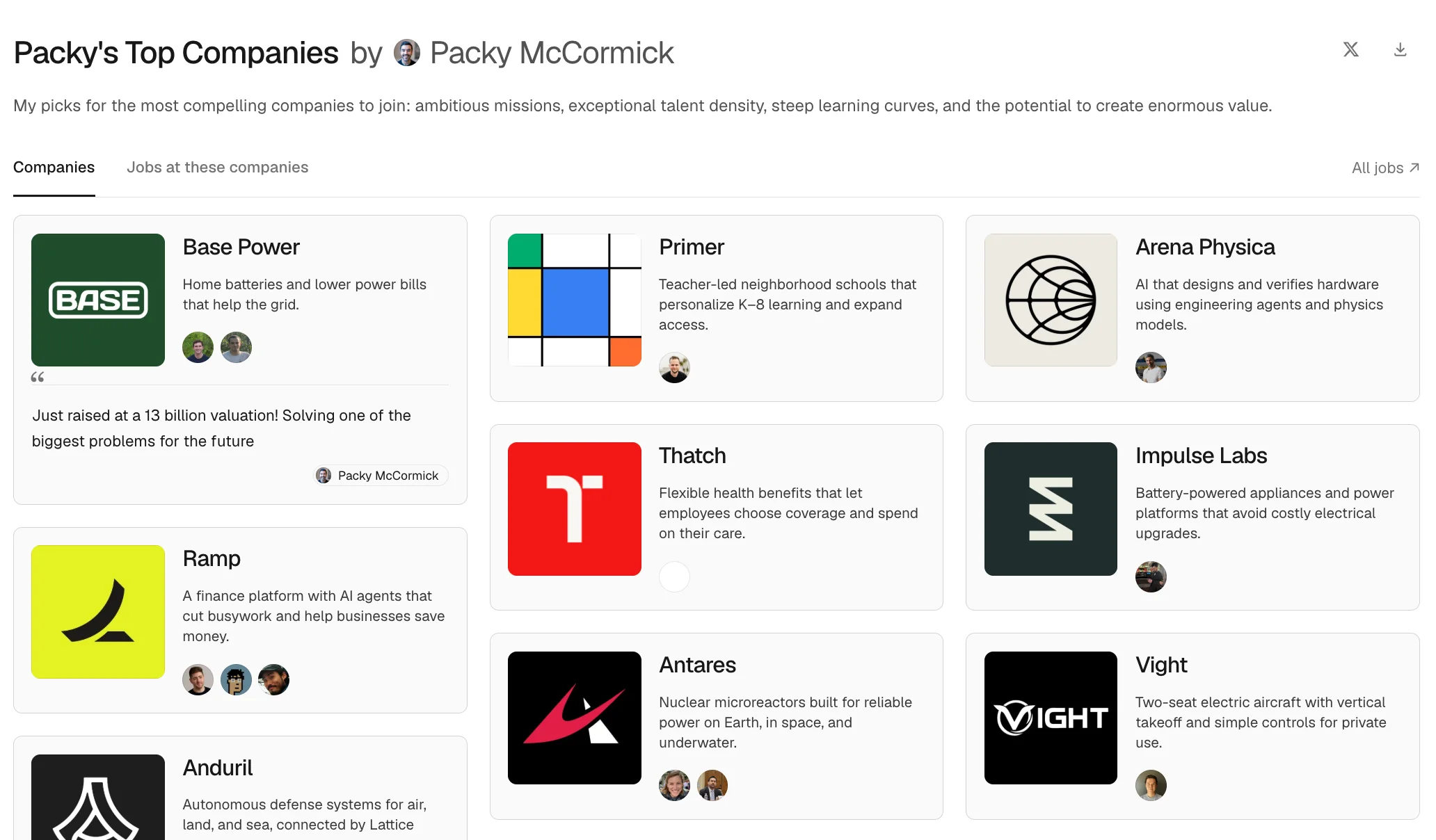
The team compares it to investing without the money. When you cosign a company, you’re publicly betting your reputation on it, and if it takes off, everyone can see you spotted it first.
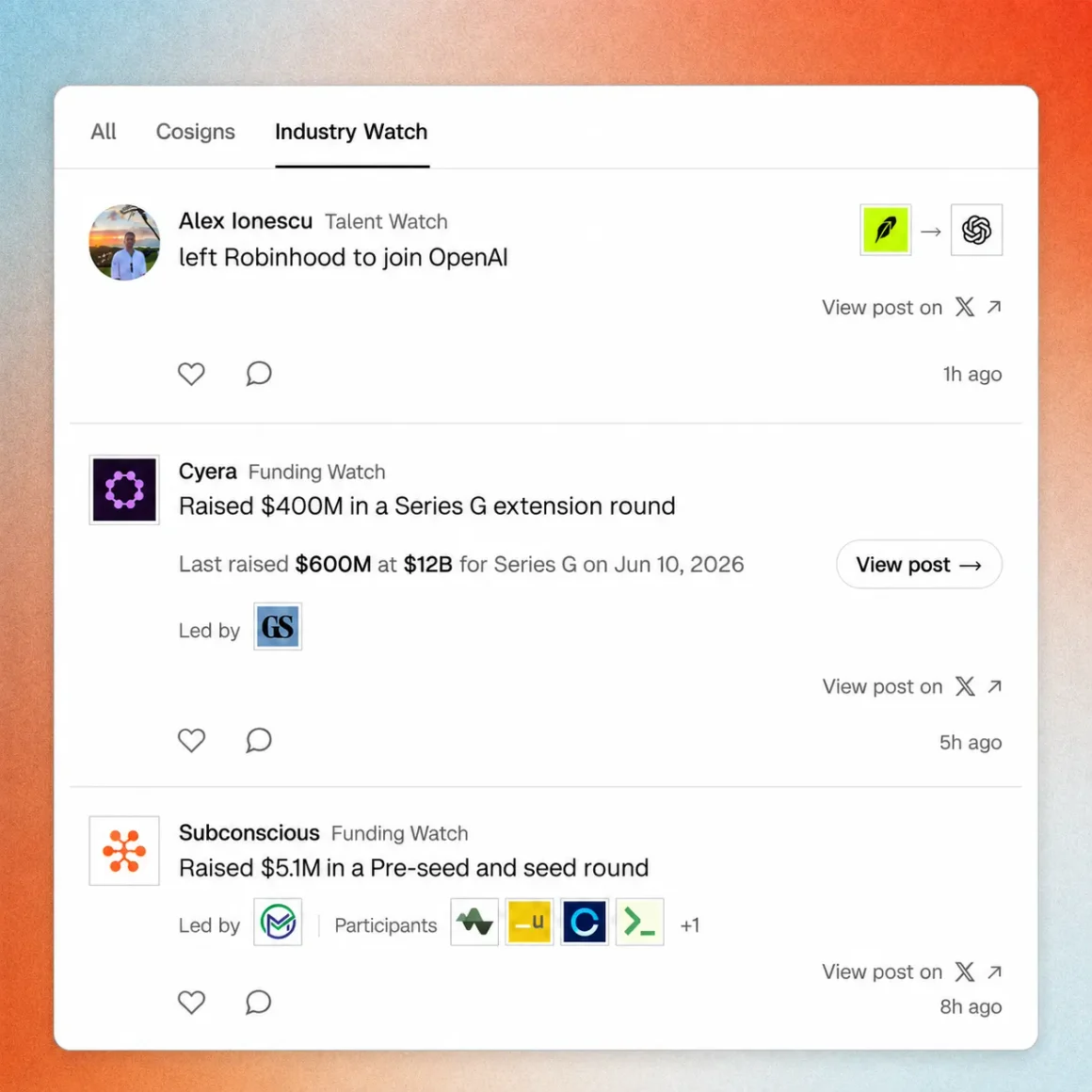
Add community questions (“Who’s a great fintech angel?”), an Industry Watch feed of talent moves, fundraises and product launches, and a jobs board, and you get something that looks a lot like the private tools VCs have kept for themselves for years. That’s exactly how a16z describes it.
The job LinkedIn never nailed
LinkedIn tried to solve the “is this person actually good?” problem once. In September 2012 it launched skill endorsements as a way to give kudos with one click. It worked a little too well. By 2016, LinkedIn had racked up 10 billion endorsements, including for talents like “chewing gum” and “punching.” And recruiters noticed this pattern early. One told Forbes in 2012 that endorsements carry “no skin in the game.”
That’s the gap. A one-click endorsement costs nothing, so it tells you nothing. A cosign attached to your name, with context about how you worked together, puts your own reputation on the line.
Erik Torenberg, the a16z general partner who recruited the Cosign team, named the second gap in his launch post: strong endorsements happen on X every day and then vanish into the feed. Cosign wants to make them permanent.
Excited to introduce @Cosign: the curated professional network for the startup community: https://t.co/yAnRgqRifu
— Erik Torenberg (@eriktorenberg) September 25, 2026
Our goal is to create the following:
– A comprehensive startup directory of investors, companies, and operators, including what they worked on and who they worked…
Why LinkedIn is so hard to beat, and why its rivals didn’t make it
Cosign isn’t the first startup to take on LinkedIn, and the last 2 serious attempts both shut down in early 2025.
Polywork let people show off their skills and side projects, not just their job titles. It raised more than $40 million from backers including Stripe’s Collison brothers and went viral in 2021 and 2022. Then growth stalled, and it shut down on January 31, 2025. Founder Peter Johnston still believed in the idea. He said he was “hopeful that one day, another team takes a crack at this problem again.”
Read.cv, a clean, design-friendly LinkedIn alternative, went the same way. Perplexity acquired it in January 2025 and wound the product down.
Today I’m excited to share that @read_cv is joining the team at @perplexity_ai in their mission to make the world's knowledge more accessible to everyone. This is incredibly bittersweet for us, as the start of this new chapter will mark the end of our time with @read_cv.
— andy chung (@_andychung) January 17, 2025
It has… pic.twitter.com/6CUinOEGsi
Both were good products, and both hit the same wall: people keep their profile where recruiters look, and recruiters look on LinkedIn. That habit is hard to break. LinkedIn has 1.3 billion members, and its revenue grew 12% in the first 3 months of 2026, an extra $521 million.
Why Cosign has a better shot than Polywork and Read.cv
Cosign starts with 3 advantages Polywork and Read.cv didn’t have.
- Distribution on day one. a16z sits in the middle of the exact graph Cosign needs: founders, operators, investors and the newsletters and podcasts they all consume. The launch was amplified across a16z’s own channels within hours.
- AI fills the empty space. Every new network dies of being empty. Cosign uses AI to auto-populate company data, research profiles, filter spam and write its news feed, so a first-time visitor lands on something useful before a single friend joins.
- A reason to come back. 70,000+ open roles and a daily feed of talent moves and fundraises give people a job to do on the site that isn’t “update my profile.”
There’s also a nice bit of history here. LinkedIn itself started as an insider network. It launched on May 5, 2003, and ended its first month with 4,500 members, mostly the co-founders’ own contacts. Starting narrow with a tight crowd is how LinkedIn began too.
Cosign’s biggest bet: private, mutual matching
The part of the launch I’d watch closest isn’t live yet. Torenberg describes an intent network where you privately signal “I’d invest in them,” “I’d hire them” or “I’d work with them,” and eventually even “I’d acquire this company.” When interest exists on both sides, Cosign makes the match.
It works a bit like a dating app for deals. Say you’re a founder and you’d love a certain angel investor in your next round. Today, you send a cold email and hope for a reply. On Cosign, you’d privately mark “I’d want them to invest.” If that angel has also marked “I’d invest in them,” Cosign introduces you. If they haven’t, nothing happens, and nobody ever sees that you asked. The same works for hiring: an engineer quietly open to a new job and a founder who’d love to hire them can find each other without either one making the awkward first move.
LinkedIn’s closest version is the #OpenToWork badge, which 40 million people used in a single month in 2024. It’s one-sided, though, and career coaches warned Fortune it can make candidates look “desperate.” Cosign’s version would work in both directions and stay hidden until there’s a match.
If a16z gets this right, Cosign stops being a place you visit to look people up. It becomes the place where deals, hires and first checks start, and that’s a much harder habit for any rival to copy.
My verdict for founders
Cosign won’t be where your mom updates her job title, and it doesn’t need to be. The real opportunity is more focused: becoming the reference check for startups.
When an investor wonders if your co-founder is the real deal, or a senior engineer wonders if your startup is worth the pay cut, Cosign wants to be the first tab they open. That job is worth a lot, and LinkedIn has never owned it.
Cosign still has to earn it, and 2 things could get in the way.
First, the vouches have to mean something. If cosigns mostly go to people who are already famous, or people start trading them (“I’ll cosign you if you cosign me”), they’ll become as meaningless as LinkedIn’s one-click endorsements.
Then there’s the question of neutrality: a16z has to stay fair to everyone. Cosign is built by one of the biggest VC firms in the world, so founders backed by rival firms need to trust it won’t favor a16z’s own companies.
I’m getting in early myself. I plan to cosign the people who shaped my career, with real specifics about how they helped, and build a list of the founders I’d back without a second thought. If you’re a founder, operator or investor in the startup world, it’s worth doing the same while the network is still forming.
The best people you’ve worked with are probably people most of the internet has never heard of. Cosign is a bet that saying so out loud, with your name attached, can change careers. Believe in someone early, and put it in writing. Your reputation grows every time you’re right.