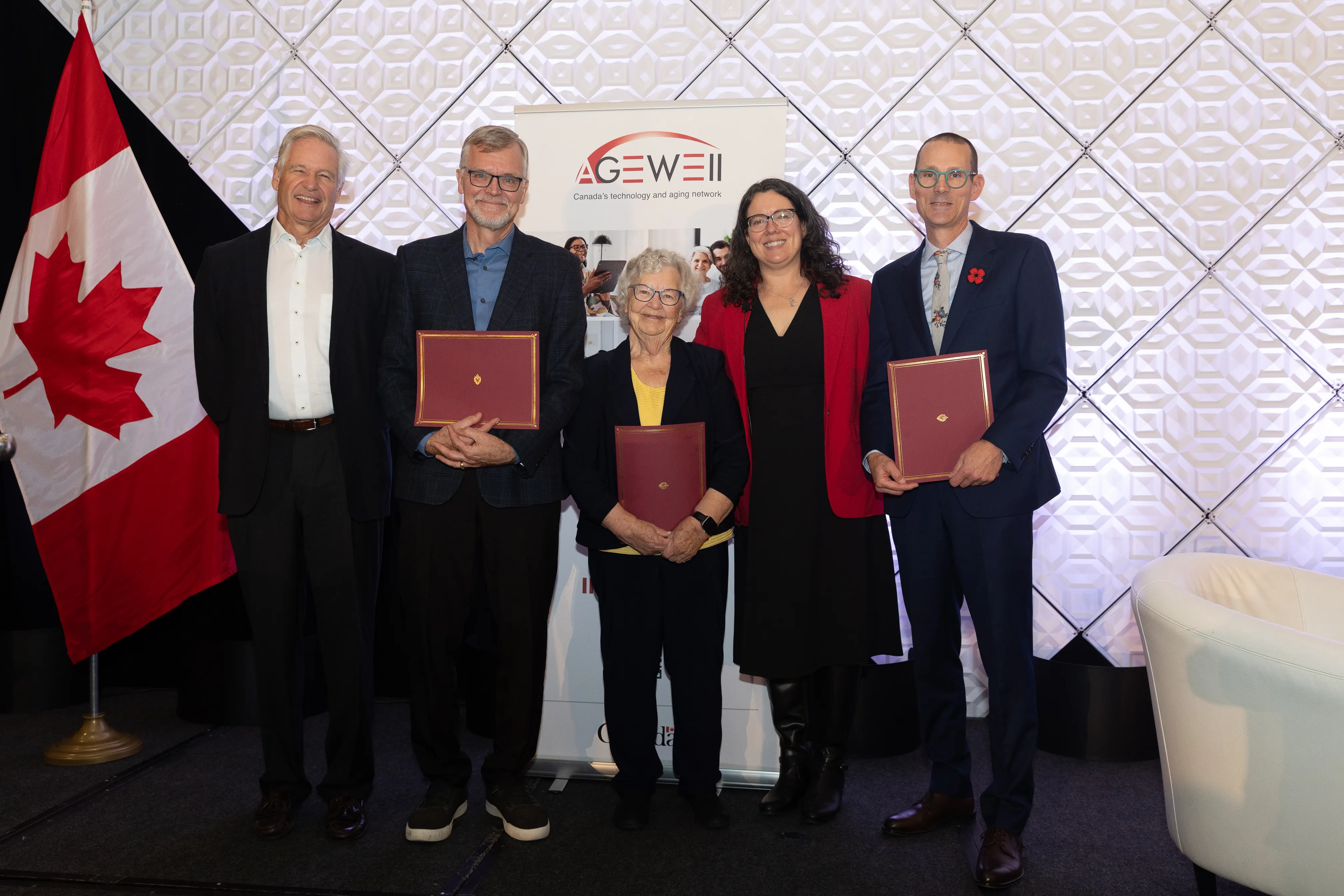
PHOTO: COURTESY OF AGE-WELL | Ian Struthers, Frank Knoefel, Olive Bryanton, Bridgette Murphy, Richard McAloney.
A seniors’ advocate who earned her PhD at 81, a family doctor who built a smart apartment inside a hospital and a chemist who now brings new technology to older adults in northern BC. AGE-WELL named all 3 Honorary Fellows in Ottawa this month. If you’re building for older adults, you should know who they are.
At 81, Olive Bryanton sat down to defend her PhD thesis and, as she told CBC, “went brain dead ahead of time.” She passed anyway, and the University of Prince Edward Island says she’s the oldest person it has ever granted a PhD. Her research asked 10 women aged 85 to 92 in rural PEI to take pictures of things that made it hard to keep living in their own homes.
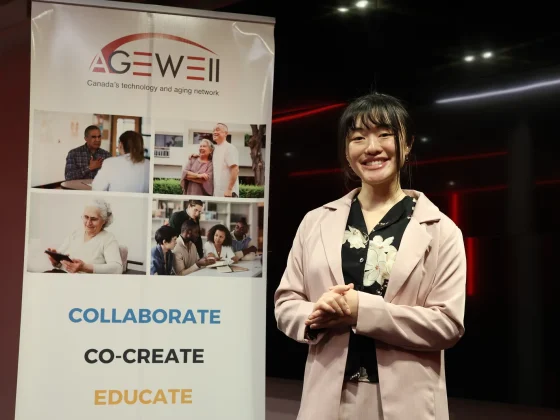
On November 3, Bryanton walked onto the stage at the 2026 AGE-WELL Annual Conference in Ottawa, and I was in the audience. She was one of 3 people named 2026 Honorary Fellows, an award AGE-WELL created 8 years ago for members who have made a lasting difference to Canada’s AgeTech sector.
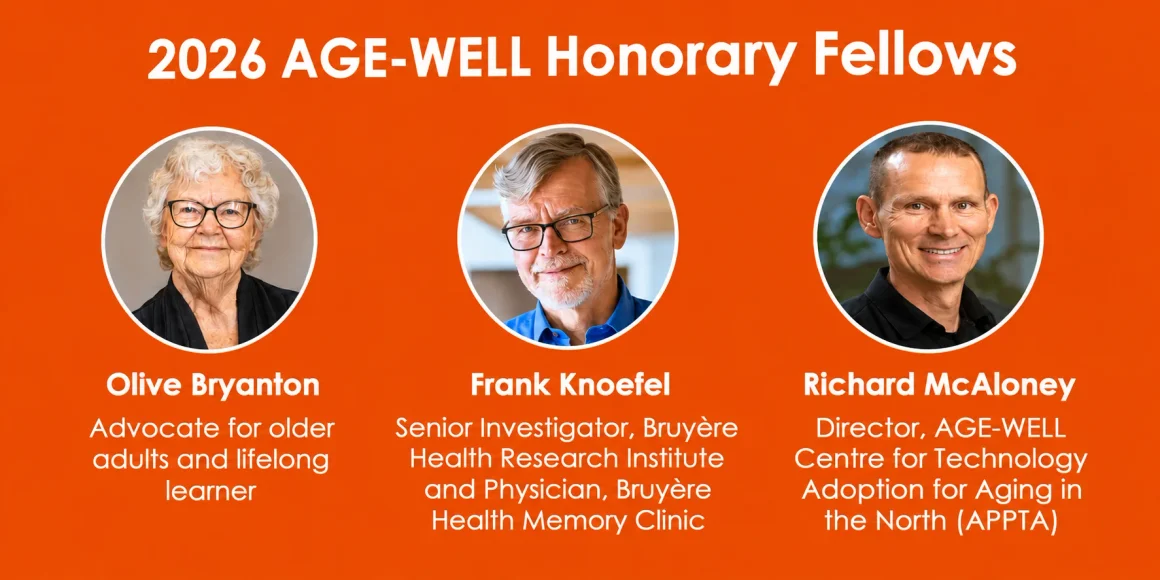
Awards like this rarely make the startup press. They should. The 3 honorees helped build things AgeTech founders now take for granted, like advisory committees where older adults weigh in and apartment labs where sensors get tested before they’re sold.
Olive Bryanton: the voice of older adults
Bryanton has spent more than 30 years making sure older adults have a say in the decisions that affect them. Earlier in her career, she coordinated the PEI Senior Citizens’ Federation and started a newspaper called Voice for Island Seniors. She helped start the Seniors College of PEI, affiliated with UPEI, and served as its first president.
In 2017, PEI’s health minister appointed her an executive advisor on the province’s Seniors Health and Wellness Strategy, and in 2022 the federal government named her to the National Seniors Council. AGE-WELL’s award citation also credits her research with shaping a provincial program that supports seniors’ independence.
She has sat on AGE-WELL’s Older Adult and Caregiver Advisory Committee since 2018, where she mentors trainees and co-hosted the network’s first AgeTech Discovery Day. AGE-WELL also credits her with helping make older adults partners in its research.
Go back to her PhD method for a second. She handed cameras to the women and let them show her what got in the way of staying home. Few product teams run user research that direct.
Frank Knoefel: the doctor who brought engineers to the bedside
Dr. Frank Knoefel is a family physician who has cared for older patients at Bruyère in Ottawa for about 30 years. He came to technology through a problem with his own patients. He told Carleton University:
“I wanted to ensure my patients didn’t end up back in hospital two weeks after I discharged them. But it was hard to get timely and sufficient home care.”
Home care was hard to get in time, so he started asking whether the home itself could help.
In 2003, he co-founded TAFETA (Technology Assisted Friendly Environment for the Third Age), which put clinicians and engineers on the same team years before anyone called it AgeTech.
By 2005, they had opened a smart apartment inside Élisabeth Bruyère Hospital. In one project, pressure and motion sensors switched on lights to guide a man living with dementia to the bathroom, and a speaker played his wife’s voice when he wandered into the kitchen. After a pilot with 16 families, nobody wanted to give the technology back.
Knoefel has been with AGE-WELL since the beginning and leads its national work on cognitive health and dementia.
He also co-founded SAM3 (Sensors and Analytics for Monitoring Mobility and Memory), an AGE-WELL innovation hub that launched in 2017 with Carleton University and Bruyère. Researchers there test sensors in an apartment lab set up like a real home environment. The goal is to help people with cognitive challenges stay safely at home.
Richard McAloney: getting technology into rural homes
Dr. Richard McAloney has a PhD in chemistry and co-founded Axela, a Toronto diagnostics company. At U of T’s Impact Centre, he served as director of technology management and entrepreneurship, running a startup incubator and training programs for researchers turning discoveries into businesses. He co-created Techno, a program for scientists and engineers starting companies, which AGE-WELL says has helped launch more than 100 startups since 2010. The Impact Centre was one of AGE-WELL’s earliest partners.
In 2020, he became founding director of CTAAN, the Centre for Technology Adoption for Aging in the North, an AGE-WELL innovation hub at the University of Northern British Columbia in Prince George, built with Northern Health. Its job is to take technology that already exists and get it into use among older adults and caregivers in rural and northern communities, where access to care is often thinnest. At the launch McAloney said:
“Technology should enable, empower, and engage those who use it”
Inside AGE-WELL, he mentors trainees in the EPIC program and has judged many of the network’s startup competitions. Founders who have pitched there may already know him.
Why founders should know their names
There’s a lot founders can learn from their work, especially about the important steps that tend to get overlooked.
- Bring older adults in before you build.
Bryanton’s photo method let the users set the agenda. Tenera Care began with that kind of close look: founder Stewart Hardie watched his stepmother fall 3 times in a month because she couldn’t work the pull cord on her care home’s bathroom wall. - Test in a real home before you scale.
Knoefel’s smart apartment let families live with the technology before anyone tried to sell it. Pontosense took the same route when VHA Home HealthCare piloted its radar fall detection with clients aging at home in Toronto. - Plan for adoption from day 1.
McAloney runs a centre devoted to the step most founders leave for later. Tochtech’s Sleepsense bed sensor earned its traction through health system partners: Fraser Health rolled it out in 3 long-term care homes, and Trellis Seniors chose it for more than 430 beds.
Bryanton is still on the advisory committee. Knoefel still leads AGE-WELL’s dementia work, and McAloney still runs CTAAN. If you’re building for older adults in Canada, you’ll probably cross paths with at least one of them, and I’d make that happen sooner. Ask what they’ve watched fail. Their answers could save you a year.